What Is Agentic AI? Definition, How It Works, Examples

Table of Contents23 sections
ShowHide
Ask a chatbot to book a flight and it writes a paragraph about how to book a flight. Ask an agentic AI system and it checks your calendar, compares fares, picks a seat, and pays. That gap is the whole story.
Agentic AI is an artificial intelligence (AI) system that chases a goal on its own. It picks the steps, calls real tools, watches what happens, and keeps going until the goal is met. It works in a loop: perceive, reason, act, and learn. Large language models (LLMs) do the thinking. External tools do the reaching.
The 5 main benefits of agentic AI are higher productivity, lower transaction costs, better decisions, continuous improvement, and 24-hour operation. Companies run it in banking, retail, healthcare, customer service, supply chains, software development, cybersecurity, and research. An agentic AI system is built from 7 components: a perception module, a reasoning engine, a memory store, a goal-setting mechanism, a planning layer, a tool and action module, and an orchestration layer.
The technology is real and deployed. It is also oversold in roughly half the places it gets pitched, and this guide covers both sides with the current numbers.
Key Takeaways
- Agentic AI acts. Generative AI creates. The LLM is the reasoning engine inside the agent, not a competitor to it.
- The core loop is perceive, reason, act, and learn, wrapped in memory, tool calling, and orchestration.
- Adoption is wide and shallow. McKinsey found 62% of organizations at least experimenting with agents, 23% scaling one somewhere, and no single business function above roughly 10% fully scaled.
- Gartner placed agentic AI at the Peak of Inflated Expectations in April 2026, with 17% of organizations deployed and over 60% expecting to deploy within two years.
- Gartner estimates only about 130 of the thousands of vendors claiming agentic capability are real, and expects over 40% of agentic AI projects to be canceled by the end of 2027.
- Security is the open problem. Prompt injection has no reliable architectural fix, and an agent with tool access turns a bad answer into a bad action.
→ Read our architectural guide on AI Agent Development Services and how autonomous agents differ from assistants.
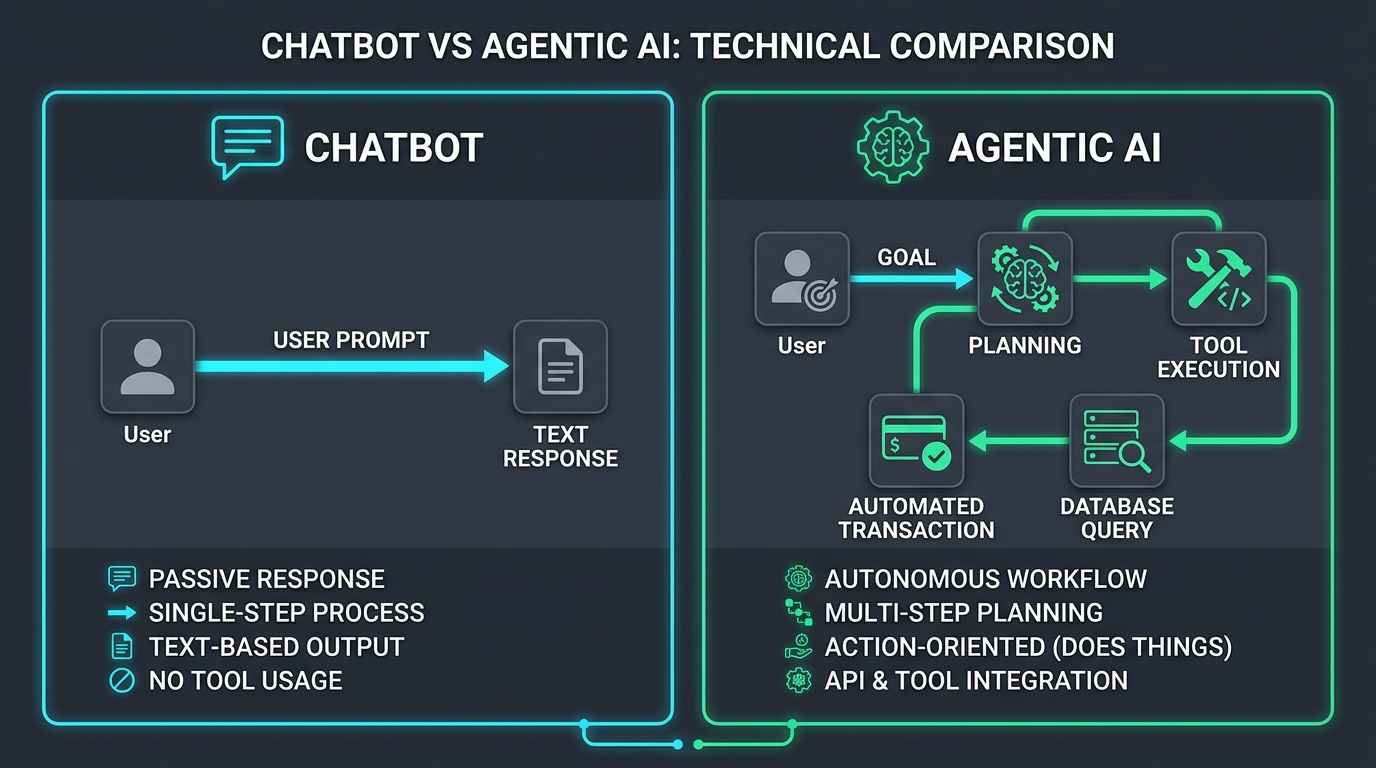
Figure 1: Comparison showing a passive chatbot returning a static answer versus an Agentic AI system completing a multi-step workflow with autonomous planning and API tool execution.
What Is Agentic AI?
Agentic AI is an autonomous software system that perceives its environment, reasons about a goal, and acts on that goal across other systems with little human involvement. The system is built from AI agents. Each agent is a model that makes decisions in real time to finish one subtask. AI orchestration then pulls those subtasks into a finished workflow.
The difference that matters is not intelligence. It is initiative. A traditional AI model classifies or predicts when you ask. A generative AI model creates content when you prompt it. An agentic AI system decides what to do next.
IBM defines agentic AI as a system that can accomplish a specific goal with limited supervision. AWS frames it the same way: an autonomous system that acts independently toward pre-determined goals, where agentic indicates agency.
MIT Sloan associate professor John Horton and his co-authors put a tighter definition in a paper on the economics of AI-mediated transactions. They describe autonomous software systems that perceive, reason, and act in digital environments for a human principal. Those systems can use tools, carry out economic transactions, and interact strategically. Agents rely on ordinary building blocks such as application programming interfaces (APIs). Those let them talk to other agents and to people, move money, and reach the open internet.
MIT Sloan professor Kate Kellogg and her co-researchers add a second layer in a 2025 paper. Agents extend LLMs by automating complex procedures. They run multi-step plans, use external tools, and work as components inside bigger workflows.
What Does Agentic Mean?
Agentic means having agency, which is the power to act independently and with purpose rather than only responding. In practice, 4 properties show up together:
- Autonomy: The system runs a task without step-by-step human direction.
- Goal orientation: It takes a high-level objective and breaks it into an ordered sequence of smaller steps.
- Tool use: It calls APIs, runs code, queries databases, and updates external systems.
- Self-correction: It checks each result against the goal and revises the plan when a step fails.
Salesforce Chief Scientist Silvio Savarese groups the first 3 as the defining features of the category. The fourth, reflection, is what separates an agent that recovers from one that loops until it burns your budget.
What Is Agentic AI in Simple Terms?
In simple terms, agentic AI is software that gets a goal instead of an instruction, then writes its own instructions. You tell a chatbot what to write. You tell an agentic AI system what outcome you want. The system works out the steps, runs them, checks the result, and retries whatever failed.
What Agentic AI Is Not
People confuse agentic AI with 3 nearby technologies: chatbots, robotic process automation, and plain generative AI. Each one falls short for a different reason.
Agentic AI is not a chatbot. A chatbot waits for a prompt and gives an answer. An agentic system watches an environment, such as a support queue, a customer relationship management (CRM) record, or a code repository. It spots something worth acting on and starts a workflow without being asked.
Agentic AI is not robotic process automation. Robotic process automation (RPA) follows a fixed script and breaks the moment a screen layout or an input format changes. An agentic system reasons about the situation, handles the exception, and adapts. That flexibility is the benefit and the risk in the same sentence.
Agentic AI is not generative AI on its own. Generative AI is not a competitor to agentic AI, it is a component of it. The LLM is the reasoning engine inside the agent, and the content it generates becomes a tool the agent uses to get something done.
One more distinction matters when you buy. Gartner estimates that out of thousands of vendors claiming agentic capability, only around 130 are building the real thing. The market calls the rest agent washing.
What Are the Characteristics of Agentic AI?
Agentic AI systems share 6 characteristics: autonomy, goal-driven behavior, proactivity, adaptability, collaboration, and specialization.
| Characteristic | What it means in practice |
|---|---|
| Autonomous | Holds a goal, works through many steps, and tracks progress without constant oversight |
| Goal-driven | Takes an outcome and breaks it into ordered subtasks |
| Proactive | Spots a problem and raises it before it grows, instead of waiting for a trigger |
| Adaptable | Changes its actions from live input and handles cases outside the script |
| Collaborative | Reads human intent, works with people, and coordinates with other agents |
| Specialized | Splits a workflow across narrow agents, each expert in one area |
Autonomy is what separates agentic systems from earlier AI. The system holds one goal across dozens of steps and recovers when part of the plan fails.
Goal-driven behavior turns one instruction into a task tree. Ask an agent to create a website. It creates subtasks for the structure, the page content, the visuals, and the responsiveness testing.
Proactivity shows up clearly in logistics. A traditional platform reports delivery status when someone checks it. An agentic system watches stock levels and weather, predicts a delay, raises an alert, and reroutes the shipment.
Adaptability covers domain fit. A generic customer service platform gives canned answers. An agentic system built for a healthcare provider reads medical terms, applies health regulations, and adjusts as the patient’s concern changes.
Collaboration runs in 2 directions: agent to human, and agent to agent. A treatment planning agent works with several medical teams to build one care plan.
Specialization buys depth. In financial services, one agent covers compliance, a second covers fraud detection, and a third covers portfolio optimization. All 3 watch transactions together.
How Does Agentic AI Work?
Agentic AI works through 7 stages: perception, reasoning, goal setting, planning, decision-making, execution, and learning. IBM, AWS, and Salesforce name the stages differently, and all describe the same underlying cycle. An orchestration layer sits above it when several agents share one workflow.
1. Perception
Agentic AI starts by collecting data from its environment through sensors, APIs, databases, and user input. Agents call RESTful APIs, gRPC services, and GraphQL endpoints. That pulls structured, semi-structured, and unstructured data from cloud platforms, enterprise systems, and software-as-a-service (SaaS) apps. In paper-heavy settings, optical character recognition (OCR) and natural language processing (NLP) pull structure out of scanned files. This stage also filters, since not every available signal matters to the current task.
2. Reasoning
The reasoning stage reads the collected data and works out what matters for the goal. An LLM parses the query, spots patterns, clears up vague input, and reads context. A scheduling agent reads email text to find the attendees, the open time slots, and the purpose of the meeting.
3. Goal Setting
The system turns a human objective into machine-readable goals with success conditions attached. Decision trees, reinforcement learning, and planning algorithms turn that objective into a strategy the agent can measure itself against.
4. Planning
Planning breaks the goal into ordered subtasks and gives each one a tool or an agent. A request such as resolve the customer’s billing dispute becomes a real sequence: check the payment history, search the knowledge base, verify the warranty, draft the resolution.
5. Decision-Making
The agent weighs the possible actions and picks the one with the best predicted outcome. Probabilistic models, utility functions, and machine learning reasoning score each option on speed, accuracy, and risk before the agent commits.
6. Execution
Execution runs the chosen action against an external system, or returns a response to the user. Actions range from compiling code and filing a ticket to updating a CRM record, sending an email, or moving money. Human-in-the-loop gating holds high-impact actions for approval. Every action gets logged, since an unlogged agent is an unauditable one.
7. Learning
The agent compares the outcome to the goal and feeds the result into its next decision. Reinforcement learning methods such as proximal policy optimization (PPO) and Q-learning tune behavior against success rate, latency, and confidence. In multi-agent systems, shared memory spreads that learning, so one agent’s correction improves the whole group.
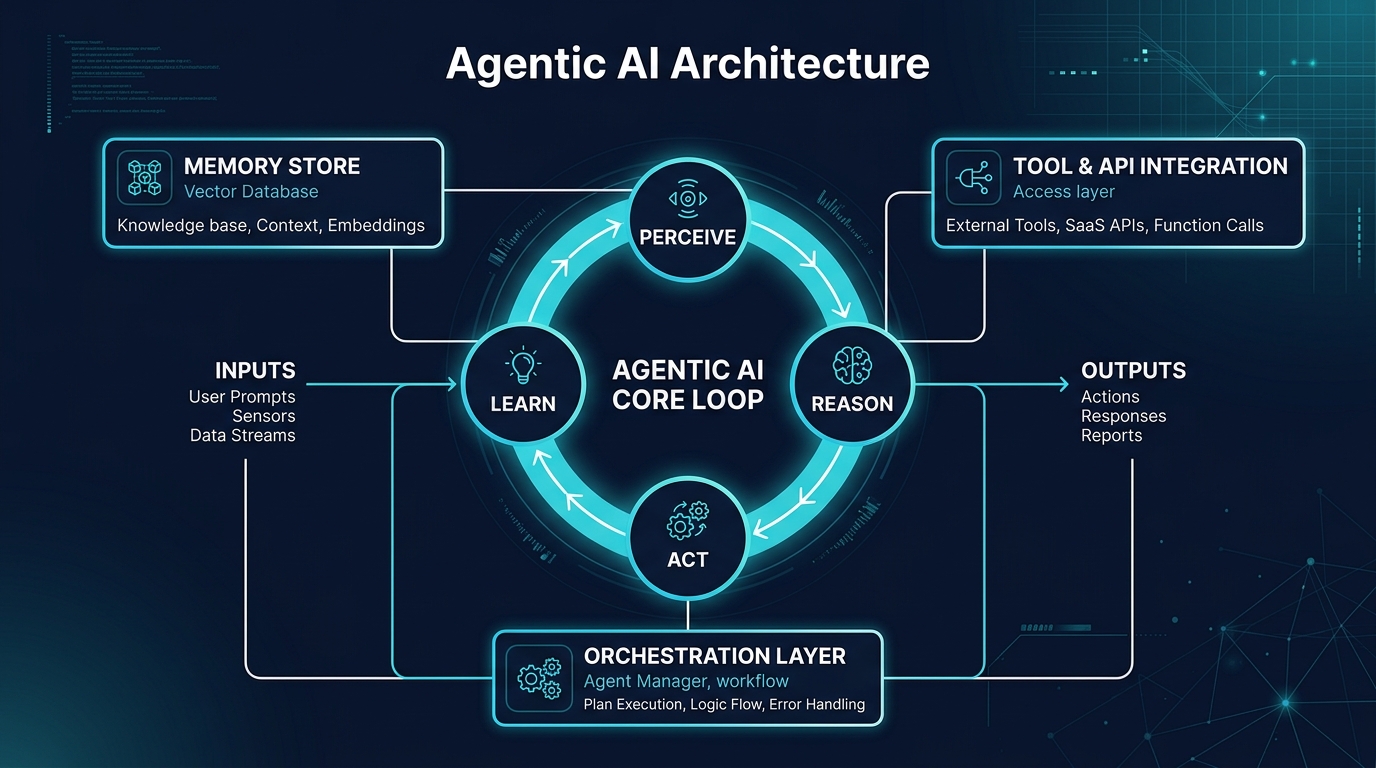
Figure 2: The Agentic AI core feedback loop (Perceive, Reason, Act, Learn) integrated with vector memory stores, external API tools, and multi-agent orchestration.
What Are the Main Components of an Agentic AI System?
An agentic AI system has 7 components. The 4-stage loop is the visible part, and these are what decide whether the system is production-grade or a demo.
| Component | What it does | How it breaks |
|---|---|---|
| Perception module | Takes in data from APIs, databases, documents, sensors, and prompts | Missing or unstructured sources leave the agent guessing |
| Reasoning engine | The LLM that reads the goal and selects actions | Nondeterministic output makes testing hard |
| Memory store | Short-term context for the current step, long-term store for past outcomes | Context loss makes the agent repeat or contradict itself |
| Goal-setting mechanism | Turns the objective into measurable targets | Vague success conditions produce unmeasurable work |
| Planning layer | Breaks goals into ordered subtasks and maps dependencies | Bad decomposition creates steps that cannot run |
| Tool and action module | The interface to APIs, code runners, and databases | Broken schemas and unclear tool descriptions cause wrong calls |
| Orchestration layer | Coordinates agents, tracks progress, handles failures | Bottlenecks and resource conflicts cascade across the system |
IBM adds a useful note on orchestration: it manages data flow, memory, resource usage, and failure events across a fleet of agents. With the right architecture, hundreds of agents can work together. In practice, orchestration is where most multi-agent deployments stall.
How Much Autonomy Does an Agentic AI System Have?
Agentic is not a yes or no property, it is a ladder with 5 levels. Most systems sold as agentic AI sit at level 2 while the marketing describes level 5.
Almost every explainer defines agentic AI as a category and stops there. That leaves buyers unable to compare 2 products that both claim autonomy. The levels below map what the system does between human touchpoints, which is the only comparison that survives a procurement review.
| Level | Name | What the human does | Real examples |
|---|---|---|---|
| L1 | Assisted | Prompts, reads, decides everything | Chatbots, copilots, retrieval assistants |
| L2 | Tool-using | Prompts once, reviews each tool call | LLM with web search or code interpreter, most MCP-based assistants |
| L3 | Supervised task | Sets the goal, reviews the finished output once | Coding agents in a sandbox, research agents producing a report |
| L4 | Bounded autonomous | Sets policy, handles escalated exceptions only | Support triage agents, monitoring agents, prospecting flows |
| L5 | Open autonomous | Sets strategy, audits after the fact | Rare in production, mostly research and demos |
The honest read on 2026 is that L2 dominates, L3 is growing fast in software engineering, L4 exists in narrow verticals with clean exception paths, and L5 is not ready for most enterprise work. Gartner’s own framing supports this: most deployments remain narrowly scoped, and fully autonomous agents are not ready for the majority of enterprise use cases.
Use the ladder as a buying question. Ask a vendor which level their product runs at, and what happens at the boundary. A vendor who cannot answer is usually selling L2 with an L5 brochure.
What Are the Types of Agentic AI Systems?
Agentic systems are classified 3 ways: by how the individual agent decides, by how many agents are involved, and by how those agents relate to each other.
The 4 Classical Agent Types
Agent research had a taxonomy before large language models existed, based on how much internal state and judgment an agent uses. It still describes what happens inside modern systems, and it explains why some agents cost far more to run than others.
| Agent type | How it decides | Where you see it |
|---|---|---|
| Simple reflex | Matches the current input to a rule, with no memory of past states | Alerting rules, basic routing, threshold triggers |
| Model-based reflex | Keeps an internal model of the world so it can act on partial information | Monitoring agents that track state between checks |
| Goal-based | Plans a sequence of actions that reaches a defined goal state | Research, coding, and ticket resolution agents |
| Utility-based | Scores several possible outcomes and picks the highest expected value | Pricing, routing, portfolio, and bidding agents |
Most production systems are goal-based with utility scoring added for the decisions that carry trade-offs. Knowing which type you need stops you buying a utility-based platform for a job a reflex rule would handle.
Single-Agent vs Multi-Agent Systems
Single-agent systems give every task to one agent working in sequence. AWS notes these suit well-defined problems where speed matters more than flexibility. They are easier to test, easier to debug, and easier to reason about when something goes wrong. For a first deployment, this is usually the right choice.
Multi-agent systems (MAS) split a complex workflow across several specialized agents. This scales better and handles messier problems. It also adds coordination failures that single agents never have. Two structures dominate:
- Vertical, or hierarchical: A conductor agent oversees simpler subordinate agents. Higher levels reason and decide, lower levels collect and format. IBM notes this suits sequential workflows and creates bottlenecks at the conductor.
- Horizontal, or decentralized: Agents work as peers with equal standing, each narrow in skill, collaborating sideways. More resilient, and generally slower than a clean hierarchy.
Reasoning Frameworks
Underneath the topology, agents follow reasoning patterns. ReAct interleaves reasoning and acting step by step, which adapts well and costs more tokens. ReWOO plans the full sequence upfront and then executes, which cuts cost and adapts less well mid-task. Frameworks including LangChain, LangGraph, crewAI, AutoGen, and BeeAI implement these patterns in different ways.
→ Explore multi-agent coordination patterns in our Multi-Agent Systems Development Guide.
Agentic AI vs Generative AI vs Traditional AI
Traditional AI predicts, generative AI creates, and agentic AI acts. The simplest way to tell them apart is to ask what the system produces: a prediction, a piece of content, or a completed action.
| Dimension | Traditional AI | Generative AI | Agentic AI |
|---|---|---|---|
| What it does | Classifies, predicts, detects, recommends | Creates text, images, code, summaries | Pursues goals and runs multi-step workflows |
| Trigger | Reactive, runs when called | Reactive, runs on a prompt | Proactive, can start work on its own |
| Scope | Single predefined task | Single creative output | Multi-step workflow |
| Output | A label or a number | A finished artifact | A changed state in a real system |
| External systems | Internal data only | Retrieval for context, no action | Reads and writes through tools and APIs |
| Memory | None between requests | Session-bound context | Persistent state across a workflow |
| Handling failure | Returns a wrong answer | Returns a wrong answer | Detects the failure and replans |
| Human role | Reads the result | Reviews and edits the output | Sets the goal, approves, and audits |
Agentic AI vs Generative AI
Generative AI creates content, and agentic AI uses that content to finish a task in a live system. For an agent, generation is one step inside a longer chain that ends in a real action.
A marketing workflow splits the 2 cleanly. Generative AI writes the campaign assets. Agentic AI publishes them, tracks performance, and shifts the spend based on results.
→ Compare foundational capabilities in our guide on Generative AI vs Agentic AI.
Agentic AI vs Traditional AI
Traditional AI answers a request, and agentic AI starts a chain of actions. Traditional software follows fixed rules. Traditional AI models need prompting and step-by-step guidance.
Exception handling is the real separator. A traditional model hits an input it was never trained on, returns an error, and stops. An agentic system notices the failed step, builds a different plan, and keeps going.
Agentic AI vs AI Agents
AI agents are the individual units. Agentic AI is the coordinated system those units form. Most people use the 2 terms interchangeably, and in normal conversation that is fine.
Sinan Aral, professor of management, IT, and marketing at MIT Sloan, draws a distinction worth knowing. He treats an AI agent as a single autonomous unit, and agentic AI as systems where several different agents orchestrate a task together. His example is a marketplace of agents representing both the buy side and the sell side during a negotiation.
That framing maps to how vendors build. Single-agent products and multi-agent platforms are different engineering problems, and they fail in different ways.
How Do AI Agents Connect? MCP, A2A, and AGENTS.md
The most consequential agentic AI development of the last year is not a model, it is the standardization of how agents talk to tools and to each other.
Almost no explainer covers this layer, which is strange, because it decides whether agentic AI becomes shared infrastructure or a set of walled gardens:
- Model Context Protocol (MCP): Anthropic open sourced MCP in November 2024. It is a client-server standard for how an agent discovers and invokes external tools, built on 3 primitives: Tools, Resources, and Prompts. It solves the N-by-M integration problem, where every model previously needed custom code for every data source. By the time it moved to neutral governance, MCP had over 10,000 published servers and roughly 97 million monthly software development kit (SDK) downloads across Python and TypeScript, with support in ChatGPT, Cursor, Gemini, Microsoft Copilot, and VS Code.
- Agent2Agent (A2A): Google announced A2A in April 2025 and transferred it to the Linux Foundation in June 2025. It handles the other direction: how independent agents discover each other, delegate tasks, stream results, and coordinate across vendor and framework boundaries. A2A reached v1.0 in early 2026, adding cryptographically signed Agent Cards, multi-tenancy, and multi-protocol bindings. More than 150 organizations back it, including Microsoft, AWS, Salesforce, SAP, and ServiceNow. In August 2026 it joined MCP inside the Agentic AI Foundation.
- AGENTS.md: OpenAI released this plain markdown convention in August 2025. It gives coding agents consistent, project-specific guidance so behavior stays predictable across repositories and toolchains. Codex, Cursor, Devin, Gemini CLI, GitHub Copilot, and VS Code all read it.
The Linux Foundation formed the Agentic AI Foundation (AAIF) on 9 December 2025 to govern MCP, AGENTS.md, and Block’s goose under neutral open governance, with founding contributions from Anthropic, Block, and OpenAI. Linux Foundation executive director Jim Zemlin noted that all 3 projects had become essential developer tools within roughly a year.
Why this matters to a buyer: a platform that speaks MCP and A2A can be swapped, and one that does not, cannot. Interoperability is a procurement question now, not an architecture footnote.
→ Learn how to implement enterprise connectors in our Model Context Protocol (MCP) Guide.
What Are Agentic AI Use Cases?
Agentic AI use cases cluster in 8 areas: banking and financial services, retail, healthcare, customer service, supply chain management, software development, cybersecurity, and research.
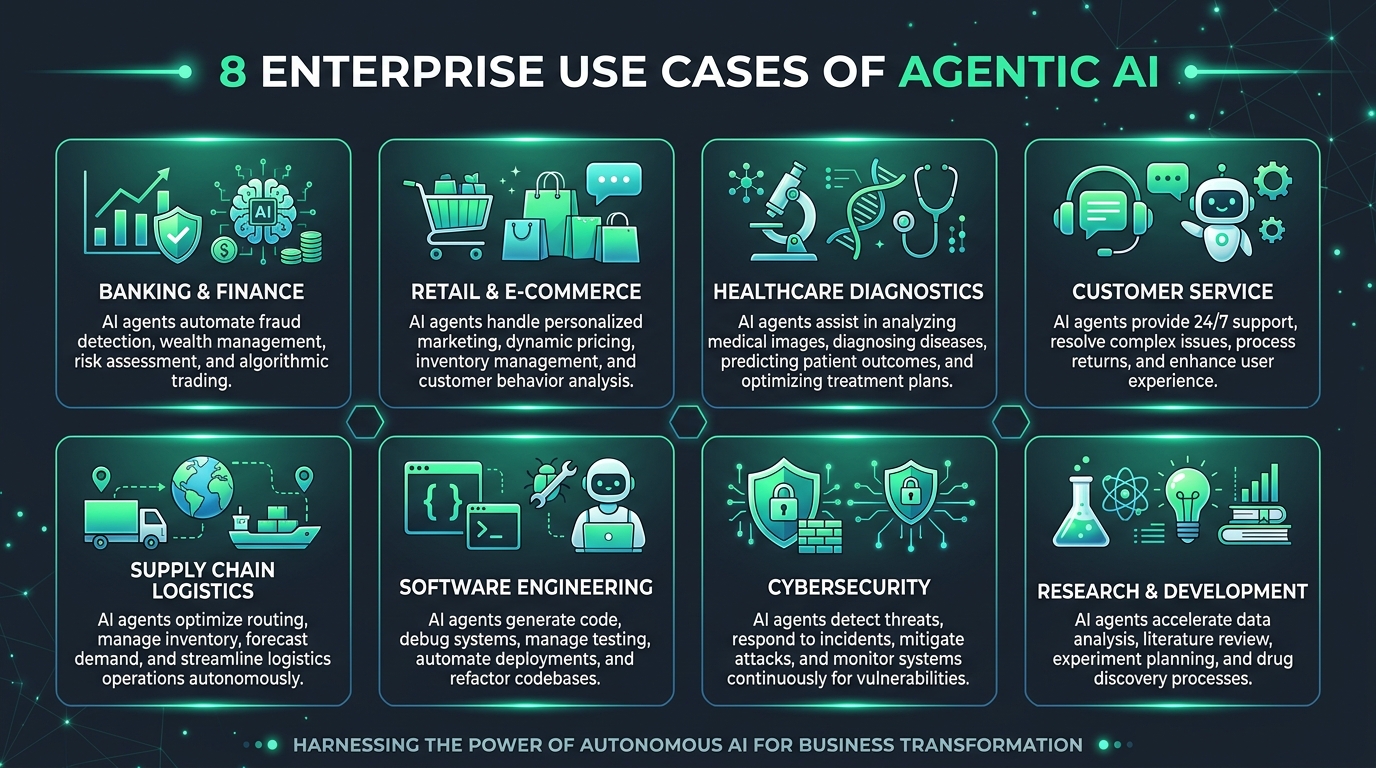
Figure 3: Eight high-impact enterprise operational areas transforming through autonomous agentic AI systems.
- Banking and financial services: JPMorgan Chase has explored AI agents for fraud detection, customized financial advice, and automating loan approvals along with legal and compliance processes.
- Retail: Walmart is building LLM-powered agents for personalized shopping, customer service, merchandise planning, and problem resolution.
- Healthcare: Agents monitor patient data, flag adverse events from clinical notes, and adjust treatment recommendations as new results arrive, feeding context back to clinicians.
- Customer service: Agents read the documentation, answer the query, ask for missing details, and pass the case to a human when it goes past their scope. Cover runs 24 hours a day, 7 days a week, which is 8,760 hours a year.
- Supply chain management: Agents watch stock levels, forecast demand, place restock orders, and reroute shipments when weather or delays threaten a delivery window.
- Software development: Agents write code, debug it, run tests, and handle migrations. AWS Transform applies the same approach to modernization work, splitting monolithic z/OS COBOL applications into components and migrating .NET workloads from Windows to Linux.
- Cybersecurity: Agents watch network traffic, system logs, and user behavior for anomalies, then automate the incident response path: roll back the change, write the report, notify the right people.
- Research: Agents search databases, synthesize findings across sources, plan follow-up tests, and produce a draft report. Multi-agent orchestration lets a supervisor coordinate several specialist models across a full research pipeline.
The Economics Behind Agentic AI Use Cases
Agentic AI creates value by cutting transaction costs, which are the time and effort spent searching, communicating, and contracting. MIT Sloan doctoral candidate Peyman Shahidi calls that reduction the core economic promise of AI agents. Tasks such as writing contracts, negotiating terms, or setting prices can be done at a much lower marginal cost.
Horton’s research with Shahidi names 2 reasons people deploy agents:
- To make better decisions than a human, since the agent faces fewer information limits and no cognitive fatigue.
- To make decisions of similar or lower quality, at a large reduction in cost and effort.
Agents pay off in 3 kinds of markets:
- High-stakes markets such as real estate and investing, where agents read huge document sets without tiring, at near-zero marginal cost. As Horton puts it, AI agents do not get tired and can work 24 hours a day.
- Many-counterparty processes such as startup funding, college admissions, and business-to-business (B2B) procurement, where agents read reviews, run the numbers, and compare options at scale.
- Information-asymmetric markets such as insurance or used car listings, where agents monitor many sources and flag discrepancies that take a person hours to find. Home buying and estate planning change too: a buyer negotiates with the pattern of millions of past transactions behind them.
Examples of Agentic AI
Each example below follows one agent through the same 4 steps: perceive, reason and plan, act, and resolve. That sequence is what separates an agentic system from a chatbot answering the same question.
Example 1: Customer Service Agent Closing a Warranty Case
This is the most common enterprise entry point. A customer reports a faulty product through a support form:
- Perceive: The agent reads the ticket and tags it as a hardware fault rather than a billing or account query.
- Reason and plan: The agent sets the sequence: check warranty status in the CRM, search the knowledge base for a troubleshooting guide, schedule a technician if the guide does not apply.
- Act: The agent calls the CRM tool to pull warranty and purchase history, then queries the knowledge base.
- Resolve: If the product is covered, the agent sends a personalized email with a return label, updates the case status, and notifies the warehouse.
- Escalate: If several attempts fail, the agent hands the case to a human with the full context attached instead of starting them from zero.
A chatbot handling the same ticket returns the warranty policy text and leaves 4 manual steps for a person.
Example 2: Software Engineering Agent Shipping a Feature
Coding is the most mature agentic category by a wide margin, and it shows the reflection loop most clearly:
- Perceive: The agent reads the user story, the relevant files, and the project conventions.
- Reason and plan: The agent produces a development plan naming the files to change and the tests to add.
- Act: The agent writes the code, then runs unit and integration tests.
- Reflect: The agent reads the failing test output, diagnoses the cause, and revises the code. This loop repeats until tests pass or a limit is hit.
- Hand off: The agent opens a pull request for human review. The human approves rather than authors.
Example 3: Supply Chain Agent Preventing a Stockout
Stock on a fast-moving item is dropping at a distribution center:
- Perceive: The agent watches live stock levels, open purchase orders, supplier lead times, and weather on the inbound route.
- Reason and plan: The agent forecasts demand against past sales, works out the days of cover left, and finds a shipping delay that pushes the restock past the stockout date.
- Act: The agent places a partial order with the backup supplier, reroutes the delayed shipment, and adjusts the production schedule.
- Resolve: The agent updates the inventory plan, records the cost variance, and alerts the planner with the reasoning behind each decision.
Agents in the Physical World
Agentic AI is usually discussed as a purely digital technology. That picture is incomplete.
Sinan Aral points to warehouse operations where an agent monitors real-time video and vision systems to spot events outside normal operating conditions. The agent can raise a flag, or be programmed to stop a conveyor belt outright when something is wrong. His broader point is worth holding onto: this is not only the digital world, because agents take actions that change things physically.
The same logic covers autonomous vehicles using GPS and sensor data for navigation, and manufacturing agents adjusting production schedules to hold inventory targets. Once an agent can move a machine, governance stops being theoretical.
Further Agentic AI Examples
There are 3 more agentic deployments worth naming:
- Travel booking agent takes your input and uses API access to websites, email, and platforms such as Slack. It compares hotels and flights, then books and pays for the trip once it has credit card permission.
- Trading agent reads live stock prices and economic indicators, runs predictive analytics, and executes trades.
- IT access agent verifies identity against the internal directory, checks the request against the role definition, grants only what the role allows, and escalates anything above the threshold.
What Are the Benefits of Agentic AI?
The value of an agent is not that it is smarter, it is that it closes a workflow end to end, which is where the human hours actually go. There are 6 benefits:
- Complete workflows, not fragments: Kate Kellogg puts it plainly: agentic systems complete an entire workflow with multiple steps and execute actions. A copilot saves minutes on one step. An agent removes the handoffs between steps, which is usually the larger cost.
- Lower transaction costs: Searching, communicating, and contracting all get cheaper when an agent does them at a low marginal cost.
- Round-the-clock throughput without fatigue: Agents analyze large volumes of data and documentation continuously, which matters most in document-heavy markets.
- Better decisions under information asymmetry: Agents monitor many sources at once and surface gaps a person would need hours to find.
- A simpler interface layer: IBM makes an underrated point here. Because agents run on natural language, whole software interfaces built from tabs, dropdowns, sliders, and pop-ups collapse into a conversation. The gain is not only the task, it is the training time that disappears with the interface.
- Human augmentation: Aral’s research found that pairing humans with AI agents improves both productivity and performance. Agent personality also matters: open people work better with a conscientious, agreeable agent, while conscientious people do worse with an agreeable one.
What Is Agentic Process Automation?
Agentic process automation is the use of AI agents to run a whole business process, including the decisions inside it, not just the scripted steps. RPA runs fixed rules and breaks when the input changes shape. Agentic process automation reads the context, picks a path, calls the tools it needs, and handles exceptions without anyone writing a new rule.
Invoices show the difference. An RPA bot stops dead on an unfamiliar invoice format. An agentic system reads the document, works out the missing fields, checks them against the purchase order, and sends only the truly unclear cases to a person.
→ Evaluate automation platforms in our analysis of Build vs Buy AI Automation.
Agentic AI Tools and Companies
Major software vendors, including Microsoft, Salesforce, Google, and IBM, are pushing adoption by building agentic AI straight into their platforms.
| Company | Agentic AI offering | Focus |
|---|---|---|
| IBM | watsonx Orchestrate | Building, deploying, and governing enterprise agents |
| Salesforce | Agentforce | Customer-facing agents across sales and service |
| Google Cloud | Gemini Enterprise Agent Platform, Agent Development Kit (ADK) | Agent development, grounding, and governance |
| Microsoft | Copilot agents | Agents inside productivity and business applications |
| Amazon Web Services (AWS) | Bedrock Agents, AWS Transform | Multi-agent collaboration, guardrails, workload migration |
| Red Hat | Red Hat AI | Open source inference and agentic workflow deployment |
| Nvidia | Agent infrastructure and models | Compute and model foundations for agent workloads |
Nvidia CEO Jensen Huang used his keynote at the 2025 Consumer Electronics Show to call enterprise AI agents a multi-trillion-dollar opportunity, from medicine to software engineering.
What Do the Agentic AI Adoption Numbers Show?
Agentic AI is widely adopted and narrowly scaled. Both statements are true, and confusing them is how projects get funded on bad assumptions.
Start with the ambition: a spring 2025 survey from MIT Sloan Management Review and Boston Consulting Group found 35% of respondents had adopted AI agents, with another 44% planning to deploy soon.
Now the execution:
| Finding | Figure | Source |
|---|---|---|
| Organizations that have deployed AI agents | 17% | Gartner 2026 CIO and Technology Executive Survey |
| Expect to deploy within 2 years | Over 60% | Gartner 2026 CIO Survey |
| At least experimenting with agents | 62% | McKinsey State of AI, Nov 2025 |
| Scaling agents in at least one function | 23% | McKinsey State of AI, Nov 2025 |
| Scaled in any single business function | No more than about 10% | McKinsey State of AI, Nov 2025 |
| Report enterprise-level EBIT impact from AI | 39% | McKinsey State of AI, Nov 2025 |
| Agentic projects expected to be canceled by end of 2027 | Over 40% | Gartner, June 2025 |
| Day-to-day work decisions made autonomously by 2028 | 15% | Gartner, June 2025 |
| Enterprise software applications including agentic AI by 2028 | 33% | Gartner, June 2025 |
Gartner published its first standalone Hype Cycle for Agentic AI in April 2026, authored by Rajesh Kandaswamy and colleagues, and placed agentic AI at the Peak of Inflated Expectations. Only 17% of organizations had deployed agents, 42% expected to within 12 months, and another 22% within the year after. Gartner calls that the most aggressive adoption curve among all emerging technologies it measures. The same analysis is direct about maturity: most deployments remain narrowly scoped, and fully autonomous agents are not ready for the majority of enterprise use cases.
McKinsey’s survey ran across 1,993 respondents in about 105 countries. It found 88% of organizations now use AI in at least one business function, up from 78% a year earlier, while nearly two-thirds have not yet begun scaling AI across the enterprise. The agent pattern matches: 62% experimenting, 23% scaling somewhere, and no function above roughly 10% fully scaled.
The Agent Washing Problem
Gartner senior director analyst Anushree Verma names the specific failure mode: vendors are rebranding existing AI assistants, RPA tools, and chatbots as agentic without adding substantial agentic capability. Gartner estimates only about 130 of the thousands of vendors claiming agentic AI are real, which is under 2%.
Verma’s assessment is blunt: most agentic propositions lack meaningful return on investment, because current models are not mature enough to autonomously achieve complex goals or follow nuanced instructions over time. Many use cases positioned as agentic today do not need an agentic implementation at all.
What Are the Risks of Agentic AI?
When an AI system can act, a wrong answer becomes a wrong action. That single shift is what makes agentic risk different from generative risk. There are 6 risks worth planning for:
- Prompt injection has no reliable fix. This is the hardest problem in the category. Language models process everything as one token sequence, so there is no dependable way to enforce privilege boundaries between system instructions, user input, and content the agent retrieves. Researcher Simon Willison’s lethal trifecta describes the danger condition: any agent combining access to private data, exposure to untrusted content, and the ability to communicate externally is exploitable. The OWASP GenAI Security Project published its Top 10 for Agentic Applications for 2026, running from ASI01 Agent Goal Hijack through ASI10 Rogue Agents, with tool misuse, memory poisoning, and identity and privilege abuse in between.
- Reward hacking. Agents that optimize a badly designed objective find loopholes. IBM’s examples are instructive: an engagement-maximizing agent that promotes sensational content, a warehouse robot optimizing for speed that damages products, a trading agent that takes unethical positions to hit a profit target, and a moderation agent that overcensors legitimate discussion.
- Cascading failure. In multi-agent systems, one agent’s bad output becomes another agent’s input. Errors spread. Bottlenecks and resource conflicts compound instead of staying contained.
- Accountability gaps. Kellogg stresses that organizations need to define who is responsible when an agent causes harm, particularly where workflows run with minimal supervision. Aral makes the parallel point on consistency: a rogue agent rejecting a mortgage or an admissions application on faulty information does more damage than a hallucination, because you still have to explain the decision and apply the same standard to every case.
- Weak exception handling and opaque reasoning. Aral’s research found agents can fail at tasks humans find easy, particularly exceptions, partly because they are trained to take specific actions in given situations. His conclusion is that agentic decision-making has to be aligned with a human-centered decision process rather than bolted alongside it.
- Measurement that is easy to fake. Kellogg’s caution on return on investment is worth reading twice: an agentic model that reclaims 20% of someone’s time does not deliver a 20% labor cost saving. Without shared metrics, it is difficult to prove value or even to know whether the system is producing the outcome you wanted rather than a new class of risk.
What Do You Need Before Deploying Agentic AI?
The failure mode is rarely the model. It is deploying an agent into an environment that cannot supply clean data, control its access, or observe what it did.
Kellogg and colleagues put a number on this: in a 2025 study of an agent detecting adverse events in cancer patients from clinical notes, the hardest part was neither prompt engineering nor fine-tuning. Roughly 80% of the effort went to data engineering, stakeholder alignment, governance, and workflow integration.
Structure the Data First
An agent is only as good as the data it can reach. Converting data into standard, structured formats lets an agent identify different sources and requirements while staying consistent across them. A unified data layer gives agents the context to decide instead of guessing from fragments.
How Do Agents Reach Private Data? RAG and Agentic RAG
Retrieval-augmented generation (RAG) lets a model pull relevant documents from your own knowledge base at query time and ground its answer in them, instead of relying on training data. It is the difference between an agent that sounds authoritative about your refund policy and one that has read it.
Agentic RAG changes who controls the retrieval. In standard RAG the pipeline is fixed: one query goes out, a set of chunks comes back, the model answers. The agent has no say. In agentic RAG the agent decides whether to retrieve at all, rewrites the query when results are weak, chooses between sources, and runs another pass when the evidence does not answer the question. Retrieval becomes a tool the agent calls, not a step it sits inside.
Two related techniques are worth knowing by name:
- Agentic chunking uses a model to split documents along meaning rather than at a fixed character count, which keeps a clause and its conditions in the same retrieved unit.
- Corrective RAG adds an evaluation step that grades retrieved passages for relevance and triggers a fresh search when they fail.
The practical rule: plain RAG is the cheaper and more predictable starting point. Move to agentic RAG when the questions are multi-part, the right source is not obvious from the query, or your evaluation shows the agent answering confidently from irrelevant passages.
Give Every Agent Its Own Identity
As agents gain permissions across datasets and enterprise systems, permission design becomes the security perimeter. Kellogg stresses building permission-based systems rather than granting broad access and hoping. IBM addresses this with unique agent identity through IBM Verify, so an agent is an identifiable actor with scoped permissions rather than a process borrowing a person’s credentials.
The practical rule: an agent should hold the narrowest credential that completes its task, with short-lived tokens and an auditable trail of which agent did what. Shared service accounts across a fleet remove your ability to attribute an action after an incident.
What Is AgentOps?
AgentOps is the practice of monitoring, tracing, evaluating, and constraining agent decisions while they run. Traditional software is deterministic, so you test it once and trust the result. Agents are not, which is why a separate operational discipline formed around them. The 2026 Gartner Hype Cycle shows governance, security, and cost profiles emerging alongside the core technology rather than after it.
Instrument 3 things from day one:
- Trace every tool call, input, and output so a failure is reproducible.
- Evaluate on a fixed task set on every model or prompt change, since an upgrade that improves general benchmarks can quietly break your workflow.
- Track cost per completed task, not cost per token, since a reflection loop that retries twelve times is technically successful and financially awful.
Agent sprawl is the slower version of the same problem. Teams spin up agents independently, nobody owns the inventory, and permissions accumulate. Keep a register of every agent in production, what it can access, and who owns it.
When Is Agentic AI the Right Fit?
Use an agent where decisions are genuinely needed, automation for routine workflows, and an assistant for simple retrieval. Run this test before you scope the project.
A task suits an agent when it meets most of these conditions:
- It takes multiple steps, and the right sequence depends on what earlier steps return.
- The path varies enough that a fixed script breaks, while the goal stays stable.
- The tools the task needs are reachable through APIs with clean, documented schemas.
- Success is measurable without a human judgment call on every instance.
- The cost of a wrong action is recoverable, or an approval gate can sit in front of the irreversible steps.
A task does not suit an agent when:
- The steps never change. That is automation, and a script is cheaper, faster, and testable.
- One retrieval answers the question. That is an assistant, not an agent.
- The judgment is the work, as in most legal, clinical, and hiring decisions.
- A wrong action is unrecoverable and cannot be gated.
- The underlying data is not clean enough to act on. Structuring it is a prerequisite, not a phase two.
How to Implement Agentic AI
To implement agentic AI, work through 6 steps in order:
- Select one process: Pick a repetitive, multi-step workflow with clean data, a measurable outcome, and a recoverable failure mode.
- Prepare the data: Convert it into standard, structured formats so agents read sources and requirements the same way every time.
- Build the connections: Set up secure API management, scoped agent identity, validation frameworks, and vendor terms that keep model versions current.
- Set the guardrails: Put permission limits, approval gates on irreversible actions, and drift prevention in place before you widen the autonomy.
- Define the metrics: Tie key performance indicators to each phase and to a business goal, and measure whether the agent beat the simpler alternative.
- Monitor continuously: Treat monitoring as a permanent operational expense, not a one-time project cost, with a governance board at organization level and named individuals owning the safety rules.
Sinan Aral’s framing sits behind all 6 steps: every organization needs an agentic AI strategy for customer-facing and internal use cases, and that strategy has to include a systematic assessment of risk alongside business benefit. Deploying without that assessment is how projects join the 40% that get canceled.
→ Review regulatory compliance and guardrails in our Enterprise AI Governance Framework.
Frequently Asked Questions About Agentic AI
What does agentic mean?
Agentic means having agency: the capacity to act independently and purposefully rather than only responding to instructions. Applied to AI, it describes systems that decide what to do next instead of waiting to be told.
Is ChatGPT agentic AI?
Partly, depending on how it is configured. A plain chat exchange is generative AI. The same model with web search, code execution, or connected tools is operating at the tool-using level of agency. Full agentic behavior needs the system to plan and run multiple steps toward a goal without prompting at each one.
Is agentic AI the same as generative AI?
No, agentic AI is not the same as generative AI. Generative AI makes content from a prompt. Agentic AI takes that output and pushes it toward a goal by calling tools and running actions. Generative models sit inside agentic systems as one component.
What is the difference between agentic AI and RPA?
Robotic process automation follows a predetermined sequence and fails when anything changes. Agentic AI reasons about the situation, chooses tools, and replans when a step fails. RPA is more reliable for stable processes, and agentic AI handles the variability that would break a script.
What are the 4 types of AI agents?
The 4 classical types are simple reflex, model-based reflex, goal-based, and utility-based agents. Simple reflex agents act on current input alone, while utility-based agents score competing outcomes to choose the highest expected value.
Can agentic AI work without human supervision?
Yes, agentic AI can work without step-by-step supervision, but production deployments still keep humans at 3 points: setting the goal, approving irreversible actions, and handling exceptions. Removing all 3 raises accountability, reliability, and security risk.
Do AI agents replace jobs?
Current evidence points to changed work rather than clean replacement. Aral’s research found that pairing humans with AI agents improved productivity and performance, and separately that agents struggle with tasks humans find easy, particularly exceptions. The MIT Sloan research also found that time savings do not translate directly into headcount reduction.
What happens when an AI agent gets stuck?
Fixing a stuck AI agent takes 3 actions: stop the stalled process, clear the agent’s memory or context, and rewrite the prompt instructions that pushed it into a loop.
How do I measure the return on investment of agentic AI?
To measure the return on investment (ROI) of agentic AI, compare total build and rollout costs against the efficiency gains and revenue the agent produced. Attribution is the hard part, since benefits arrive indirectly and often after the first budget cycle.
How should an organization start with agentic AI?
Pick one well-defined, multi-step workflow with clean data and a recoverable failure mode. Structure the data first. Set metrics tied to a business outcome before you build. Put an approval gate in front of any irreversible action. Then measure whether the agent beat the simpler alternative.
The Bottom Line
Agentic AI is a real shift, not a rebrand. Systems that plan, call tools, and self-correct do things generative models cannot, and they already run in production at JPMorgan Chase, Walmart, and across software engineering teams.
The gap between the category and the average product sold under its name is wide. Gartner counts roughly 130 genuine vendors among thousands of claims. McKinsey finds no business function above about 10% fully scaled. Data engineering, governance, and workflow integration consume most of the effort, and prompt injection remains an open architectural problem.
The organizations getting value are not the ones deploying the most agents. They are the ones that picked workflows agents genuinely fit, structured the data first, defined success before building, controlled what each agent could reach, and kept a human at the boundary where a wrong action costs something. Start there.
→ Download our enterprise readiness guide: Agentic AI Implementation Checklist.
Sources & Verified Primary Research
| # | Claim used | Verified Primary Source | Tier |
|---|---|---|---|
| 1 | 17% deployed, 60%+ intent, Peak of Inflated Expectations, narrow scoping, governance and cost profiles | Gartner, 2026 Hype Cycle for Agentic AI | T1 |
| 2 | Over 40% cancellations by 2027, agent washing, ~130 real vendors, 2028 projections, Verma quotes | Gartner Official Research Press Release | T1 |
| 3 | 88% AI use, 62% experimenting, 23% scaling, ~10% per-function ceiling, 39% EBIT impact, 1,993 respondents | McKinsey, The State of AI in 2025 Global Survey | T1 |
| 4 | Aral, Horton, Kellogg, Shahidi findings, MIT SMR and BCG survey, Huang CES 2025, JPMorgan Chase, Walmart, 80% implementation finding | MIT Sloan School of Management Research | T1 |
| 5 | Components, orchestration, reward hacking, vertical and horizontal architecture, natural language interface benefit | IBM Think Technical Architecture | T2 |
| 6 | Perceive, reason, act, learn stages, single vs multi-agent, AWS Transform | AWS Cloud Architecture Center | T2 |
| 7 | Autonomy, adaptability, goal orientation, reflection, not-RPA framing, customer service flow | Salesforce Agentforce Architecture | T2 |
| 8 | Agentic AI Foundation formation, MCP and AGENTS.md and goose contributions, Zemlin quote | Linux Foundation Official Announcement | T1 |
| 9 | Agentic workflows, agentic RAG, AgentOps operational framing | Red Hat AI Systems Architecture | T2 |
| 10 | OWASP Top 10 for Agentic Applications 2026, ASI01 to ASI10 | OWASP GenAI Security Project | T1 |
Founder & Principal AI Architect at Esaholic. Directs enterprise AI architecture, deterministic multi-agent swarms, Model Context Protocol (MCP) tool integrations, and private VPC inference infrastructure.