Kendrick Lamar AI: Voice Cloning and Rights Explained
Written by Danish Mustafa · Reviewed by Amir Iqbal ·
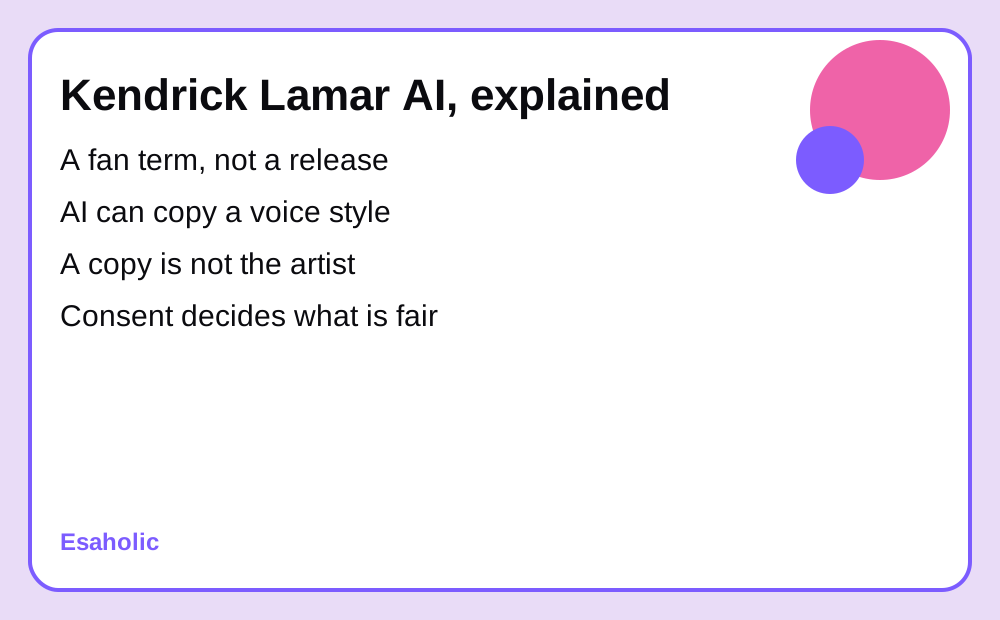
Kendrick Lamar AI is a phrase fans and searchers use for AI made music and voice clips that sound like Kendrick Lamar. It is not, in this article, the name of an official release, a confirmed project, or a song we can point you to. It is a search term that covers a mix of things: fan made voice clones, AI covers of existing songs, imagined collaborations, and sometimes outright fakes shared as if they were real. This guide explains that whole picture in general terms, so you can enjoy AI music talk without being fooled by it, and without crossing lines that harm artists.
The core idea is simple to state and hard to handle well. AI can now learn the sound of a voice from recordings and then speak or sing new words in a voice that sounds very close to that person. That power excites fans, because they can imagine a favorite artist singing a song the artist never sang. It also worries artists, labels, and lawyers, because a voice is part of a person's identity and livelihood. A cloned voice can confuse listeners, take attention and money from real work, and put words in an artist's mouth that the artist never said. This article keeps both sides in view: the curiosity that drives fans, and the consent that protects artists.
Two ground rules shape everything that follows. First, this article links to no cloned voice, no deepfake audio, and no unauthorised track, and it does not tell you where to download one. A deepfake, in this context, is a fake audio or video made by AI that looks or sounds like a real person. Second, this article claims no song or release is AI made unless a reputable source confirms it, and it makes no such claim about Kendrick Lamar here. If you read a claim elsewhere that a track is a new AI Kendrick release, treat it as a rumour until the artist, the label, or a trusted news outlet confirms it through an official channel.
What Kendrick Lamar AI Means
When people search for this phrase, they usually mean one of four things, and it helps to separate them. The first is an AI voice clone, which is a model trained to copy the sound of a voice. The second is an AI cover, where a cloned voice sings a song that already exists, often a song by another artist. The third is an AI original, where a cloned voice sings new words written by a fan or by another AI tool. The fourth is a fake release, where someone shares an AI track with a title, cover art, and story that make it look like a real new single or album track.
Only the first item is a technology. The other three are uses of that technology, and their fairness depends on consent, credit, and context. A fan who makes a clone for private learning and never shares it raises different questions from a channel that uploads a fake "new single" and earns money from views. A parody that clearly labels itself as AI made raises different questions from a track that hides its AI origin and tricks listeners. The technology does not decide these questions. People, labels, platforms, and laws do.
Kendrick Lamar matters in this discussion because his voice, flow, and writing are so distinct. Flow, in rap, means the rhythm and pattern of how words ride over the beat. When a voice is that recognizable, a clone can feel convincing even when the words are weak, because listeners fill in the gaps with what they know about the artist. That recognition is also why the stakes are high. A convincing fake can travel faster than a correction, and many listeners may never see the correction at all. Fans who love an artist should be the first to protect that artist from fakes, not the first to spread them.
How AI Voice Cloning Works in General
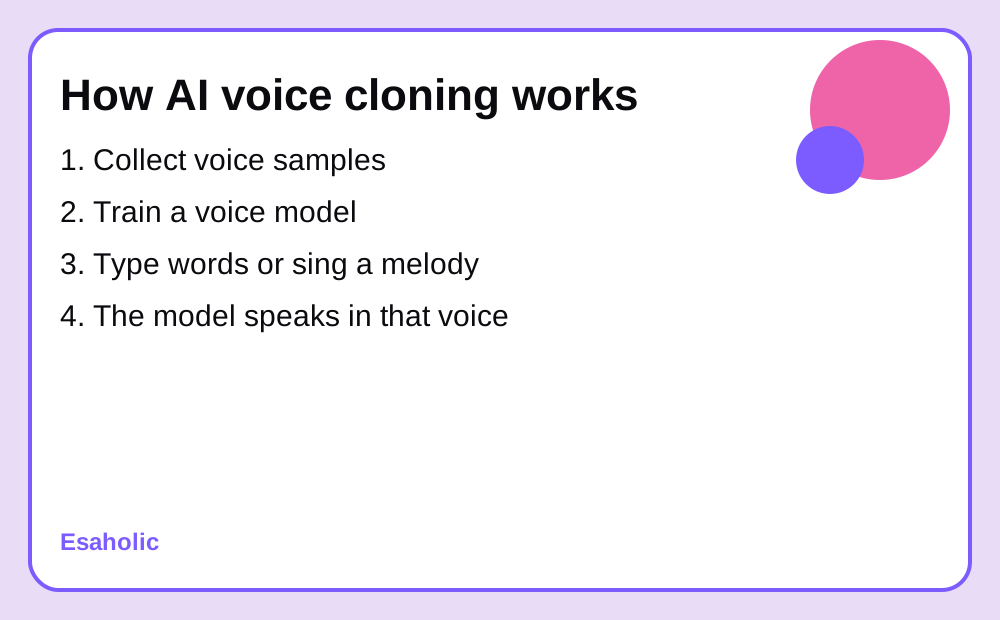
AI voice cloning starts with voice samples, which are recordings of a person speaking or singing. A voice model studies those samples and learns patterns: pitch, which is how high or low the voice sounds, tone, speed, accent, breath, and the small habits that make a voice recognizable. Modern tools need far fewer samples than older tools did, and some can build a rough clone from a short clip. That low barrier is part of the problem, because it means a public interview, a song, or a video clip can become raw material for a clone without the artist ever agreeing to it.
Once the model learns a voice, a user gives it new material. That material can be typed text, which the model reads aloud in the cloned voice, or a melody with new lyrics, which the model sings in that voice. The model then builds sound wave by wave, shaping it to match the learned voice patterns. The result can sound close to the real voice, especially in a short clip on a phone speaker. Longer tracks, fast rap verses, and emotional shifts expose more flaws, because the model must hold the voice steady across many sounds and feelings, and it often slips.
AI generated music adds another layer. A music model can also generate a beat, a melody, or a full backing track from a prompt, which is the written instruction you give the tool. Combine a generated beat with a cloned voice, and you get a track that sounds complete, even though no human singer entered a studio. That completeness fools the ear. Listeners hear a full song and assume a full human process behind it, when the process may have been one person, one prompt, and one afternoon.
Why Fans Make AI Covers and AI Songs
Fans make AI music for reasons that are easy to understand. Curiosity comes first. People want to hear how a favorite voice would sound on a song it never touched, or how a classic verse would sound in a different style. That "what if" question has driven fan art, remixes, and mashups for years, and AI simply makes the experiment faster and more realistic. A fan who once imagined a collaboration can now hear a rough version of it in minutes.
Tribute is a second reason. Some fans see an AI cover as praise, a way to show love for an artist by placing that voice in a song they love. They may not think about rights at all, because their intent feels positive. Intent matters, but it does not settle the question. A tribute that confuses listeners, earns money from someone else's voice, or puts new words in an artist's mouth can still harm the artist, even when the fan meant no harm. Good intent calls for extra care, not less.
Community and attention form a third reason. AI tracks spread well on social platforms, because surprise drives shares. A track that sounds like a famous artist singing an unexpected song earns clicks, comments, and followers fast. That reward shapes behavior. Creators learn that a convincing fake travels further than an honest original, and the platform rewards the fake before anyone checks it. Fans who share without checking become part of that chain, even if they only pressed share once.
What Is Real and What Is Not: Checking Claims
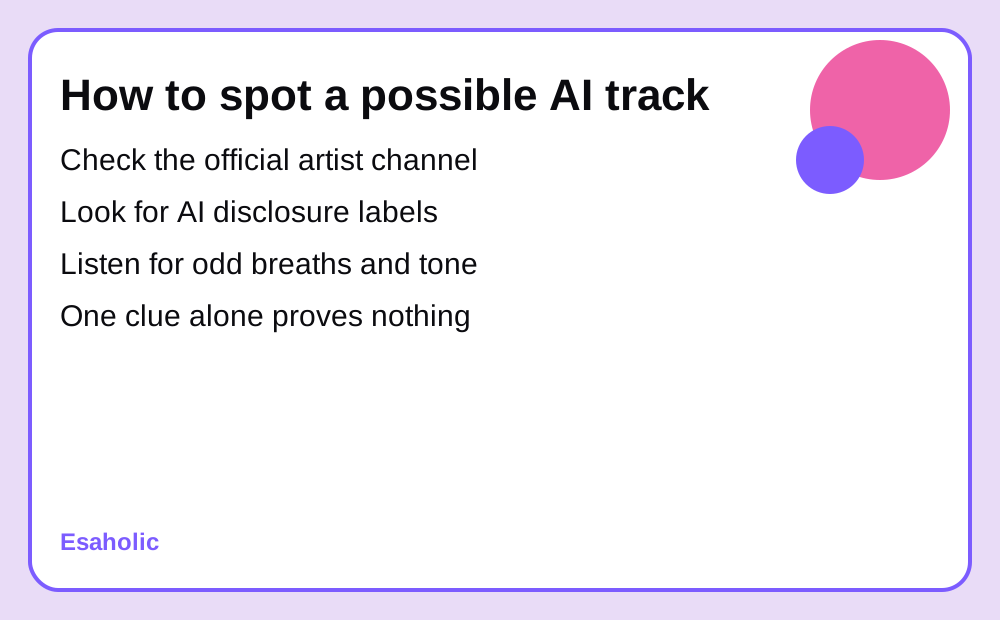
The safest habit for any AI music claim is to check the source before you believe it or share it. Start with the artist's official channels: the artist's own social accounts, the official video channel, and the label's release pages. A real new release appears there, with credits, a release date, and a consistent story across those channels. A fake often appears first on a small channel, a repost account, or a forum post, with a dramatic title and no official link.
Next, check reputable music press. Trusted outlets report a real release with quotes, credits, and context, and they correct errors when they make them. A single anonymous post is not the same as a reported story, even if the post has many views. Views measure attention, not truth. If no reputable outlet and no official channel confirms a track, the honest label for it is unverified, not real, and not fake with proof, but unverified. That word should slow you down, not speed you up.
Audio clues can help, but they cannot settle the question alone. Listen for odd breaths, flat emotion in lines that should carry feeling, strange pronunciation of simple words, and a voice that sounds steady in a way a live human voice rarely does. Also listen for lyrics that feel generic, or references that do not fit the artist's known work. These clues raise doubt, but a skilled fake can hide them, and a real low quality recording can show them. Use audio clues to prompt a source check, never as a final verdict.
This article applies that standard to itself. It does not claim that Kendrick Lamar has released an AI song, has approved an AI voice model, or has taken a public position that this article can quote, because no such verified claim is cited here. Readers who want the artist's actual position should look for it in his own words or in reputable reporting, not in fan uploads or AI track titles. That restraint is not a gap in the article. It is the point.
Rights, Consent, and Copyright
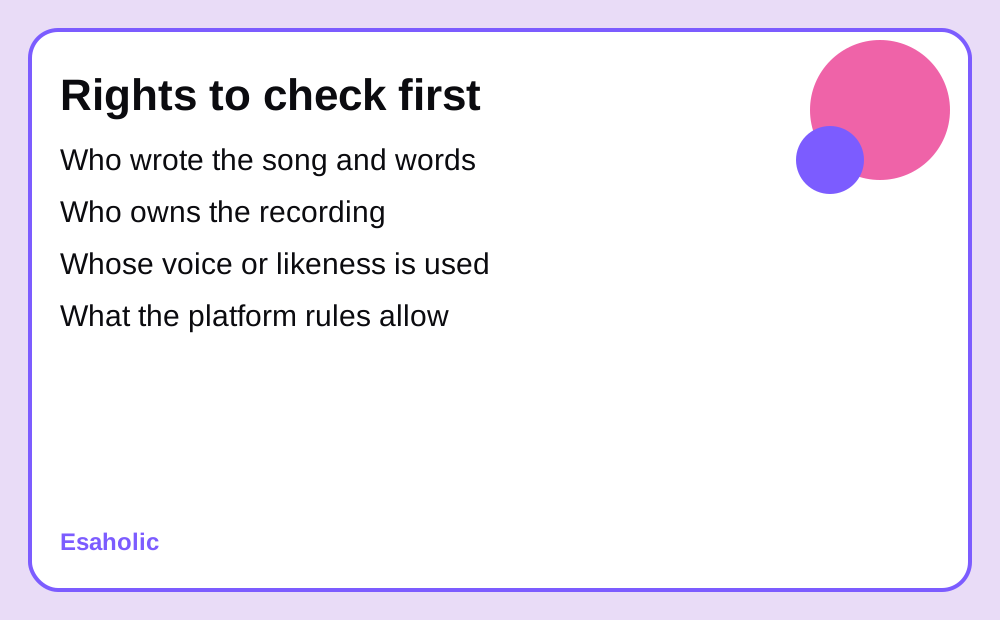
Three different rights often get mixed up in AI music talk, and separating them makes the debate clearer. Copyright protects creative works such as songs, lyrics, and recordings. It decides who can copy, share, adapt, or sell a work. Voice and likeness rights, often called the right of publicity in the United States, protect a person's name, voice, and image from commercial use without permission. Platform rules form a third layer, because a platform can remove a track even when a court has not ruled on it, simply because the track breaks that platform's rules.
An AI Kendrick style track can touch all three at once. If it uses a real song's melody or lyrics, it touches copyright in that song. If it uses a recording as training material or as a base, it touches copyright in that recording. If it clones the voice, it touches voice and likeness rights, even when the melody and lyrics are brand new. A track can therefore be original in its words and still be a problem, because the voice itself was used without consent. New words do not fix a borrowed voice.
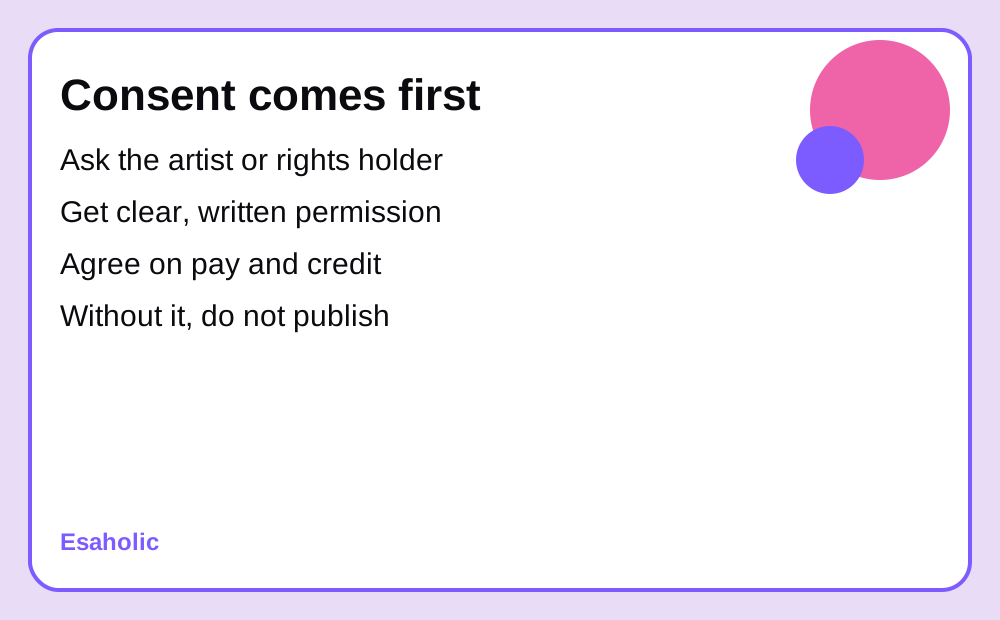
Consent is the word that cuts through most of the confusion. Consent means clear, informed permission from the person whose voice is used, and from the owners of any song or recording involved. It should be specific: which voice, which use, for how long, and for what pay or credit. A vague claim that an artist "would probably like it" is not consent. Silence is not consent. Popularity is not consent. Only an actual agreement counts, and for commercial use, that agreement should be written.
For general background from official sources, the U.S. Copyright Office pages on AI explain how copyright treats human authorship and AI assisted work, and the Recording Industry Association of America site sets out the recording industry's position on artist rights. Neither page settles every AI music case, and neither replaces legal advice for your own project, but both show why consent and human creativity sit at the center of the debate.
How Laws and Platforms Are Responding
Laws on AI voice cloning vary by place and are still changing, so no single rule covers every country or state. Some places have passed or proposed laws that give people stronger control over AI copies of their voice and likeness, including rules that require consent before a commercial AI copy can be used. Tennessee, for example, is widely reported as an early mover with a law aimed at unauthorised AI replicas of artists' voices. California has also moved on consent for AI likenesses in commercial settings. The details, dates, and scope of these laws differ, and they keep changing, so check the current law where you live and where you publish before you act on any summary, including this one.
At the federal level in the United States, copyright guidance has stressed human authorship. In plain terms, copyright protects creative work that comes from a human author. A work generated by a machine with little human creative input faces a harder path to protection, while a work where a human shapes the creative choices has a stronger claim. That distinction matters for AI music makers who hope to own or sell what they generate. Owning a file is not the same as owning the copyright in it, and a platform or buyer may ask for proof you cannot give if the human creative role was thin.
Labels and artist groups have pushed for consent based licensing instead of a free for all. The model they describe is simple: if a tool wants to use an artist's voice, it should ask, agree terms, and pay. Licensed tools that follow that model do exist, and they point to a healthier future where fans can play with AI voices that artists actually chose to offer. That future depends on fans choosing licensed paths over unlicensed clones, because demand shapes what tools get built next.
The Artist Side: Why Consent Matters
From an artist's side, a voice is not just a sound. It is a career built over years of writing, recording, touring, and building trust with listeners. When a clone sings new words, listeners may judge the artist by words the artist never wrote, in a style the artist never chose, for a cause the artist never supported. That can harm reputation in ways that are hard to undo, because a clip can outlive any denial. An artist should control the words that reach the public in their voice, just as a writer controls the words that reach the public under their name.
Money matters too, in a direct way. Streams, sales, and attention that go to a fake track do not go to the real artist, and they can crowd out real releases in search results and feeds. A fan who streams a fake "new" track ten times may never hear the real new work when it arrives, because the feed already gave them a substitute. Over time, that substitution weakens the link between an artist and their audience, and it rewards the copier more than the creator.
Safe and Legal Ways to Explore AI Music
The safest path starts with your own voice. Clone your own voice, with a tool that lets you do so, and make original songs with it. You control the voice, the words, and the release, and no one else's rights stand in the way. You can also use licensed voice models, where the singer or speaker agreed to offer their voice through that tool, on stated terms. Read those terms before you publish, because a license for private play may not cover commercial release, and a license for one platform may not cover another.
Original music with AI help is another clean path. Use AI to generate a beat, a melody idea, or a backing track, then write your own lyrics, sing or rap them yourself, and shape the final track with human choices you can explain. Keep notes on what you made, what the tool made, and what you changed. Those notes help you disclose the AI role honestly, and they help you answer questions from a platform, a collaborator, or a buyer later.
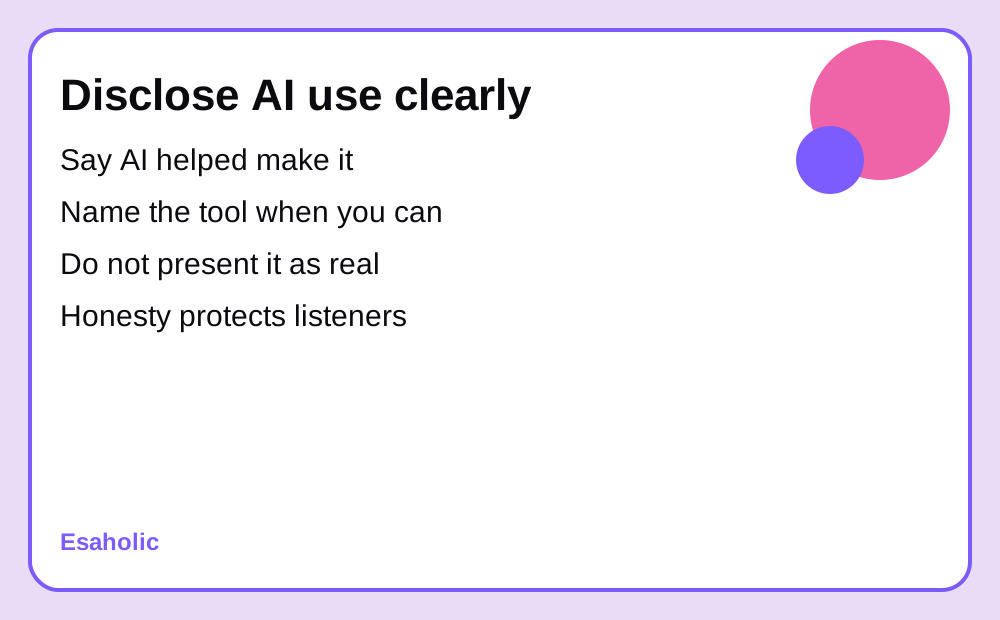
Disclosure should be a habit, not an afterthought. If AI helped make a track, say so in the title, description, or credits, in plain words. Name the tool when you can, and say what it did: beat, backing vocal, mix help, or full generation. Disclosure protects listeners from confusion, protects you from claims that you tried to deceive them, and protects the artists whose work you admire by keeping a clear line between real and generated.
Legal Uses Versus Risky Uses
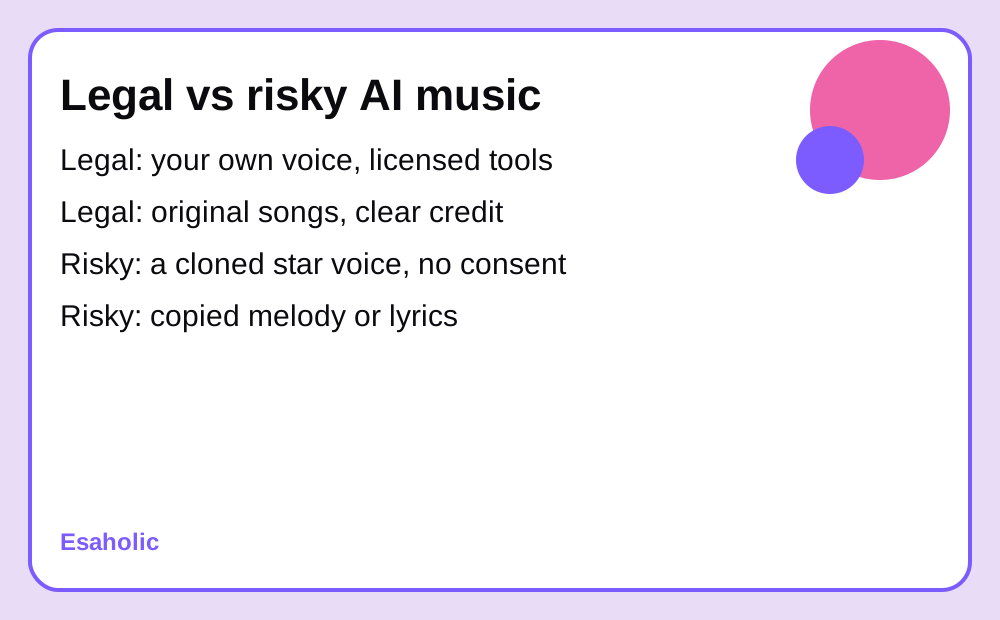
The table below sums up the paths in this guide. It is a general guide, not legal advice. When money, a label deal, or a large audience is involved, talk to a lawyer or a rights expert before you publish.
| Use | General position | Why |
|---|---|---|
| Your own voice, original song | Generally safe | You control the voice and the work |
| Licensed voice model, within its terms | Generally safe if terms allow it | The voice owner agreed to that use |
| Human cover in your own voice, credited | Usually allowed with proper licensing | Credit and license cover the song, voice is yours |
| Cloned star voice, no consent, published | High risk | Voice rights, copyright, and platform rules may all apply |
| Fake release presented as real | High risk | Listeners are misled and the artist's name is misused |
| AI track sold as if a real artist made it | High risk | Fraud and rights problems stack together |
For readers who want to understand how AI tools are built and checked in client work, our generative AI development services explain how teams plan AI features with guardrails and human review, and our AI and ML development services cover the modeling work behind them. For a related guide to how AI pictures raise similar consent questions, see our guide to Vheer AI and image generation, and for how AI roles work in teams, see who a generative AI data scientist is.
Conclusion
Kendrick Lamar AI, as a search phrase, tells us more about fan curiosity and AI power than about any confirmed release. AI voice cloning can copy a recognizable voice from samples, build new vocals from text or melody, and pair them with generated music to make a track that sounds complete. That power makes for fun experiments and serious risks in the same package: fun when it stays private, licensed, or clearly labelled, and risky when it publishes a cloned voice without consent, copies a protected song, or pretends to be a real release.
The fair path forward is clear even while laws keep changing. Check the source before you believe or share a track. Treat unverified AI claims as unverified. Get consent before you publish a real person's voice. Use your own voice or a licensed model for your own experiments. Disclose AI help in plain words. And keep supporting the real artist, whose voice, writing, and choices made the music worth imitating in the first place. AI can help fans imagine new music, but it should never replace the artist it imitates, and it should never fool the listeners who love that artist's work.
Frequently Asked Questions
Has Kendrick Lamar released an AI made song?
This article makes no such claim, because no verified AI made Kendrick Lamar release is cited here. Treat any track labelled as an AI Kendrick song as unverified unless the artist, his label, or a reputable news source confirms it through an official channel.
Can fans legally make an AI song in Kendrick Lamar's voice?
Making and especially publishing a song that clones a real artist's voice without permission carries serious legal risk, because it can breach voice and likeness rights, copyright, and platform rules. Private learning with your own voice or with a licensed tool is a safer path, and publishing a cloned star voice without consent is not a safe default.
How can I tell if a track is AI generated?
Check the official artist channel and label first, look for AI disclosure labels on the platform, and listen for odd breaths, flat emotion, or strange pronunciation. No single clue proves a track is AI made, so use the source and the disclosure together, not one audio detail alone.
Written by Danish Mustafa
Danish Mustafa is an AI systems engineer who writes about AI systems, voice technology, and responsible AI use in plain language. Visit Danish Mustafa's team page.
Reviewed by Amir Iqbal
Amir Iqbal reviews AI content for Esaholic, with a focus on clear, accurate explanations. Visit Amir Iqbal's team page.
Relevant Blogs
Who Is a Generative AI Data Scientist?
A simple guide to the people who build and test generative AI tools.
Vheer AI and Image Generation
How AI image tools work, and how to use them safely.
Predictive Analytics in Supply Chain
How data models help teams plan stock, routes, and demand.
Back to all blog guides · Explore Generative AI Development Services