
Ai Chip News Explained

An AI chip is a processor, which is a piece of hardware that runs calculations, designed to handle the maths behind artificial intelligence quickly. Most AI work comes down to huge numbers of small calculations, done again and again, on lists of numbers that describe words, pictures, or sounds. A normal computer processor can do that maths, but it does it step by step, so large AI jobs run slowly. An AI chip spreads the maths across many small cores, which are tiny calculation units inside a chip, so the work finishes far faster.
Chip news fills headlines because chips shape what AI can do, how much it costs, and who controls it. A new chip announcement may promise faster answers, lower costs, or new features on a phone. A supply story may explain why a product costs more or ships later. A policy story may cover rules on selling powerful chips to certain countries. This guide sorts those stories into plain ideas, so you can follow the news without needing an engineering degree or trusting every peak number in a press release.
You will learn what AI chips do, how the main chip types differ, why training and running a model need different hardware, and who the main players are in general terms. You will also learn how to read an announcement with care, where chips show up in everyday devices, and what to ask before you buy hardware or rent cloud capacity. For background on the hardware idea itself, IBM's guide to AI accelerators explains specialist AI hardware clearly, and our guide on on-device AI news shows what small AI chips do inside phones.
What an AI chip actually does
AI models work with numbers. A language model turns words into number lists, mixes those lists through many layers of maths, and picks the most likely next word. A vision model turns picture dots into number lists, mixes them through layers, and picks the most likely label, such as cat or road sign. Each layer needs millions of multiplications and additions, and a large model may need billions of them for a single answer. A chip built for AI runs those multiplications in parallel, which means many at the same time, instead of one after another.
Memory matters as much as maths. A model holds millions or billions of trained numbers, and the chip must fetch those numbers fast, or the maths units sit idle and wait. That is why chip stories talk about memory size and memory speed, not only about raw calculation speed. Power matters too, because more maths and faster memory need more electricity and produce more heat. A good AI chip balances maths, memory, power, and cost for one kind of job, rather than winning on a single number while failing on the rest.
A simple picture helps: think of a general processor as one brilliant chef cooking dish after dish alone, and an AI chip as a large kitchen where hundreds of cooks each handle one small step at the same time. The large kitchen wins when the recipe repeats the same small steps millions of times, which is exactly what AI maths does. It loses when the job needs varied, one off decisions, which is why general processors still run the rest of a computer.
CPU, GPU, TPU, and NPU in plain terms
A CPU, which stands for central processing unit, is the general brain of a computer. It handles many kinds of work well, from running apps to managing files, but it runs only a few maths tasks at once. A GPU, which stands for graphics processing unit, started life drawing pictures for games, and it holds thousands of small cores that suit parallel maths. That design made GPUs the workhorse of AI training, because training needs the same maths done on huge piles of data, again and again.
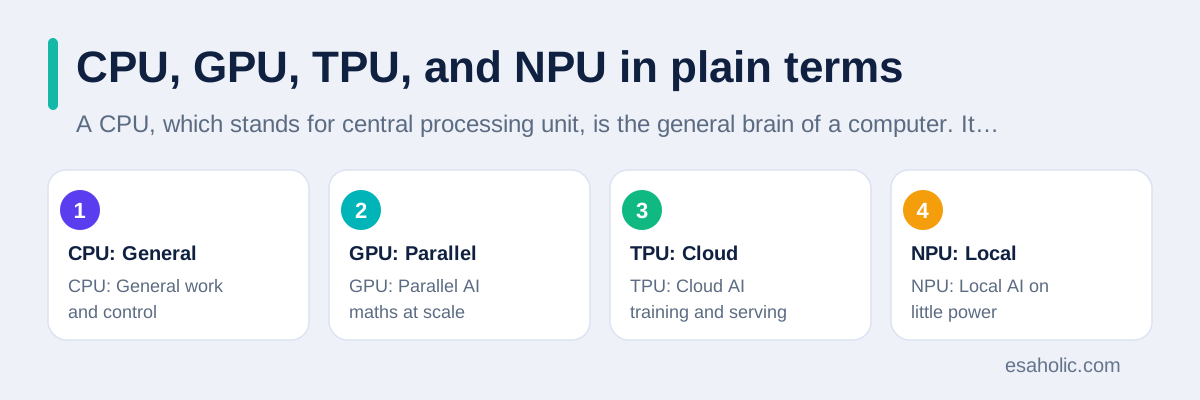
A TPU, which stands for tensor processing unit, is a cloud chip built mainly for AI maths, and a tensor is just a grid of numbers that AI models use. Cloud firms run TPUs inside their own data centres, which are large buildings full of computers, to train and serve their own models. An NPU, which stands for neural processing unit, is a small AI block inside a phone, laptop, or camera, built to run trained models locally with little power. The table below sums up the family, and the key lesson is simple: the right chip depends on the job, the place, and the power budget, not on the newest name.
Device makers also mix chip types inside one product, so a phone may hold a general processor, a graphics block, and an AI block on one chip, with each block handling the work it does best. That mix saves power, because the AI block can run a small model without waking the larger blocks. When a story calls a device an AI phone or an AI PC, it usually means the device carries such a block, not that the whole chip changed.
| Chip type | Best at | Where you meet it |
|---|---|---|
| CPU | General work and control | Every computer and phone |
| GPU | Parallel AI maths at scale | Data centres and gaming PCs |
| TPU | Cloud AI training and serving | Inside a cloud provider |
| NPU | Local AI on little power | Phones, laptops, and cameras |
Training versus inference, and why the split matters
Training means teaching a model. A team feeds a model huge amounts of data, checks its answers, and adjusts its numbers, over many rounds, until it performs well. Training needs the most powerful hardware, the most memory, and the most electricity, and it may run for weeks on many chips at once. Inference means running a trained model for one answer, such as writing a reply, labelling a photo, or transcribing speech. Inference needs far less power per answer, but it runs billions of times, so its total cost still matters a great deal.
Chip news often mixes these two jobs, and that mix causes confusion. A chip built for training may waste money on a simple inference job, while a chip built for phones may fail on a training job. Cloud firms split the work: they train on large clusters, which are groups of many chips working together, and serve answers from chips tuned for speed and cost per answer. When you read a story, ask whether the chip targets training, inference, or both, and ask what workload, which means the exact job and data, the claim actually covers.
Costs split in a useful way: training is a large one off cost to create a model, while inference is a small cost repeated billions of times. A firm may accept a huge training bill if the model then serves cheap answers for years, while a firm with few users may prefer a smaller model that costs less to train and serve. Chip news that only quotes training cost, or only quotes speed per answer, tells half the story, so always ask which side of the split the number covers.
The main players in general terms
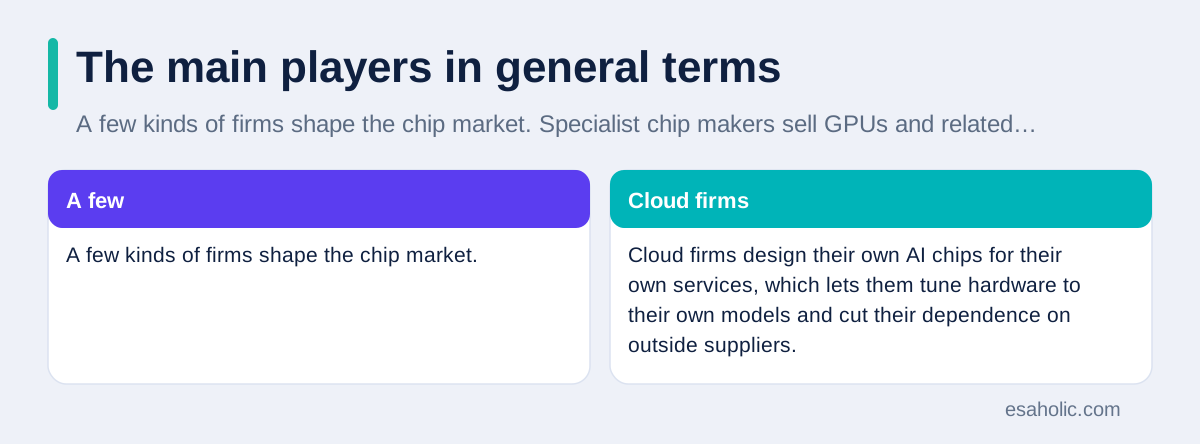
A few kinds of firms shape the chip market. Specialist chip makers sell GPUs and related chips to data centres, cloud firms, and device makers, and they also build the software tools that help developers use those chips well. Cloud firms design their own AI chips for their own services, which lets them tune hardware to their own models and cut their dependence on outside suppliers. Phone and PC makers add AI blocks to their own processors, so devices can run AI features locally without sending every request to the cloud.
Computer makers with long histories in processors also build AI chips for servers and laptops, and a crowd of startups tries new designs for one narrow job, such as fast inference or low power edge work, which means AI running on a device near the user. No single firm wins every job, and partnerships shift often, with firms buying, licensing, and co-designing chips together. For a reader, the player list matters less than the pattern: more firms now design their own AI chips, software support decides whether a chip succeeds, and supply, not only design, often decides who can ship on time. Our guide to the hottest AI startups in Silicon Valley profiles the kind of new firms trying these narrow chip designs.
Software lock in deserves attention too. Developers learn one set of tools, build models around it, and face real work to move elsewhere, so a chip with the best loved tools can hold its lead even when a rival chip looks faster on paper. Open tools and standard formats reduce that lock in, but they rarely remove it fully. When you compare chips, count the cost of retraining staff and rewriting code, not only the price of the hardware itself.
How to read a chip announcement without hype
Chip announcements love peak numbers. A peak number shows the fastest result in a lab test, with ideal data and no real world delays, and it rarely matches daily work. A more honest check asks about a real task: how fast does the chip answer your kind of question, with your kind of data, on a system you can actually buy? Ask about memory too, because a model that does not fit on the chip must fetch numbers from slower storage, and that delay can erase a peak speed advantage. Ask about power, cooling, and price across the whole system, not only the chip alone.
Software support is the quiet test that many stories skip. A chip needs tools, libraries, which are ready made code collections, and model support, so developers can run popular models without rewriting everything. A fast chip with weak software may sit idle while teams struggle to use it, while a slower chip with strong software may ship sooner and cost less to run. Also watch for availability words: announced, sampling, and shipping mean very different things, and a chip that only exists in a lab cannot help your project this quarter. Wait for independent tests on real workloads before you plan around a launch claim.
Benchmarks need the same care as chip claims. A benchmark is a shared test with fixed rules, and a vendor may tune a chip for that test while real work looks different. Ask who ran the test, whether an independent lab confirmed it, and whether the test used your kind of data. A chip that wins one benchmark and loses the next may still suit your job, so match the test to the task before you judge.
Where AI chips show up in everyday life
Phones carry the most familiar AI chips. A phone chip sharpens photos, removes background noise from calls, adds live captions, and runs voice typing, often without sending data to the cloud, which helps privacy and speed. Laptops now carry similar AI blocks, so they can blur video backgrounds, transcribe meetings, and run small local models while the main processor rests. Cameras, doorbells, and factory sensors use small AI chips to spot people, defects, or intruders on the device itself, instead of streaming every frame to a server.
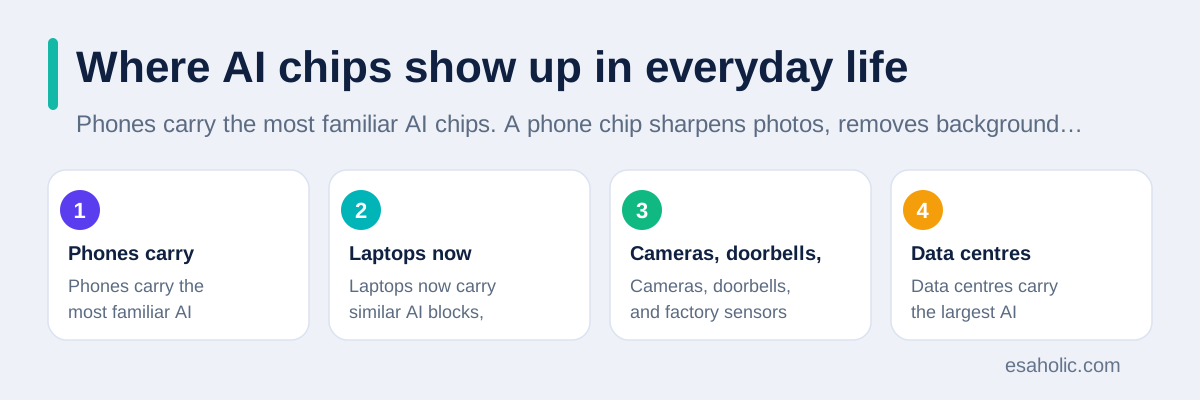
Data centres carry the largest AI chips, and they serve the chatbots, search tools, and creative apps that millions of people use at once. Cars use AI chips to sense roads, read signs, and assist drivers, paired with cameras, radar, and strict safety rules, because a missed object can cause harm. Even a simple voice speaker holds a small AI chip that listens for a wake word, which is the word that wakes the device, before it sends anything further. Chips fade into the background when they work well, and that quiet success is the real story behind most chip news.
Local AI also changes privacy in a plain way: when a model runs on your device, your photos, voice, or notes may never leave the device, while a cloud model must send that data to a server. That local path helps speed too, because the answer does not wait for a network round trip. The trade is model size, because a phone chip cannot hold the largest models, so devices run smaller models locally and send hard questions to the cloud.
Supply, rules, and energy in general terms
Chips depend on a long supply chain, which is the chain of firms that design, build, package, and ship a product. Only a few firms can build the most advanced chips, and only a few places hold the machines and skills to run those factories, so a factory delay, a trade rule, or a shortage of a key part can ripple across the whole market. Governments also set export controls, which are rules that limit selling certain powerful chips or chip making tools to certain countries, and those rules change how firms plan factories and sales. A reader does not need every rule detail, but should know that supply and policy, not only design, shape prices and availability.
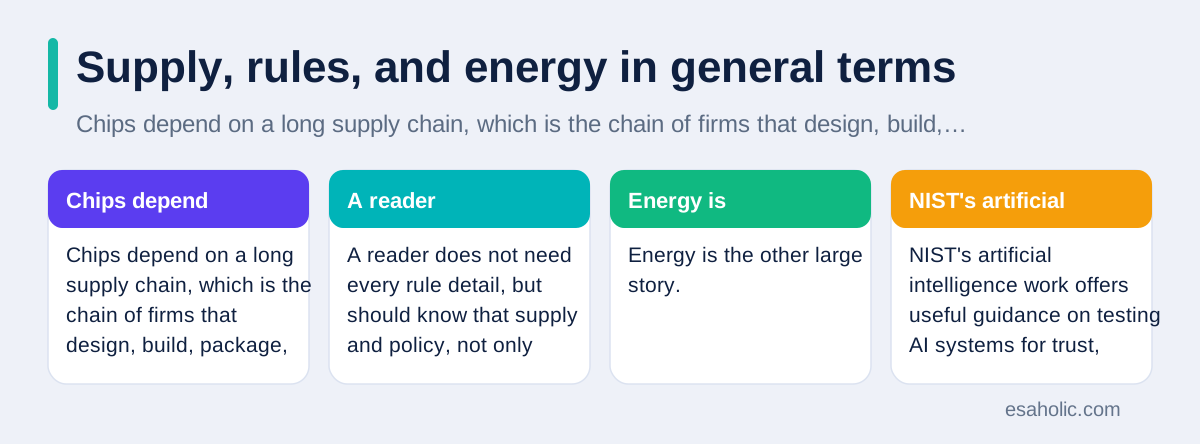
Energy is the other large story. NIST's artificial intelligence work offers useful guidance on testing AI systems for trust, which helps teams judge efficiency claims beside accuracy claims. Training large models and serving billions of answers needs large amounts of electricity, and data centres need cooling as well as power. That is why chip makers stress efficiency, which means more useful work per unit of electricity, and why cloud firms site data centres near cheap power and cooling. For a business, the honest question is total cost: chip price plus power plus cooling plus staff plus the cost of switching later. A chip that looks cheap on a price list can cost more over three years than a pricier chip that sips power and runs your software well.
Water and land use enter the story through data centres, which need cooling and space as well as power. Firms report these impacts in different ways, so a reader should treat any single green claim with care and look for fuller reports that cover power, water, and waste together. Efficiency gains help, but total use still grows when more people use AI more often, so the honest picture covers both the gain per answer and the growth in total answers.
What to ask before you buy or rent AI hardware
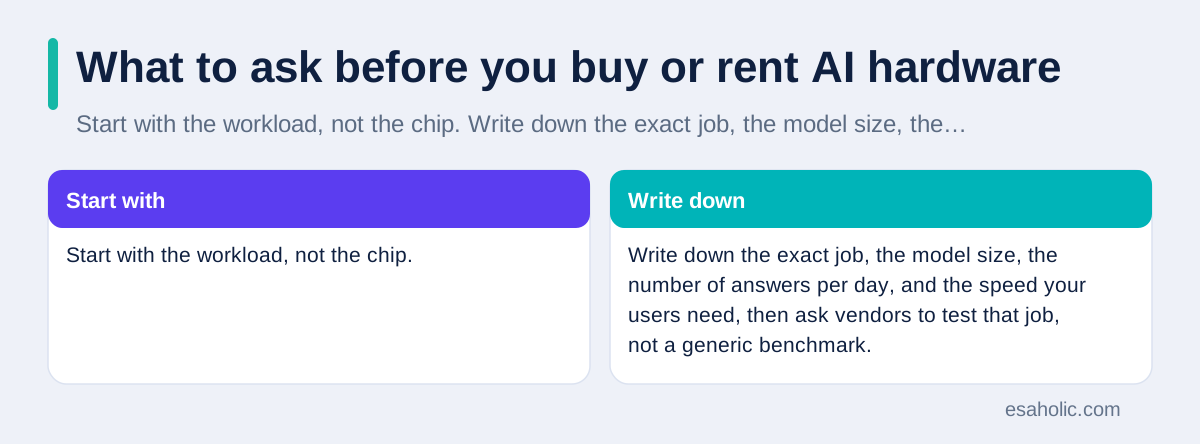
Start with the workload, not the chip. Write down the exact job, the model size, the number of answers per day, and the speed your users need, then ask vendors to test that job, not a generic benchmark. Check software support for your models, check memory fit for your largest model, and check power and cooling for the room or rack where the hardware will live. If you rent cloud capacity instead of buying, compare the price per useful answer, not only the price per hour, because a faster chip that finishes sooner can cost less per answer than a cheaper chip that runs longer.
Plan an exit too. Ask how hard it would be to move your models to another chip or cloud later, and avoid tools that lock you into one supplier with no open path out. Small teams often do best by renting first, learning their real workload, and buying only when the monthly rent clearly exceeds the cost of owning. Our AI and ML development services help teams make that kind of practical choice, and our guide on computer vision research news shows how hardware and research progress feed each other. A calm, workload first choice beats a headline driven purchase almost every time.
A final tip: pilot before you commit. Rent a small amount of capacity, run your real workload for a week, and measure speed, cost per answer, and failure rate. That week of real data beats a month of reading announcements, because it shows how a chip behaves on your data, with your software, under your traffic. Keep the pilot notes, and use them as the baseline for the next chip comparison.
Conclusion
AI chip news makes sense once you separate the job from the headline. Chips run AI maths in parallel, memory and power shape real speed, and training and inference need different hardware. A few kinds of firms build the chips, software decides whether a fast chip proves useful, and supply, rules, and energy shape what you can actually buy. Ask about your own workload, your total cost, and your exit path, and let independent tests, not peak numbers, guide the choice.
Frequently Asked Questions
What does an AI chip do in simple terms?
An AI chip runs the huge piles of small maths calculations behind AI models in parallel, which means many at once, instead of one after another. That parallel design makes training and answering far faster than a general processor alone.
What is the difference between a GPU, a TPU, and an NPU?
A GPU is a parallel processor used widely for AI training and serving, a TPU is a cloud chip built mainly for AI maths inside a provider, and an NPU is a small AI block inside a phone or laptop that runs trained models locally on little power.
How should I judge a new AI chip announcement?
Judge it on a real task like your own workload, on memory fit, on power and cooling, on software support, and on whether independent tests confirm the claim. Peak lab numbers alone do not tell you how the chip will perform for your work.
Written by Amir Iqbal
Senior AI Systems Architect and Lead Technical Reviewer
Amir Iqbal is a senior AI systems architect at Esaholic who leads production readiness checks for agents, model serving, and data systems before they reach real users.
Reviewed by Umar Abbas
Founder, Principal AI Architect and Operator
Umar Abbas is the founder of Esaholic and a principal AI architect who designs reliable large scale AI systems for regulated industries.
Relevant blogs
Computer Vision Research News Explained
What researchers are working on, how to read claims, and where vision work reaches products.
On-Device AI News: Phones, Privacy, And Local AI
How phones run AI locally, why privacy and speed improve, and what limits remain.
Llm News Today: A Guide To Model Updates
A calm guide to large language model news, open versus closed models, and how to read updates without hype.
Uk Ai Regulation News Today 2025: A Review
The UK approach to AI regulation in 2025, its safety themes, and what stayed undecided.
Back to all blog guides · Back to AI News and Regulation guides · Explore AI and ML Development Services