Computer Vision Research News Explained
Computer vision research is the study of how computers learn to understand pictures and video. A camera collects light, but understanding takes more work. A system must find objects, tell them apart, follow movement, and guess what a scene means. Researchers improve each step, and their results appear in news stories, short videos, and product announcements. This guide helps you follow that news without getting swept up by every bold headline.
The field moves fast, and not every announcement means the same thing. Some stories describe a tested method that other teams can repeat. Others describe an early demo, a company claim, or a small test on clean pictures. A careful reader learns to spot the difference. The goal is not to memorize every new model name. The goal is to understand what changed, what stayed hard, and what still needs proof.
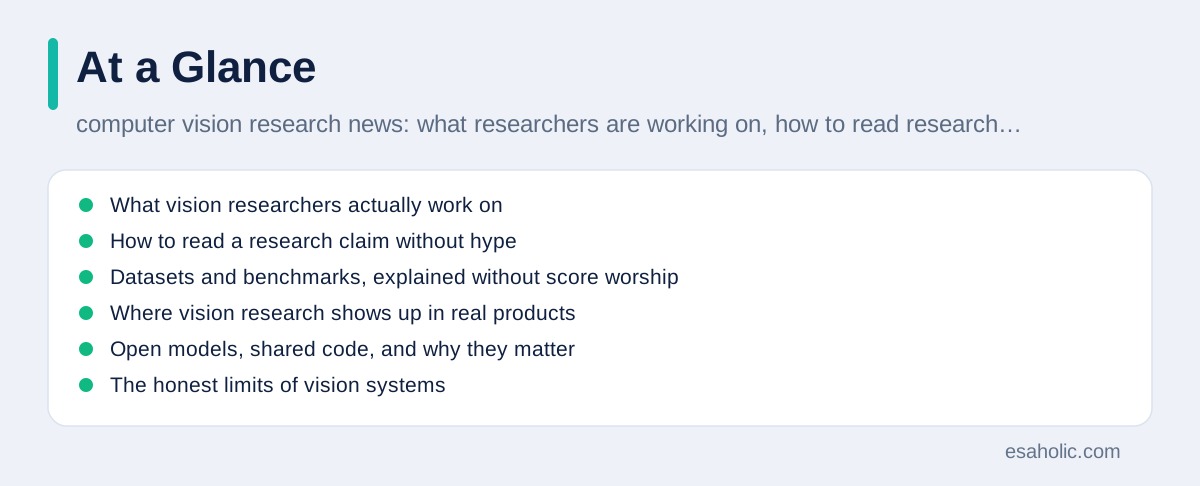
In this guide, you will learn what vision researchers work on, how to read a claim in plain steps, and where the work reaches everyday products. You will also learn the honest limits of vision systems, so you can judge demos with clear eyes. For a solid background on the field itself, IBM's guide to computer vision explains the core ideas in plain language, and our guide on how AI visual search works shows one familiar use in action.
What vision researchers actually work on
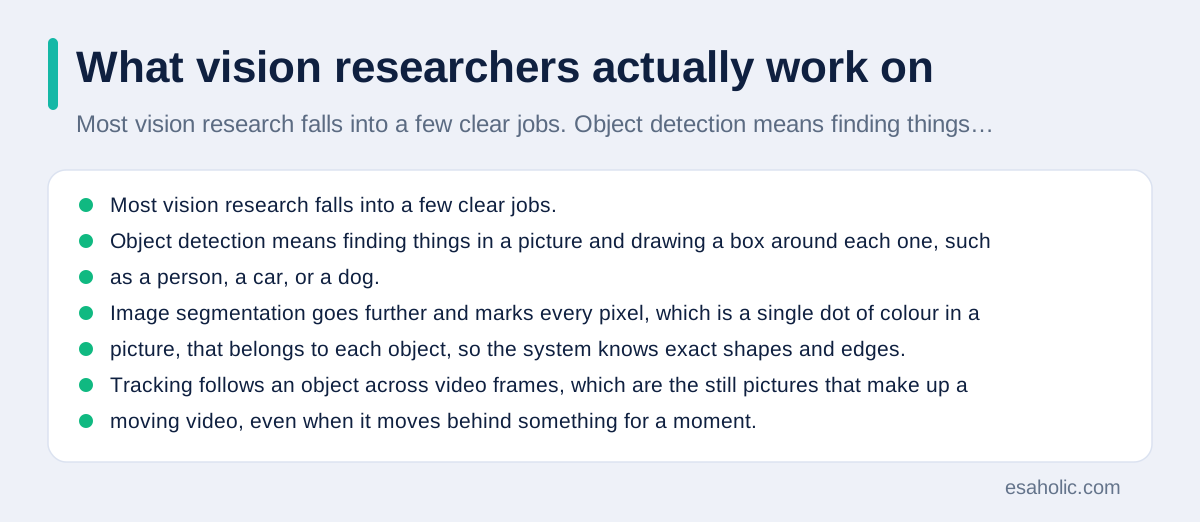
Most vision research falls into a few clear jobs. Object detection means finding things in a picture and drawing a box around each one, such as a person, a car, or a dog. Image segmentation goes further and marks every pixel, which is a single dot of colour in a picture, that belongs to each object, so the system knows exact shapes and edges. Tracking follows an object across video frames, which are the still pictures that make up a moving video, even when it moves behind something for a moment. Each job sounds simple, but real scenes add clutter, shadows, and motion, and that is where the hard research lives.
Other researchers work on depth, which means judging how far away things are from a flat picture, and on scene understanding, which means describing a whole scene in words or in a simple map. Some teams study video, where the system must use time as well as space, so it can tell walking from falling or waving from reaching. Others study how a system can learn from fewer labelled pictures, because labelling means a human marks what each picture shows, and that work costs time and money. When you read a news story, first ask which job it improves, because a win in one job does not mean a win in all jobs.
A useful habit is to sort each story by its stage. An idea stage story describes a method tested on a small set, a validation stage story shows tests on larger and messier data, and a product stage story shows the method working inside a real tool with real users. Most headlines skip the stage, so a reader may treat an idea as a finished product. When you name the stage yourself, the news becomes far less confusing, and you can decide whether to watch, test, or wait.
How to read a research claim without hype
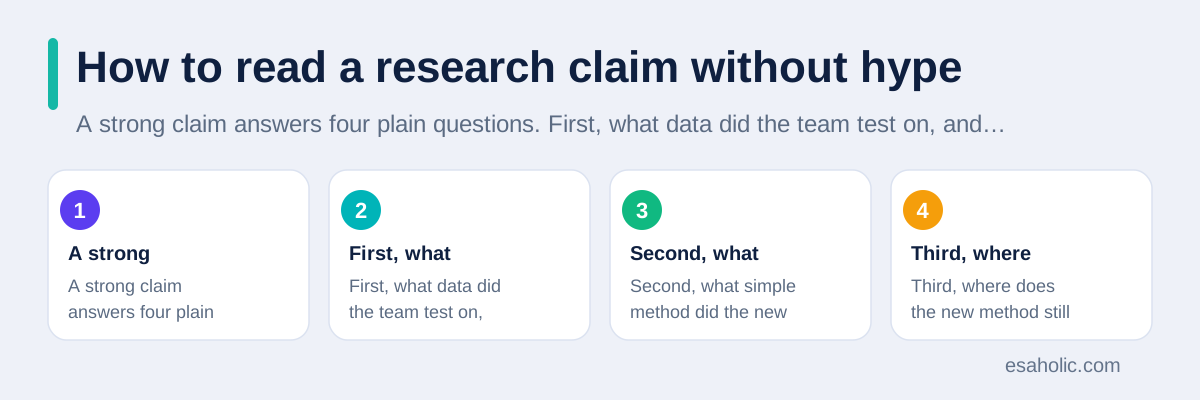
A strong claim answers four plain questions. First, what data did the team test on, and did that data look like real life or like a tidy lab set? Second, what simple method did the new method beat, and by how much, in a fair test? Third, where does the new method still fail, and did the team show those failures honestly? Fourth, can another team repeat the result with the shared code and data, or does the claim rest on one private test? If a story answers none of these questions, treat it as a hint, not as proof.
Watch for words that hide weak evidence. A claim that a method is the best often means it scored highest on one test, not that it works best everywhere. A claim about human level skill often means the test matched one narrow task, not that the system sees like a person. A demo video can also mislead, because a team can pick the best clips and hide the failed tries. Slow down when a story uses superlatives, which are words like best, fastest, or first, without naming the test, the rival method, and the limits. Good research news names those details, even in a short summary.
Another check is the author list and the venue, which is the conference, journal, or preprint server where the work appeared. A preprint, which is a paper shared before formal peer review, can still be strong, but it has not yet passed outside review, so you should read it with extra care. A paper that passed peer review, which means independent experts checked it before publication, still deserves the same four questions, because review checks methods, not future success. Treat venue as context, not as a guarantee, and let the evidence carry the weight.
Datasets and benchmarks, explained without score worship
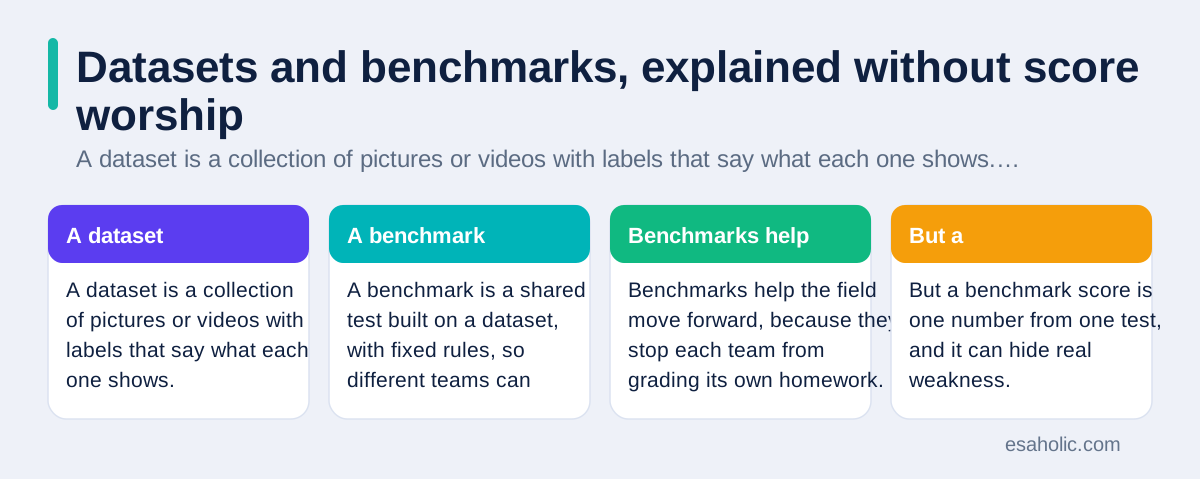
A dataset is a collection of pictures or videos with labels that say what each one shows. A benchmark is a shared test built on a dataset, with fixed rules, so different teams can compare results fairly. Benchmarks help the field move forward, because they stop each team from grading its own homework. But a benchmark score is one number from one test, and it can hide real weakness. A model can top a leaderboard, which is a public ranking of scores, while still failing on rainy roads, dark rooms, or rare objects that the test barely covers.
Ask three questions about any score you see in the news. Did the test include the conditions you care about, such as low light, crowds, or fast motion? Did the team test on fresh pictures the model never saw in training, or could it have memorized similar pictures? Did the score improve a little, which may mean a small step, or a lot, which may mean a real change or a test that favours the new method? A small gain on a hard, realistic test can matter more than a large gain on an easy test. The best news stories say which test they mean and what it leaves out.
Dataset quality also shapes results in ways a single score hides. A dataset may hold many pictures of one kind of scene and few of another, or it may label some objects wrongly, because labelling large sets quickly can introduce errors. A team that cleans its labels, reports its errors, and tests on a second dataset gives you more reason to trust the result than a team that reports only a top score. When a news story mentions a dataset by name, look up what that dataset covers, and ask whether it matches the job you care about.
Where vision research shows up in real products
Vision research reaches products in quiet ways. Phones use it to sharpen portraits, find a photo by a search word, and add live captions, which are written words shown with spoken or video content, for video calls. Factories use cameras to spot defects on fast production lines, where a human eye would tire quickly. Clinics use vision tools to help experts review scans, but a trained clinician still makes the final call. Farms use cameras on tractors and drones to watch crops and spot early signs of disease, so a farmer can act before a problem spreads.
Cars and robots use vision to sense the world around them, but they pair cameras with other sensors and with strict safety rules, because a missed object can cause harm. Shops use vision to count stock, watch shelves, and speed up checkout, while offices use it to read forms and sort documents. If you want to see how these ideas become working systems, our guide on computer vision applications walks through everyday uses, and our computer vision development services describe how teams build such systems with care. The pattern stays the same: research proves an idea, engineers test it in real conditions, and only then does it reach users.
The path from paper to product also includes cost, speed, and maintenance, which news stories often skip. A method that needs a large server may work in a lab but fail on a phone or a small factory computer. A method that needs frequent retraining, which means teaching the model again on new data, may cost more to run than it saves. Engineers test these practical points before a launch, and they often pick a slightly less accurate method that runs fast, costs less, and fails in ways they can predict. That trade is good engineering, not a failure of research.
Open models, shared code, and why they matter
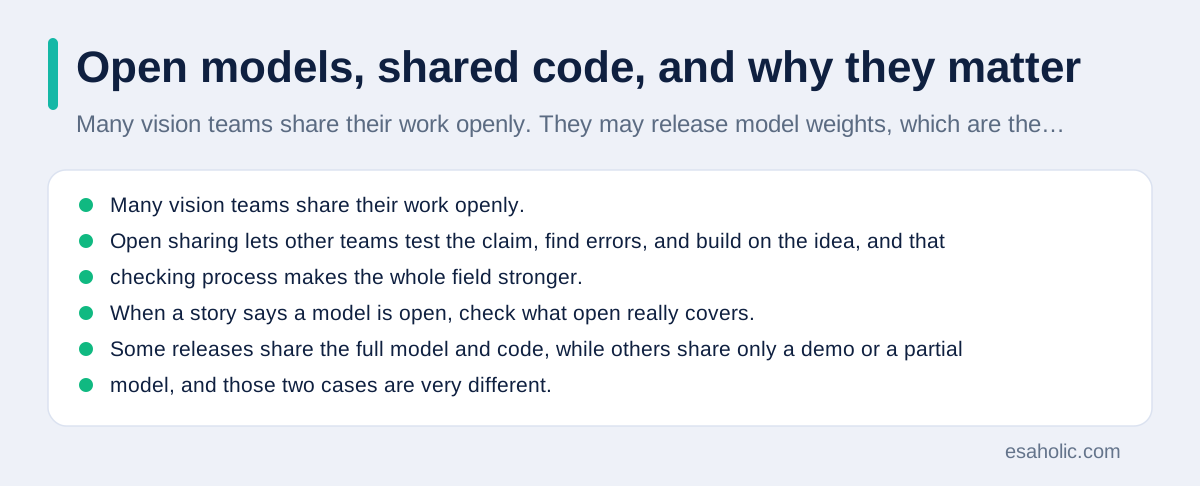
Many vision teams share their work openly. They may release model weights, which are the trained numbers inside a model, plus the code that runs the model, plus a short card that describes the training data and the known limits. Open sharing lets other teams test the claim, find errors, and build on the idea, and that checking process makes the whole field stronger. When a story says a model is open, check what open really covers. Some releases share the full model and code, while others share only a demo or a partial model, and those two cases are very different.
Licences matter too. A licence is a legal note that says what you may do with a model or a dataset, such as use it for research only, or use it in a paid product. A team that plans to use a model at work should read the licence, check the data card for gaps, and test the model on its own pictures before it trusts any public score. Google Cloud's vision documentation shows how a mature vision service describes its features and limits, and that style of plain documentation is a good model for any team. Open work still needs the same care as closed work, because a shared model can still fail on your data.
Shared work also helps small teams compete, because a small team can start from a shared model instead of training one from scratch, which would need huge data and computing power. That head start still leaves real work: the team must test the model on its own pictures, fix its weak spots, and watch it after launch, because real data changes over time. A shared model is a starting point, not a finished product, and teams that treat it that way build more reliable tools than teams that ship it unchanged.
The honest limits of vision systems
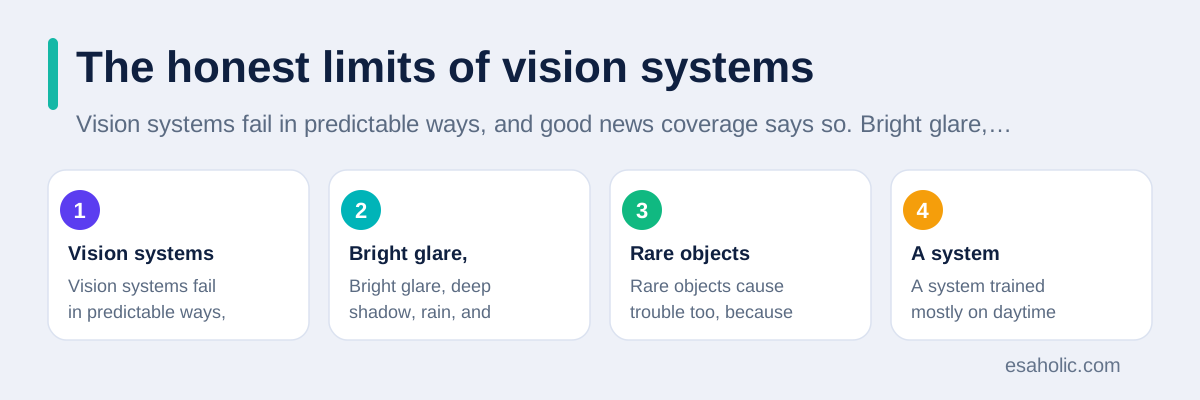
Vision systems fail in predictable ways, and good news coverage says so. Bright glare, deep shadow, rain, and fog can change a picture enough to confuse a model. Rare objects cause trouble too, because a model learns most from common examples and sees few rare ones. A system trained mostly on daytime street scenes may struggle at night, and a system trained on one region may struggle with signs, clothes, or vehicles from another region. These gaps are not a scandal. They are the normal limits of learning from limited data, and naming them helps users plan around them.
Bias is another real limit, and it deserves plain language. Bias means a system works better for some groups of people, places, or objects than for others, often because the training data covered those groups unevenly. That uneven skill can cause real harm, for example when a system misreads some faces more often than others. Privacy matters as well, because cameras collect images of real people, and a team must ask what it stores, who can see it, and how long it keeps it. NIST's artificial intelligence work offers useful guidance on testing AI systems for trust, and teams should treat fairness and privacy as design work, not as an afterthought.
Safety testing should cover the cases that matter most, not only the cases that are easy to test. A team building a tool for roads should test night driving, heavy rain, and unusual vehicles, even if those tests are hard to run. A team building a tool for people should test many ages, skin tones, clothes, and settings, and it should report where results differ. A news story that only quotes an average score hides those differences, so ask for results split by condition and by group. Averages can look good while a specific group still gets poor results.
Questions to ask before you trust a demo
A demo can teach you a lot if you ask the right questions. Ask what the demo left out, such as failed tries, slow cases, or hard lighting. Ask whether the system ran live, with no editing, or whether the team recorded the best run and cut the rest. Ask how much human help the demo needed, such as a person picking the right frame or fixing the result. Ask what happens when the input changes a little, because a system that breaks on a small change may not survive real use. A team that answers these questions clearly earns more trust than a team that shows only a polished clip.
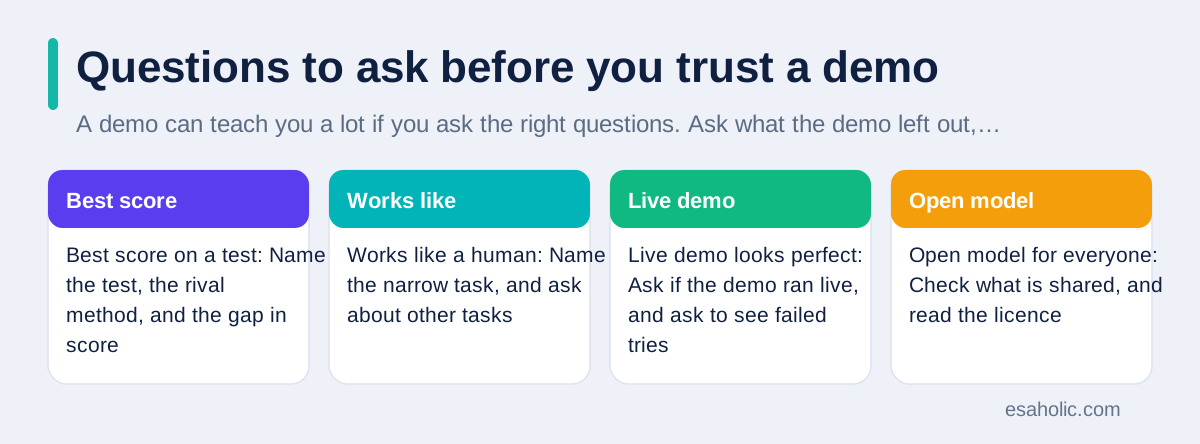
The table below turns those questions into a quick checklist you can use for any news story or product video. Keep it beside you the next time a headline promises a breakthrough, and use it to sort real progress from marketing. If a story fails most of the checklist, you can still enjoy the idea, but you should wait for independent tests before you plan work around it. That patience saves money, time, and embarrassment, and it rewards the teams that publish honest results.
Independent testing adds the strongest check of all. When a second team, a journalist, or a customer tries the same method on fresh data and gets a similar result, the claim grows stronger. When independent tests fail, the original team learns where its method breaks, and the field learns too, even if the headline fades. You can look for independent tests in follow up stories, in open code comments, and in honest product reviews that describe real use. A claim with no independent test is not false, but it is unfinished, and you should treat it that way.
| Claim in the story | Quick check you can run |
|---|---|
| Best score on a test | Name the test, the rival method, and the gap in score |
| Works like a human | Name the narrow task, and ask about other tasks |
| Live demo looks perfect | Ask if the demo ran live, and ask to see failed tries |
| Open model for everyone | Check what is shared, and read the licence |
| Ready for hospitals or cars | Ask who tested it in real conditions, and who stays responsible |
A calm routine for following the field
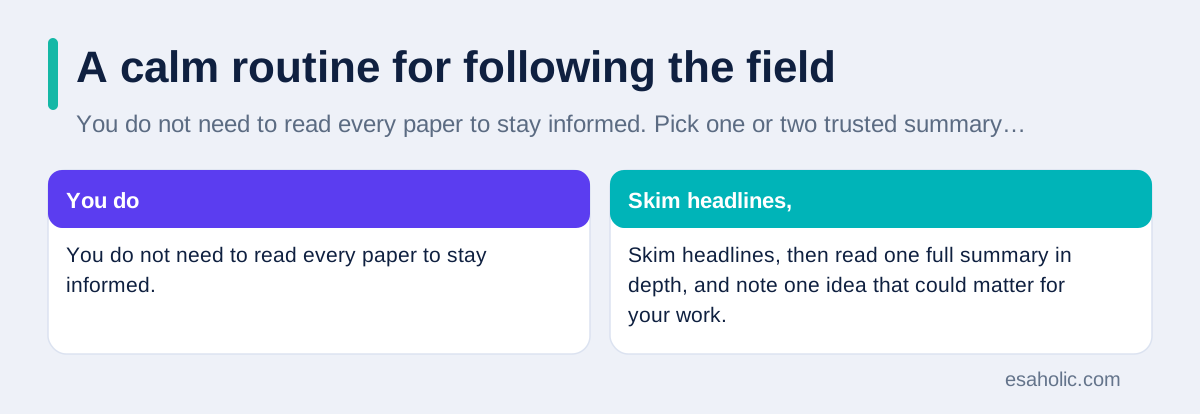
You do not need to read every paper to stay informed. Pick one or two trusted summary sources, such as a university lab page, a respected research blog, or a news outlet that names tests and limits, and check them on a fixed day each week. Skim headlines, then read one full summary in depth, and note one idea that could matter for your work. Skip sources that only repeat press releases, because they add noise without adding checks. Over a month, that small habit builds a clearer picture than a frantic day of catching up on dozens of stories.
Keep a simple note for each story you trust: the job it improves, the test it used, the limit the team named, and whether another team repeated it. After a few months, you will see patterns, such as which labs publish careful work, which jobs improve fastest, and which claims fade when independent tests arrive. You can also follow related news with the same calm method, such as our guides on on-device AI news and creative tools news, which cover how models reach phones and creative work. The field will keep moving, but a steady routine keeps you ahead of the hype without stealing your week.
Finally, keep your routine small enough to survive a busy week. A routine that asks for an hour a day will collapse, while a routine that asks for twenty minutes a week will last. Save links that proved useful, delete sources that only hype, and review your notes once a month to see which ideas still matter. Over time, your own notes become a better guide than any single news feed, because they reflect your work, your users, and the tests you actually ran.
Conclusion
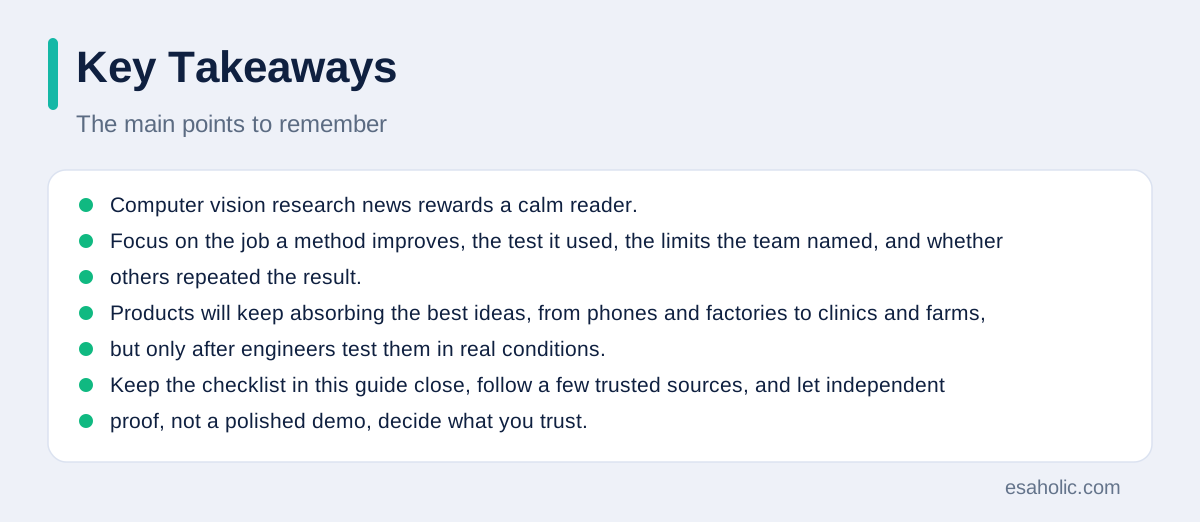
Computer vision research news rewards a calm reader. Focus on the job a method improves, the test it used, the limits the team named, and whether others repeated the result. Products will keep absorbing the best ideas, from phones and factories to clinics and farms, but only after engineers test them in real conditions. Keep the checklist in this guide close, follow a few trusted sources, and let independent proof, not a polished demo, decide what you trust.
Frequently Asked Questions
What is computer vision research news in simple terms?
Computer vision research news covers new methods that help computers understand pictures and video, such as finding objects, tracking movement, and describing scenes. Good coverage names the job improved, the test used, and the limits that remain.
How can I tell if a vision research claim is trustworthy?
Check the test data, the simple method it beat, the failures the team showed, and whether another team repeated the result with shared code. A claim that answers those questions is far more trustworthy than a headline alone.
Where does vision research reach everyday life?
Vision research reaches phones, factories, clinics, farms, shops, cars, and robots, usually after engineers test it in real conditions. Phones sharpen portraits and search photos, factories spot defects, and clinics help experts review scans with a human still in charge.
Written by Ahmad Jajja
Senior AI Research Engineer and Generative AI Specialist
Ahmad Jajja is a senior AI research engineer at Esaholic who specializes in generative AI and data systems grounded in real documents.
Reviewed by Danish Mustafa
Senior Agentic AI Engineer and Systems Architect
Danish Mustafa is a senior agentic AI engineer at Esaholic who designs multi-step AI systems with clear steps, safe limits, and human approval for high stakes actions.
Relevant blogs
Computer Vision Applications: Where Cameras Help Work
Where cameras and vision models help in phones, factories, clinics, and shops.
On-Device AI News: Phones, Privacy, And Local AI
How phones run AI locally, why privacy and speed improve, and what limits remain.
Ai Creative Tools News: Image, Video, Music
What is new in image, video, music, and design tools, their honest limits, and the rights rules that matter.
Ai Chip News: A Plain Guide To AI Hardware
What AI chips do, why they matter, and how to read chip announcements without hype.
Back to all blog guides · Back to AI News and Regulation guides · Explore AI and ML Development Services