✦ Esaholic Computer Vision Team

Computer Vision Development Services That See Your Work Clearly

We provide computer vision development services that turn photos, scans, and video into reliable answers for your business. We build systems that inspect products, read documents, count objects, and flag problems early, then prove the results on your own images before launch.

Inspection preview, built from your image types

This is a static preview of the kind of result your system would return. It is not a live model.

✓ Defect foundLocation: top edgeConfidence: high
Result · With review note

Outcome: Send to review. The mark on the top edge matches a known defect pattern, so a person should confirm before the item moves on.

Every result carries its reason and its confidence level, so your team can check it in seconds.

✦ The Cost of Looking by Hand

Manual image review slows you down. Tested vision systems do not.

When every image waits for a person, backlogs grow and small faults slip through. A tested system clears the routine cases and sends only the uncertain ones to your team.

×

Review by hand, every time

Staff open image after image, compare each one from memory, and type results into another tool. Tired eyes miss small defects, and the same document can be read differently by two people. When volume rises, the queue grows, follow up slips, and your team spends its day on looking instead of deciding.

✓

A production vision approach

Our computer vision development services start with your real images and a clear task. We train and test a model on those images, show you the errors openly, and set review rules for uncertain cases. Routine images pass quickly, doubtful images go to a person, and every decision stays logged so you can trace it later.

As a computer vision development company, we do not sell a generic demo and hope it fits. We scope one task, agree on how success will be measured, and build only what your images can support. If a task is not ready for automation, we tell you during discovery and suggest the smaller step that is ready.

✦ Specialized Services

Specialized computer vision services built around your images

Each service below is a complete project type. Pick the one task that costs you the most time, and we build for that task first.

◉

Quality inspection and defect detection

Our visual inspection services check products on a line or in photos for scratches, cracks, missing parts, and wrong labels. The system flags suspect items, marks the fault location, and sends only those items to a person for a final call.

▤

Document and ID scanning with OCR

Our OCR services read invoices, forms, and ID documents and turn them into structured data your systems can use. OCR, short for optical character recognition, reads printed text from an image. Unclear fields are flagged for review instead of being guessed.

▣

Object detection and counting

Our object detection services find and count items in photos or video, from stock on a shelf to vehicles in a yard. You receive clear totals, a visual record of what was counted, and alerts when a count falls outside the range you set.

⌕

Visual search for catalogs

Customers upload a photo and find matching or similar products in your catalog, even when they do not know the product name. We build the search index from your own catalog images, so results stay tied to stock you actually sell.

⬢

Safety and access checks

Vision checks can confirm protective gear, spot blocked exits, or support entry checks at controlled areas. These checks assist your staff and never replace your safety policy. Sensitive cases always go to a trained person for the final decision.

✂

Image segmentation for precise measurement

Our image segmentation services separate each part of an image, pixel by pixel, so you can measure area, size, or damage with more precision than a simple box allows. This suits inspection, medical imaging support, and catalog work where exact outlines matter.

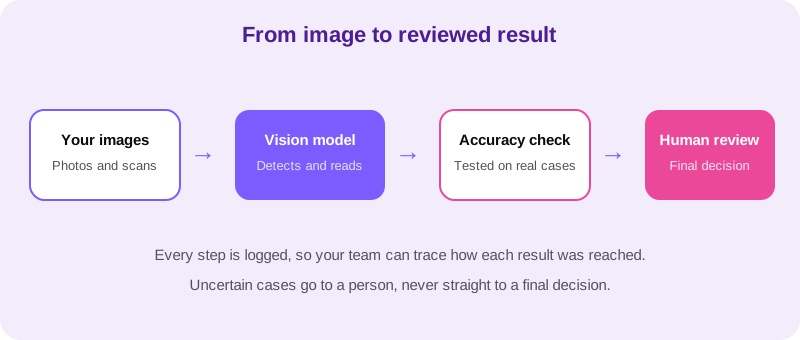
Computer vision development services pipeline showing image capture, detection, testing, and human review.
From image to reviewed result: your images pass through detection, an accuracy check, and human review before any final decision.
✦ Where It Pays Off

Business use cases where vision work earns its keep

Vision systems work best on work that repeats, follows a visible pattern, and creates a backlog when done by hand.

▦

Manufacturing and quality teams

Inspect every unit on the line instead of sampling a few. Defects are caught at the station where they happen, rework is logged with a photo record, and your quality team reviews only the borderline cases.

▤

Operations and back office teams

Turn piles of scanned invoices, forms, and delivery notes into clean data without retyping. Staff check the flagged fields only, and the rest flows into your existing systems in the format they already use.

▣

Retail, warehouse, and catalog teams

Count stock from photos, check shelf layout, and let shoppers search by image. Your team spends less time on manual counts and more time on stock decisions that actually need judgment.

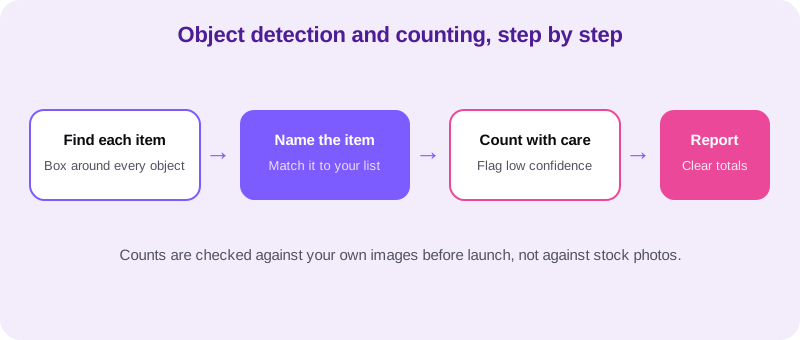
Object detection services showing how items are found, named, counted, and reported with checks.
Object detection in plain steps: find each item, name it, count it, and report the total with low confidence cases flagged.

Custom computer vision solutions fit best when the task is visible, repeated, and costly to delay. If your images vary wildly, change every week, or need deep human judgment on every case, we say so early and scope a narrower task that can succeed.

✦ Capabilities and Tools

Core capabilities and a toolset chosen for your task

We pick tools after we see your images, not before. The options below are the ones we use most, and each is explained in plain terms.

◉

Image recognition and classification

Image recognition services sort images into the categories you define, such as product type, damage type, or document type. This is the base step for routing, reporting, and triage.

⬢

Object detection with YOLO and OpenCV

We use proven frameworks such as YOLO for fast detection and OpenCV for image handling. YOLO finds objects in a single pass, which suits live video and fast lines, while OpenCV prepares and cleans images before they are analyzed.

▤

OCR and document understanding

Beyond reading single words, our OCR services find fields such as totals, dates, and ID numbers, then check them against your rules. Handwriting and poor scans get lower confidence scores and go to review.

≡

Models built on TensorFlow and PyTorch

Convolutional neural networks, a model type designed to learn visual patterns layer by layer, are built with TensorFlow or PyTorch. We choose the framework that fits your deployment, your team, and your update plan, and we document that choice.

⬡

Edge deployment for fast, local answers

Edge deployment runs the model on a device near the camera, so images stay local and answers arrive fast. This suits factory lines, secure sites, and places with weak internet, and it keeps sensitive images off the public cloud.

☁

Cloud deployment on AWS, Azure, and Google Cloud

When workloads vary or teams work from many sites, we deploy on AWS, Microsoft Azure, or Google Cloud. Cloud hosting makes updates easier and scales with demand, while access controls and logging stay under your rules.

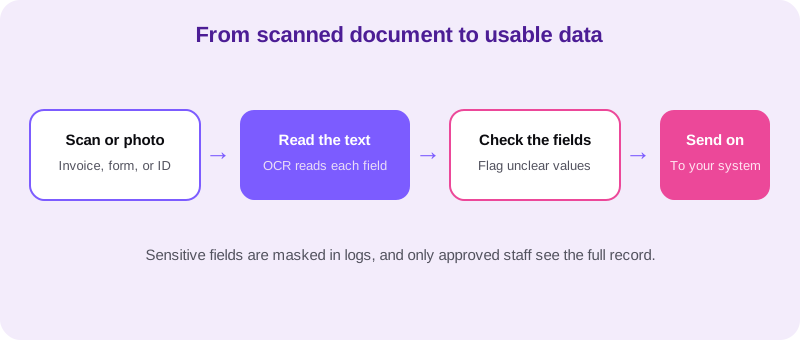
OCR services showing how a scanned document is read, checked, and sent to your system.
Document reading in plain steps: scan, read each field, flag unclear values, and send clean data to your system.
✦ Testing Before Launch

How we prove accuracy on your own images before launch

Many vision demos look strong on stock photos and fail on real work. Your lighting, angles, and product range are different, so we test on your images from the start. During discovery you share a sample set that covers normal cases, hard cases, and the edge cases your team already knows about.

We label that set with your team, agree on what counts as correct, and run the first model against images it has never seen. You receive a clear error report that shows misses, false alarms, and the exact images behind each error type. That report, not a sales claim, is what you approve before the full build goes ahead.

After launch, testing does not stop. New images are sampled and checked, drift in accuracy is watched, and the model is retrained on approved examples when your products or documents change. If accuracy falls below the agreed level, the system routes more cases to human review until it is fixed.

✦ Edge or Cloud

Where your vision system should run: edge or cloud

Both options are valid. The right choice follows your speed needs, your privacy rules, and your budget for upkeep.

What to compareEdge deploymentCloud deployment
SpeedFastest answers, since images are processed beside the camera.Fast for most tasks, but depends on upload speed and connection.
PrivacyImages can stay on your site and off the public cloud.Images travel to the cloud, so access controls and retention rules matter more.
UpdatesUpdates reach each device on a schedule you approve.One update reaches every user at once, which suits fast change.
ScaleBest when camera sites are fixed and known in advance.Best when volume varies or new sites open often.
Cost shapeMore device cost up front, steadier running cost after.Lower start cost, running cost that rises with volume.

Some projects use both: fast edge checks on site, with cloud review and retraining behind them. We recommend the mix only when it clearly beats either option alone for your task.

✦ Honest Limits

Accuracy, limits, and the human review that keeps results trustworthy

No vision system is right every time, and any vendor who claims otherwise should be challenged. Poor light, glare, blur, new product variants, and damaged documents all lower accuracy, so we design for those cases instead of pretending they will not happen.

Every result carries a confidence level. High confidence results can pass automatically when you approve that rule. Low confidence results go to a person, with the image, the reason for doubt, and the suggested action shown together. Your team makes the final call on sensitive cases, including safety checks, identity checks, and any decision that affects a customer.

Compliance readiness is built the same way. We support data handling rules you set, limit who can see sensitive images, mask sensitive fields in logs, and keep an audit trail of results and reviews. This is readiness support for your own policies, not a certification claim, and your legal team reviews the final setup before launch.
✦ Delivery Process

From image collection to a system your team can trust

Five phases, with an approval point at the end of each one. Nothing moves to the next phase until you approve it.

1

Define the task

We agree on one task, the image types, and how success will be measured. You approve the scope before any model work starts.

2

Collect and label images

You share real images, including hard cases. We help label them with your team and confirm the labels before training begins.

3

Build and test the first model

We train a first model and test it on unseen images. You approve the error report before we expand the build.

4

Deploy with review rules

We deploy on edge or cloud, connect your tools, and set confidence thresholds and review queues. You approve the live setup in a pilot run.

5

Launch and support

We monitor accuracy, retrain on approved examples, and fix issues under the agreed support plan. You approve each model update before it goes live.

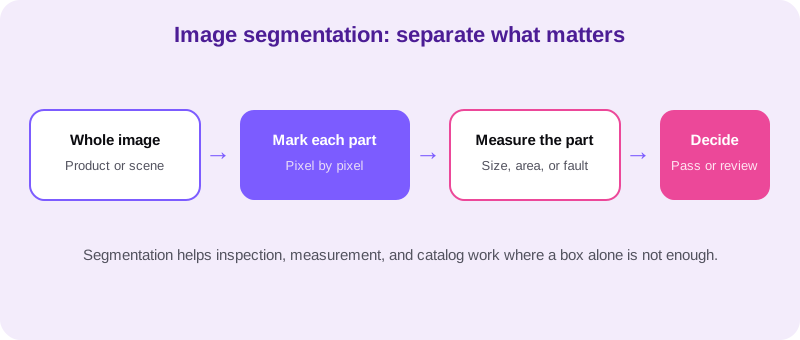
Image segmentation services showing how each part of an image is marked, measured, and decided.
Segmentation in plain steps: mark each part of the image, measure what matters, and pass or send the case to review.
✦ Deliverables

What you receive when your vision system goes live

No vague solution. A working system, clear records, and a team that knows how to run it.

⬢

The working system and model

The deployed vision system, the trained model built for your task, and the review screens your team uses every day. You own the code and the model.

≡

Test results and error report

The full test set results, the error breakdown by case type, and the confidence rules in plain language, so future decisions stay grounded in evidence.

▤

Documentation and training

Setup guides, review procedures, and short training for your staff, covering daily use, edge cases, and what to do when a result looks wrong.

✓

Support after launch

Monitoring, fixes, and retraining under an agreed support plan. Model updates are approved by you before they reach production.

✦ Engagement

How we scope, price, and support your project

Every project starts with a free consultation. Bring one task and a sample of your images, and we will tell you whether vision automation fits, what test we would run first, and what the first phase would cover. If the task is not a fit, we say so and suggest the closest useful step.

After discovery, we agree on a fixed scope and a fixed price before build work starts. The scope names the task, the image types, the accuracy checks, the review rules, the deployment choice, and the support period. Changes later are agreed in writing, with the price, before work on the change begins.

Support after launch covers monitoring, fixes, and retraining on approved examples. You can pause or end support under the agreed terms, and everything we built stays yours, with documentation your team can use on its own.

✦ FAQs · Computer Vision Development Services

Computer vision questions buyers ask before they start

What do computer vision development services include?

We build software that understands images and video for a defined business task. That can mean inspecting products, reading documents, counting objects, searching a catalog by image, or checking a safety rule. You receive a working system, tested on your own images, with clear rules for human review and a record of every result.

How accurate will the system be on my images?

We do not promise a number before testing. During discovery we test on your own images and give you a clear error report that shows what the system got right, what it missed, and which cases still need a person. You approve the accuracy target and the review rules before we build the full system.

Do I need thousands of labeled images to start?

Not always. Some tasks start well with a smaller set of good examples, and some need more. We review your images first, tell you honestly what is missing, and help you label the examples that matter most. If your data cannot support the task yet, we say so before you spend on a full build.

Should the system run on site or in the cloud?

It depends on speed, privacy, and cost. On site or edge deployment keeps images local and answers fast, which suits factory lines and secure sites. Cloud deployment suits varied workloads and easier updates. We compare both for your task and recommend the option that fits your limits.

Who owns the system and the trained model?

You do. The code, the trained model built for your task, the test results, and the documentation are yours. We hand over everything your team needs to run, update, and review the system, and we support you after launch if you want continued help.

How is the price set for a computer vision project?

After a free consultation and a short discovery, we agree on a fixed scope and a fixed price. The scope covers the task, the image types, the accuracy checks, the review rules, and the support period. If the scope changes later, we agree on the change and the price before work starts.

Start with a free consultation.

Bring one task and a sample of your images. Leave with a clear test plan and a fixed scope.

[email protected] →

Or book directly at /contact/. We serve businesses in the United States, delivered remotely.