◎
Monitoring and alerts
We provide monitoring and updates services that watch uptime, errors and slow pages, and raise an alert when something needs attention. Problems are seen early, before most users notice them.
We provide support and maintenance services for software, websites and AI tools after launch. We monitor your product, fix problems in priority order, apply updates safely, and report every change in plain terms.
This is a static preview, not a live dashboard. It shows the kind of clear summary your monthly report would use.
Your report would list your product, your systems and your agreed priorities.
A launch feels like a finish line, but a live product keeps changing from the day it goes live. Models drift as your content and your questions change. APIs change, sometimes with little warning. Rules change, content goes out of date, and small bugs appear only when real users meet real data. A product that is not maintained slowly loses the trust it earned at launch.
That is why support matters as much as the build. Our managed support services treat the live product as a working asset that needs regular care. We watch it, fix it, update it and review it, so small problems stay small. Your team keeps using the product with confidence, and your customers keep seeing a tool that works.
Support is not a help desk alone. It is a steady service that covers the product, its data, its integrations and its AI parts together. When one part changes, we check the effect on the rest before anything goes live. That joined up care is what keeps a product healthy month after month, instead of patched in a rush when something breaks.
Every product needs a different mix of care. A website needs content updates and security patches. A business tool needs bug fixes and integration checks. An AI tool needs model updates and output checks. The six scope types below describe what our support and maintenance services cover, and your monthly plan picks the mix your product actually needs.
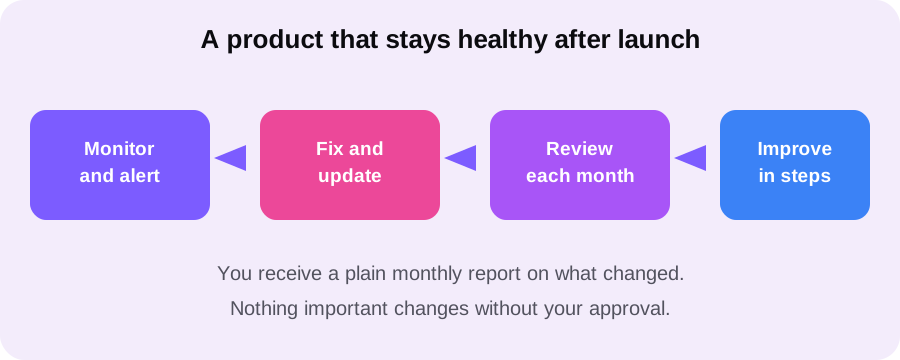
We provide monitoring and updates services that watch uptime, errors and slow pages, and raise an alert when something needs attention. Problems are seen early, before most users notice them.
We fix bugs in priority order, starting with problems that stop work or affect customers. Each fix is tested against real examples before it reaches the live product, and the change is recorded.
We apply security updates for the platform, libraries and plugins your product uses. Updates are tested first, so a patch does not break a workflow your team depends on.
We provide AI support services that cover model updates, prompt and retrieval checks, and content updates. As your documents and questions change, outputs are tested again so answers stay accurate.
We check API changes and connected systems on a regular basis. When a provider changes a field, a limit or a login step, we adapt the integration and test it before users are affected.
We use part of each month for small improvements, such as clearer screens, better forms or faster steps. Larger features stay separate project work, agreed in writing before they start.
We do not set a monthly plan price until we know what we are supporting. The health check is the first step, for products we built and for products another team built. It gives both sides a clear picture before any ongoing work is agreed.
During a health check, we review the code and hosting, the data and backups, the integrations, the access rules, and any AI parts such as models, prompts and retrieval setup. We look for risks that need urgent attention, such as missing backups or outdated security patches, and for smaller issues that can join the monthly plan. The report is written in plain terms, with each finding, its effect, and a suggested next step.
After the health check, you receive a proposed monthly plan with a price set after that check. The plan states what is included, how issues are prioritized, and what counts as separate project work. If the product cannot be supported safely, we say so in the report and outline what would be needed first. You decide whether to proceed, with full information and no pressure.
When something goes wrong, the first question is how serious it is. Incident triage starts with impact: who is affected, what work has stopped, and whether customer data is at risk. We agree the priority with you, so urgent work is never delayed by a small task, and small tasks are never lost because an urgent one arrived.
Each fix follows the same steps. We reproduce the problem, find the cause, and test the fix against real examples before it reaches the live product. If a fix needs a change to how users work, we agree that change with you first. If a fix needs more work than the monthly plan covers, we say so before starting, so there is no surprise in the report.
Reporting closes the loop. Your monthly report lists what was monitored, what was fixed, what was updated, and what is planned next. Audit logs show who changed what, which supports reviews and helps your team answer questions about the product with evidence, not memory.
Security and backup handling work best when they are routine, not a response to a crisis. Our application support services treat them as part of every month, with checks your team can see in the monthly report.
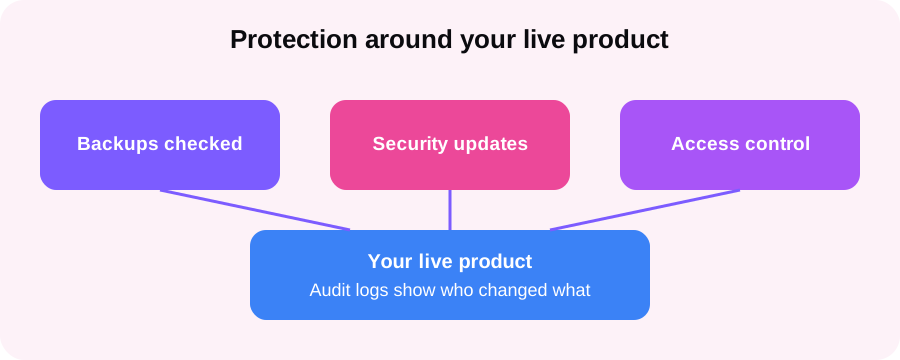
We check that backups run and that they can be restored, not only that a backup job was started. If a backup fails, it joins the fix list at once, because an untested backup is not a safety net.
We apply security updates in a test step before the live product, and we record which version changed and why. That record helps your team show reviewers that patches are applied on time.
We maintain role-based access, so each person sees only the records their job requires. When team members join or leave, access changes are part of the monthly work, not an afterthought.
We keep audit logs of important changes, so your team can see who changed what and when. Logs support internal reviews and help trace a problem back to its cause.
We review API keys and integration access on a regular basis, and rotate or remove access that is no longer needed. Old access is a common risk, and it is easy to overlook without a monthly check.
We provide website maintenance services as part of application support, covering content updates, form checks, broken links and plugin updates, so a public site stays accurate and working.
A support plan works when the rhythm is steady. Checks run through the month, fixes follow priority, updates are tested before release, and the month ends with a report you can read in a few minutes. That rhythm stops small issues from growing into urgent rebuilds.
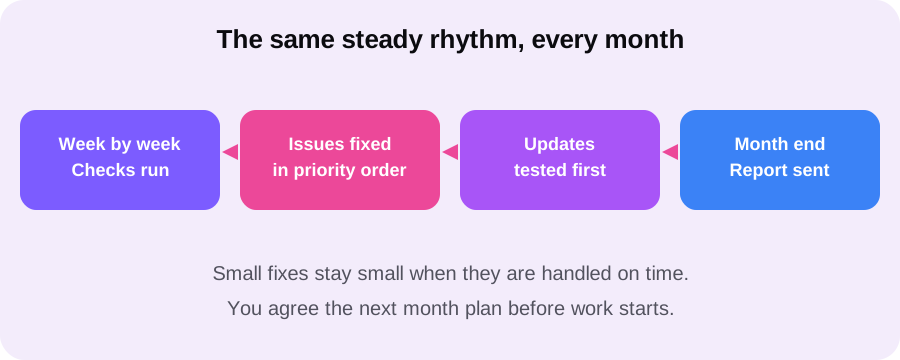
Monitoring and alerts run through the month, covering uptime, errors, slow pages and failed integrations, so problems are seen early.
Issues are triaged with you, fixed against real examples, and tested before release. Urgent issues come first, and user-facing changes are agreed first.
Security updates, model updates, content updates and API changes are tested in a safe step before the live product, with a rollback step if needed.
Each month ends with a review: what changed, what is still open, and what the next month should cover. You agree the next month plan before work starts.
Support also covers the difference between a maintained product and one that is left alone. A maintained product adapts as APIs change, as models drift and as rules change. A neglected product keeps working until one change breaks it, and then the fix is urgent, expensive and rushed. A monthly plan spreads that work into small, planned steps.
A monthly plan should be easy to check. You receive the same set of items each month, so you can see what was done, what changed, and what comes next, without chasing updates.
A plain summary of uptime, errors and alerts for the month, with any problem that needed action and how it was resolved.
A list of every fix and update applied, with what changed, why it changed, and which part of the product it affects.
Confirmation that backups were checked and security updates were applied, with any open risk noted and a plan to close it.
An agreed plan for the next month, covering open issues, planned updates and small improvements, so work starts with your approval.
The right plan depends on the product, not on a standard package. A small website needs a lighter plan than a business tool with many integrations, and an AI tool needs model and output checks that a plain website does not. The health check is what lets us match the plan to the product.
| What to compare | With Esaholic | Typical ad hoc support |
|---|---|---|
| Monitoring | Watched through the month, with alerts | Checked only when someone reports a problem |
| Fixes | Triaged with you, in priority order | Fixed in the order they arrive, however urgent |
| Updates | Tested first, then released, with a record | Applied when time allows, with no test step |
| Backups | Checked for restore, every month | Assumed to work, until they are needed |
| Reporting | Written monthly report and next month plan | Verbal updates, with no written record |
| AI parts | Model, prompt and output checks included | Left alone, so outputs drift unnoticed |
When a product outgrows its plan, or when a new feature is needed, that work is agreed as a separate project step, with a fixed scope and price after discovery. Support stays focused on keeping the live product healthy, and new work stays visible and approved.
Support plans are shaped by the product, because a website, a business tool and an AI assistant fail in different ways. A website fails when content goes out of date, a form stops working, or a plugin update breaks a page. A business tool fails when an integration changes, a workflow rule no longer matches the work, or a record cannot be found. An AI tool fails in a quieter way, when answers slowly drift from your current documents, prices or policies.
Our software maintenance services cover all three, under one monthly plan for each product. For websites, we cover website maintenance services such as content updates, form checks, broken link checks and plugin updates. For business software, we cover application support services such as bug fixes, integration checks, access changes and data checks. For AI tools, we cover AI support services such as model updates, prompt and retrieval checks, and evaluation against real questions from your team and your customers.
The value of one support partner across these products is simple. When a problem touches more than one part, such as a website form that feeds a business tool, or a chatbot that reads from a product database, one team can trace the problem across the whole chain. Your team reports the problem once, we find the cause, and the monthly report explains the fix in one place. That joined up view also helps planning, because the monthly review can show which product needs attention next, and which part is stable and needs only routine care.
If you are unsure whether a product fits a support plan, the health check will answer that question. It reviews the product as it is today, not as it was at launch, and it gives you a plain report you can act on, whether you proceed with Esaholic or not. A product that is well documented and regularly updated is easy to support. A product with missing backups or unknown access rules needs a first step to make it safe, and the health check will name that step clearly.
Support and maintenance services keep a live product working after launch, through monitoring, fixes, security updates, backups, content updates and small improvements. At Esaholic, that means software maintenance services, AI support services, application support services, managed support services and website maintenance services, delivered on a monthly plan that you agree in advance.
We triage every issue by impact and urgency, with you. A problem that stops customers or staff from working comes first, a problem that affects one workflow comes next, and a small improvement waits for the monthly plan. You approve any change that affects how users work, and every fix is tested before it reaches the live product.
Yes, in most cases. The first step is a health check, where we review the code, the hosting, the data, the backups, the integrations and the access rules. If the product can be supported safely, we agree a monthly plan. If it cannot, we say so plainly and outline what a rebuild or a handover step would require.
AI support services cover the parts that change after launch, including model updates, prompt and retrieval checks, content updates, API changes and evaluation against real questions. Models drift as your content and your questions change, so we test outputs on a regular basis and report what improved, what weakened and what needs your approval before a change goes live.
A monthly plan price is set after a health check, once we know the size of the product, the number of systems it connects to, and the level of monitoring and response you need. The plan states what is included, such as monitoring, fixes and updates, and what counts as separate project work, such as a new feature. You agree the plan before work starts each month.
Write to [email protected] or use the contact page and describe the product, who uses it, and any problem that is worrying you now. We will arrange a health check, report what we find in plain terms, and propose a monthly plan with a price set after that check. There is no obligation to proceed after the health check report.
Tell us about your product and one worry you have today. We will outline a health check and a monthly plan you can approve.
Email us at [email protected] or use the contact page to start. A monthly plan price is set after a health check, never guessed in advance.