
404 Area Code: Atlanta Guide, Dialing, and Scam Checks
When a call arrives from a number that starts with 404, or when you need to call a business in Atlanta, you may search for 404 area code and ask a simple question: where is this number from, and can I trust it? The short answer is that 404 is the area code for Atlanta, Georgia, in the United States, and it is one of the oldest area codes in North America. An area code is the first three digits of a phone number in the North American system, and it tells you which region the number was assigned in, not where the caller sits right now. That distinction matters more than ever, because modern phones let callers fake, or spoof, the number shown on your screen, and a familiar local code is one of the oldest tricks in a scammer toolkit.
This guide explains the 404 area code in plain terms, without invented statistics and without hype. You will learn which places 404 covers in general terms, how the code began and why Atlanta later gained extra codes, how to dial a 404 number from inside the United States and from abroad, what ten digit dialing means, and how to handle a suspicious call that uses a 404 number. You will also learn the warning signs that matter far more than the code itself, such as pressure to act at once, a demand for payment by gift card or wire transfer, and a request for passwords or codes. By the end, you will treat any area code as a useful hint and nothing more, and you will know the calm steps that protect you when a call feels wrong.
One honesty note runs through this whole guide: phone numbering changes over time, as new codes are added and old boundaries shift, so treat the coverage described here as general, and check the current numbering plan if you need an exact boundary for a legal or business decision. The North American Numbering Plan Administrator, often shortened to NANPA, is the body that manages area codes in the United States and nearby countries, and its site is a good source for current assignments. For everyday use, though, you need only three facts: 404 means Atlanta, you dial it with the full ten digit number in the United States, and you never trust a caller just because the code looks local.
What the 404 Area Code Covers
The 404 area code covers Atlanta and nearby communities in Georgia, including the city center and many close suburbs where Atlanta daily life spills across city lines. Atlanta is the capital of Georgia and a major hub for business, transport, media, and universities, so a 404 number often belongs to a business, a government office, a school, or a resident in the Atlanta metro area, which is the wider region around the city. The code does not cover the whole state of Georgia, because Georgia now uses several area codes, and the Atlanta region itself now uses more than one code, as later sections explain. Still, when most Americans hear 404, they think Atlanta first, and that association is correct in general terms.
It helps to picture an area code as a postal zone for phones rather than a precise street map. A number keeps its area code even when its owner moves to another city, because mobile numbers travel with their owners, and a business can keep an Atlanta number after it opens an office elsewhere. That means a 404 number tells you where the number started, not where the phone sits today, and a caller in another state or another country can hold a 404 number quite legally. The same logic applies in reverse: a person living in Atlanta today may hold a number from the city they moved from, so their code may look distant even though they live nearby. Area codes describe number history, not current location, and that single idea prevents many wrong assumptions.
A Short History of the 404 Area Code
The 404 area code is one of the original area codes created when North America first divided its phone network into regions. In the early days of direct dialing, which is the system that lets callers dial long distance numbers themselves without an operator, the continent received a set of codes, and 404 was the code assigned to the whole state of Georgia. That original assignment explains why 404 feels so tied to Georgia identity: for decades, every Georgia phone number outside a local call started with 404, and the code became part of songs, sports chants, and local pride in Atlanta. Older residents still associate 404 with Georgia as a whole, even though the numbering map has changed since then.
As Georgia grew, the single code ran short of numbers, because each area code can hold only a limited set of seven digit local numbers, and more people, more businesses, more fax machines, and later more mobile phones all needed numbers. Phone planners answered growth in two ways, and both ways shaped the map you see today. A split divides a region into two parts, giving one part a new code and leaving the other part with the old code, while an overlay adds a new code on top of the same region, so old and new numbers share the same area and everyone must dial ten digits. Georgia used splits first, carving new codes out of the old 404 territory, and later used overlays in Atlanta, so that new Atlanta numbers could receive a different code while old 404 numbers stayed unchanged.
How Area Codes Work in North America
The North American Numbering Plan is the shared system that the United States, Canada, and several nearby countries use to assign phone numbers, and it gives every number the same shape: a three digit area code, a three digit central office code, often called the exchange, and a four digit line number. Together, the area code and the seven digit local number make the ten digit number you dial in the United States, and the country code 1 sits in front of that ten digit number for calls from abroad. The system keeps numbers unique across a huge region, because the same seven digit local number can exist in many area codes without clashing, just as the same street name can exist in many cities without clashing.
NANPA, the administrator of this plan, assigns new codes when a region runs low, retires codes that no longer serve a purpose, and publishes the current assignments for carriers, which are the phone companies that carry calls, and for the public. You do not need to memorize the full plan, but knowing that one body manages it helps you find trustworthy answers: if a website claims a new Atlanta code or a changed boundary, check it against NANPA or a major carrier before you act on it, because number blogs copy each other and errors spread fast. The NANPA site lists area codes and their regions, and it is the most direct source for a current assignment question. A general encyclopedia entry on the 404 area code also summarizes its history and coverage in one place for readers who want background.
Dialing a 404 Number From Inside the United States
Dialing a 404 number inside the United States is simple, because you dial ten digits: 404, then the seven digit local number. From a mobile phone, you can also dial 1 before the ten digits, as in 1-404-555-0100, and most carriers accept both forms, because the leading 1 is the trunk code, which is the digit that marks a long distance call inside the North American system. From a landline, dialing 1 before the area code is the safer habit for a call outside your local area, while a call inside an overlay region still needs the ten digits even if the person you call lives next door. If your phone shows an error about incomplete dialing, the usual cause is a missing area code, because seven digits alone no longer reach a unique phone in an overlay area.
Save Atlanta contacts in full ten digit form, with the country code if your phone app supports it, as in +1 404 555 0100, because the plus format works in most countries and prevents dialing errors when you travel. The plus sign tells a mobile phone to insert the correct exit code for the country you are in, which is a small convenience that saves real confusion abroad. Check the number before you save it, because one wrong digit sends your call to a stranger, and a stranger who answers a wrong number call is not a scam, just a person who received your mistake. If you dial a business and reach the wrong department, ask for the right department politely rather than redialing at random, because large Atlanta organizations route many numbers through one main line.
Calling a 404 Number From Outside the United States
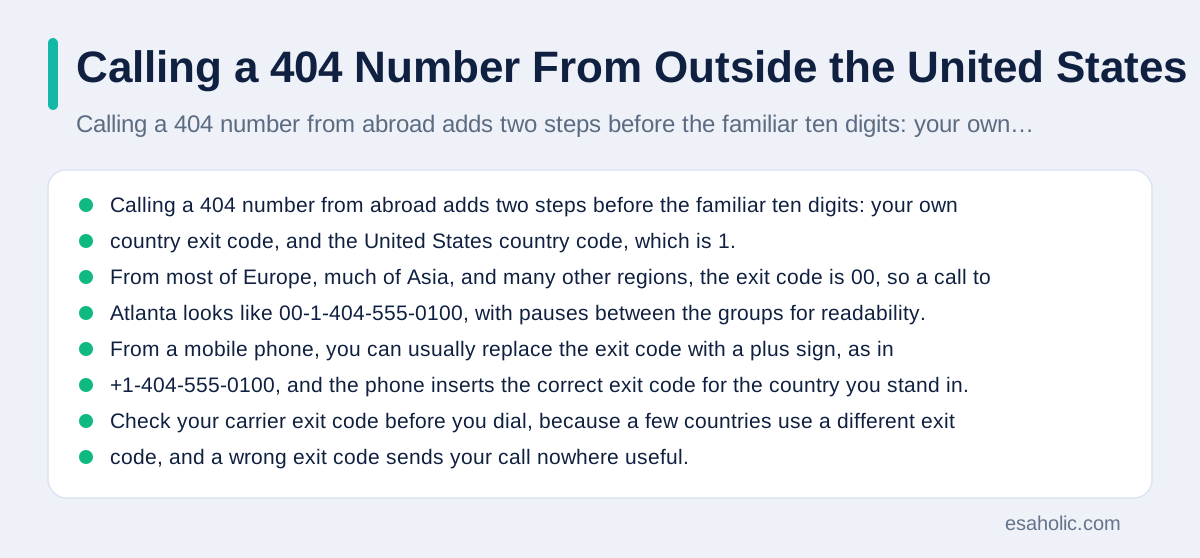
Calling a 404 number from abroad adds two steps before the familiar ten digits: your own country exit code, and the United States country code, which is 1. From most of Europe, much of Asia, and many other regions, the exit code is 00, so a call to Atlanta looks like 00-1-404-555-0100, with pauses between the groups for readability. From a mobile phone, you can usually replace the exit code with a plus sign, as in +1-404-555-0100, and the phone inserts the correct exit code for the country you stand in. Check your carrier exit code before you dial, because a few countries use a different exit code, and a wrong exit code sends your call nowhere useful.
Time zones matter as much as dialing codes when you call Atlanta from abroad, because Atlanta sits in the Eastern Time Zone of the United States, and its clock shifts with daylight saving time, which is the seasonal clock change that moves clocks forward in spring and back in autumn. A call that feels like midday in London arrives as early morning in Atlanta, and a call that feels like evening in Tokyo arrives in the middle of the Atlanta night, so check the current Atlanta time before you dial, especially for a business call. Most phone apps show world clocks, and a quick search for the current time in Atlanta prevents an awkward midnight call. If the matter can wait, an email that the recipient reads in working hours often works better than a badly timed phone call.
How to Spot Scam Calls Using the 404 Code
A scam call is a call where the caller pretends to be someone trustworthy in order to steal money or personal details, and the 404 code is a favorite tool for such callers because it looks local and familiar to Atlanta residents. Spoofing, which is the technical term for faking a caller ID number, lets a caller display any number they choose, including a 404 number, a number from your own city, or even a number that looks like your own number. The technology behind spoofing is cheap and widely available, so a 404 display proves nothing about the caller location, the caller identity, or the caller honesty. Treat every unexpected call the same way, whatever code it shows: listen to what the caller asks for, not to what the screen shows.
Several warning signs mark a scam call far more reliably than any area code. Pressure to act at once, such as a claim that your account closes today or that police will arrive within the hour, is a classic pressure tactic, because real organizations give you time to check. A demand for payment by gift card, wire transfer, cryptocurrency, or a payment app to a personal account is another strong warning, because real companies and government offices do not collect fines or debts that way. A request for your full password, a one time code, or your bank login details is a third warning, because no legitimate caller needs those secrets to help you. A caller who refuses to let you hang up and call back on a trusted number is a fourth warning, because a real organization welcomes verification.
The same verification habit protects your inbox and your computer, so read our guide on how to spot fake messages and our guide on keeping malware off your computer, because scammers reuse the same pressure tricks across phone, email, and software.
What to Do After a Suspicious 404 Call
If a call feels suspicious, hang up calmly, without arguing, without confirming personal details, and without pressing buttons the caller asks you to press, because button presses can confirm your number is active or route you to another scammer. Do not call back the number shown on your screen, because a spoofed number may belong to an innocent person, or it may route you back to the scammer. Instead, find the real organization number yourself: use the number printed on your bank card, on a recent bill, or on the organization official website, which you open by typing its address yourself. Explain what the caller claimed, and ask whether the organization actually contacted you, because that single check resolves most scam stories in minutes. The same rule applies online: search google or type a url explains when to type an address yourself instead of trusting a result or a link.
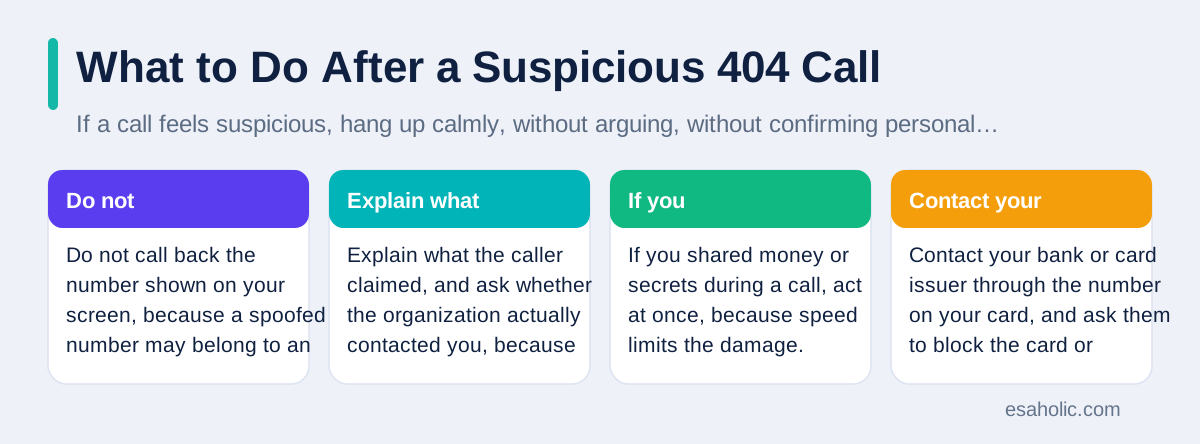
If you shared money or secrets during a call, act at once, because speed limits the damage. Contact your bank or card issuer through the number on your card, and ask them to block the card or reverse the payment if possible. Change the password of any account whose details you shared, and turn on two step verification for that account, so a stolen password alone cannot open it again. If you shared a government ID number or a tax detail, check the guidance from your local consumer protection office about placing a fraud alert, which is a notice that asks lenders to check your identity more carefully before opening new credit. Keep notes of the call, including the date, the time, the number shown, and what the caller asked for, because those notes help your bank and any report you file.
Area Code Myths, and When 404 Actually Matters
Several myths about area codes lead people astray, and correcting them makes every phone decision easier. The first myth says a local code means a local caller, but spoofing and mobile portability, which is the ability to keep your number when you move or change carrier, both break that link. The second myth says an unfamiliar code means a scam, but legitimate businesses, hospitals, and schools call from many codes, including codes from other states, so an unfamiliar code alone proves nothing either way. The third myth says calling back a missed number is always safe, but some scam numbers charge high rates for return calls, or route you to a fake agent, so a missed call from an unknown number deserves a search first, not an instant callback.
The fourth myth says a number with many online complaints must be a scam, but complaint sites mix real scam reports with wrong number complaints, business disputes, and recycled number confusion, so a complaint page is a hint, not a verdict. The fifth myth says phone companies can fully stop spoofed calls, but while carriers now label many suspected spam calls and block some of them, spoofing adapts quickly, and no filter catches every fake call. The honest picture is layered: carrier labels help, call blocking helps, and your own verification habit helps most, because it works even when technology fails. Use all three layers together, and do not rely on any single layer alone.
For organizations that handle many customer calls, our support and maintenance service page explains how a structured support process keeps customer contact safe, recorded, and consistent, which reduces the confusion scammers exploit.
Protecting Yourself Beyond One Call
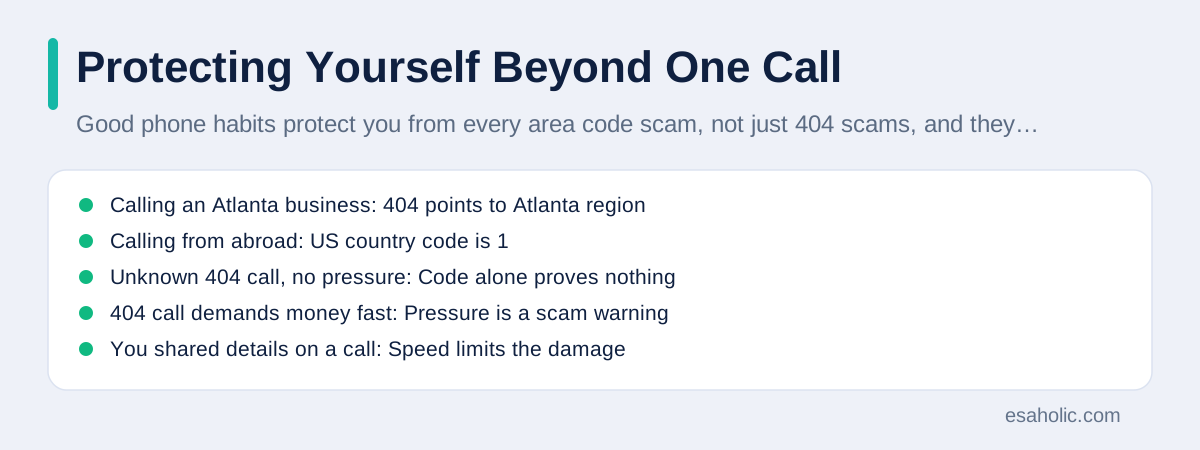
Good phone habits protect you from every area code scam, not just 404 scams, and they take only a few minutes to set up. Turn on your carrier spam labeling and call blocking features, because they flag many known scam numbers before your phone rings, and check your phone settings for a silence unknown callers option, which sends unknown numbers to voicemail while letting your contacts through. That option suits many people, but it can delay genuine calls from a doctor office or a delivery driver using an unknown number, so check your voicemail regularly if you turn it on. Review the blocked and silenced lists now and then, so a genuine caller does not sit unheard for days. If the browser page you need will not load while you check a number, not enough memory to open this page walks through closing tabs and restarting the browser.
Teach the same habits to family members who receive many calls, especially older relatives, because scammers target people who answer politely and stay on the line. Agree a family rule: no money, no passwords, and no codes over the phone unless the family member hangs up first and calls back on a trusted number, and agree a safe word for genuine family emergencies, so an impersonator cannot fake a crisis call easily. Write the trusted numbers for your bank, your utility company, and your local government office on paper near the phone, because a paper list survives a dead phone battery and a moment of panic better than a contact search. A short family conversation about these rules prevents more loss than any app can.
| Situation | What the code tells you | What to do |
|---|---|---|
| Calling an Atlanta business | 404 points to Atlanta region | Dial 404 plus the seven digit number |
| Calling from abroad | US country code is 1 | Dial exit code, then 1, then 404, then the number |
| Unknown 404 call, no pressure | Code alone proves nothing | Let it go to voicemail and check the message |
| 404 call demands money fast | Pressure is a scam warning | Hang up and call the real organization directly |
| You shared details on a call | Speed limits the damage | Call your bank, change passwords, keep notes |
Conclusion
404 area code means Atlanta, Georgia, in general terms: a historic code from the early North American phone system that once covered the whole state and now serves the Atlanta region alongside newer overlay codes. Dial it as ten digits inside the United States, and as your exit code, then 1, then 404, then the local number from abroad, and save Atlanta contacts in full so they dial correctly wherever you travel. Never trust a caller because the screen shows 404, because spoofing lets any caller display any code, and judge every unexpected call by its demands instead: pressure, gift card payment, and password requests are warnings, not coincidences. Hang up on suspicious calls, verify through a number you find yourself, and keep the code in its proper place, as a dialing detail and a piece of Atlanta history, not as proof of who is calling.
Frequently Asked Questions
What city uses the 404 area code?
The 404 area code covers Atlanta, Georgia, and nearby communities. It is one of the original North American area codes, and it now shares the Atlanta region with overlay codes, which are extra codes added for the same area.
How do I dial a 404 number from outside the United States?
Dial your own country's exit code first, then 1 for the United States, then 404, then the seven digit local number. From most countries the exit code is 00, but always check your own carrier's exit code before you dial.
Does a 404 number on my caller ID prove the caller is in Atlanta?
No. Scammers can fake, or spoof, any caller ID number, including a 404 number. Treat the code as a hint about the number's origin, never as proof of who is calling, and verify important claims through a trusted number you find yourself.
Written by Umar Abbas
Founder, Principal AI Architect and Operator
Umar Abbas is the founder of Esaholic and a principal AI architect who designs reliable large scale AI systems for regulated industries.
Reviewed by Amir Iqbal
Senior AI Systems Architect and Lead Technical Reviewer
Amir Iqbal is a senior AI systems architect at Esaholic who designs resilient systems and reviews guides for practical, testable detail.
Relevant blogs
Redo Shortcut: Windows, Mac, and App Guide
The redo keys for Windows, Mac, and common apps, plus why redo is greyed out and how to fix it.
Enter Password to Unlock 30 30 Attempts Remaining: Help
What a locked Android phone message means, and safe steps for the real owner.
Computer Virus Prevention: A Simple Home Guide
Simple steps that keep malware off your computer, from updates and safe downloads to backups and quick recovery.
Gmail Users Warned About Phishing Attacks
What the phishing warning means, how to spot fake messages, and steps that protect a Gmail account.