
Agentic RAG Explained
What is agentic RAG? In simple terms, it is a question answering system that does not just search once and guess. It plans the question, searches your own documents, reads what it finds, notices what is still missing, searches again with a better query, checks the answer against the sources, and only then replies. RAG stands for retrieval augmented generation, which means the system retrieves, or fetches, relevant documents first, and then generates, or writes, an answer based on those documents. The word agentic adds the planning and looping behavior of an AI agent, which is a program that carries out multi-step work on its own, with tools and with checks along the way.
Plain RAG already helps a lot. A support assistant built on plain RAG can pull the correct return policy and write a clear reply, instead of inventing a policy from training data. But plain RAG struggles when a question needs several facts from several places, or when the first search returns weak results. A user who asks, "Compare our refund policy for damaged goods with the warranty terms for the same product, and tell me what a customer with a six month old item should expect," needs more than one search. An agent breaks that question into parts, searches for each part, compares the passages, and flags any conflict before it answers. That looping, checking behavior is the heart of the agentic approach.
This guide explains agentic RAG from the ground up: how plain RAG works, how an agent changes it, what an agent RAG architecture looks like in 2026, how teams build RAG agents with LLMs, which is short for large language models, and which best practices keep search, cost, and accuracy under control. It also explains when plain RAG still wins, because the agentic version costs more, runs slower, and adds new ways to fail. If you want the wider agent picture first, IBM's guide to agentic AI covers agent patterns clearly, and IBM's guide to retrieval augmented generation explains the plain RAG base in plain terms.
Plain RAG First: Search, Then Answer
Plain RAG follows three steps. First, it splits your documents into chunks, which are short passages of a few hundred words each, and it stores those chunks in a search index that understands meaning, not only exact words. That index is often called a vector store, because it turns each chunk into a list of numbers, called a vector, that captures its meaning, so a search for "return a broken item" can find a passage about "damaged goods refunds" even though the words differ. Second, when a user asks a question, the system searches the index for the most relevant chunks. Third, it gives those chunks to a language model together with the question, and the model writes an answer based mainly on those chunks. The answer stays grounded, which means it rests on real documents the reader can check, instead of floating on the model's memory alone.
Plain RAG fails in predictable ways. It fails when the question uses words that do not match the documents, when the answer spans several documents, when the top search results look relevant but miss the key condition, and when the documents themselves conflict. It also fails when the model ignores the retrieved passages and answers from its training data anyway, a behavior teams call leakage from memory. A careful team reduces these failures with better chunking, clearer document titles, and a final check that compares the answer with the passages. But some failures need more than better retrieval. They need a system that can notice a weak result and try again, and that is exactly what an agent adds.
Think of plain RAG as a diligent librarian who fetches five books on your first request and then stops, even if those books miss the point. Think of an agentic system as a researcher who reads those five books, notices a gap, asks a sharper question, fetches three more books, compares them, and tells you when the books disagree. The researcher costs more time, but for a hard question, the researcher earns it. The rest of this guide shows how that researcher works inside software, and how to keep it honest.
What an Agent Adds: Planning, Tools, and Loops
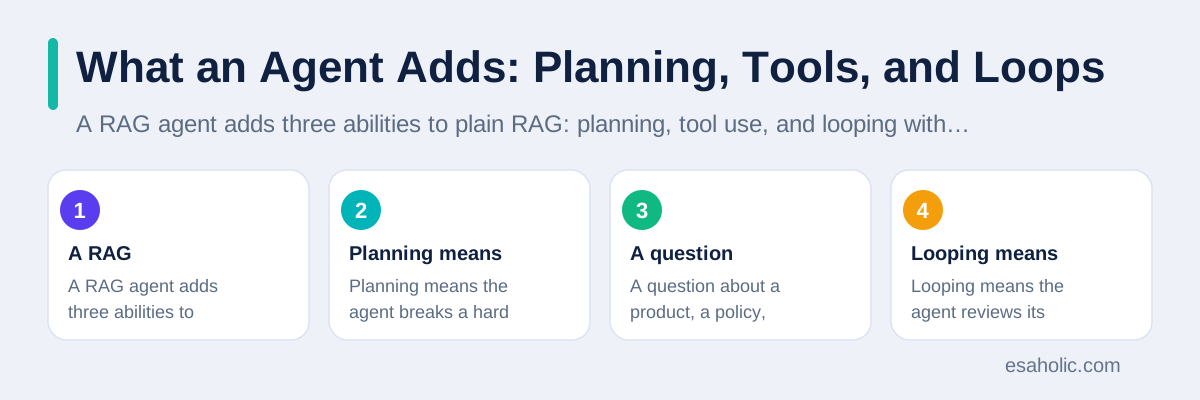
A RAG agent adds three abilities to plain RAG: planning, tool use, and looping with checks. Planning means the agent breaks a hard question into smaller subquestions before it searches. A question about a product, a policy, and a deadline becomes three searches, not one vague search. Tool use means the agent can call more than a document search: it can query a database, run a calculation, check a calendar, or call another internal tool, and it can choose which tool fits each subquestion. Looping means the agent reviews its own progress after each step and decides whether to search again, ask the user a clarifying question, or stop and answer. Those three abilities together turn a single search into a small research project.
A RAG AI agent also carries memory across steps. It remembers which documents it already read, which facts it already found, and which subquestions remain open, so it does not repeat the same search or contradict an earlier finding without noticing. Memory can be short term, covering only the current question, or longer term, covering past conversations with the same user. Longer memory helps with follow up questions, such as "and what about the warranty on that same item," because the agent already knows which item the user means. Longer memory also raises privacy questions, because past conversations may hold sensitive details, so teams should store only what the task needs and let users clear history easily.
Agents also need a stopping rule, which is a clear condition that ends the loop. Without a stopping rule, an agent can search forever, chasing ever smaller details while the user waits and the cost climbs. Good stopping rules include a maximum number of searches, a maximum run time, a confidence check, which means the agent stops when the evidence covers every subquestion, and a user interrupt, which lets the user stop the agent at any time. A stopping rule turns an agent from an endless researcher into a useful colleague who knows when to report back, even if the answer includes an honest "the documents do not cover this part."
Agent RAG Architecture in Plain Terms
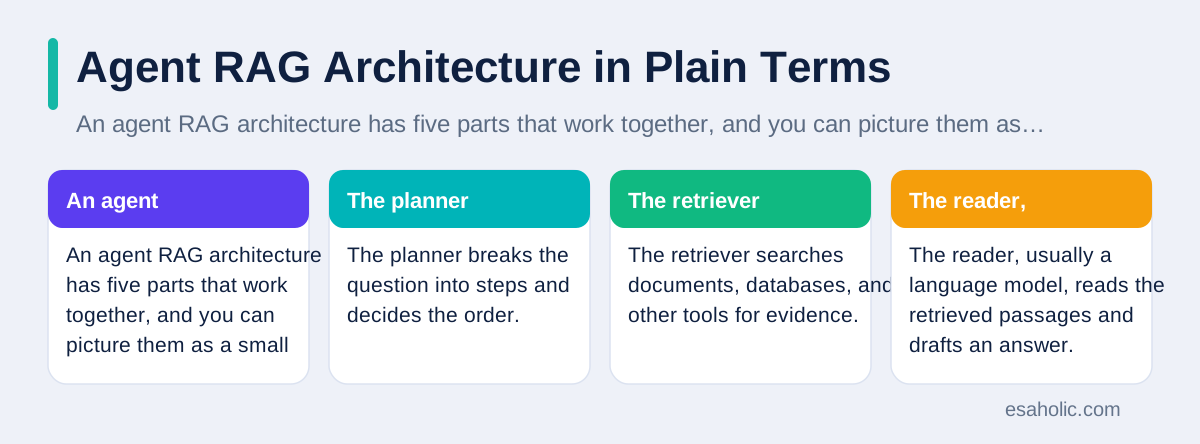
An agent RAG architecture has five parts that work together, and you can picture them as a small team around a table. The planner breaks the question into steps and decides the order. The retriever searches documents, databases, and other tools for evidence. The reader, usually a language model, reads the retrieved passages and drafts an answer. The checker compares the draft with the passages, flags claims without support, and sends weak parts back for another search. The memory keeps the plan, the evidence, and the open questions in one place so the team does not lose track. A coordinator, which is often just the planner with extra logic, moves work between these parts until the stopping rule fires.
In 2026, most agent RAG architecture designs share this shape, even when vendors give the parts different names. Some designs use one agent that does everything, switching between planning, searching, and checking in turns. Others use several small agents, each owning one job, with a lead agent that coordinates them. The single agent design is simpler to build and debug, because one log shows the whole chain of thought. The multi-agent design can handle harder tasks, because a specialist checker can focus only on verification, but it costs more and it creates more places where two agents can misunderstand each other. Start with a single agent, and split it into specialists only when one job clearly needs its own focus and its own tests.
The data layer matters as much as the agent layer. Documents need clean titles, clear dates, and a stated owner, so the agent can prefer fresh, authoritative passages over stale ones. Chunks need sensible sizes: too short, and a passage loses context; too long, and the search returns noise around the useful sentence. Metadata, which means data about the data, such as document type, region, and version, lets the agent filter searches to the right set before it ranks by meaning. A team that fixes its document layer first will find that even a simple agent performs well, while a team that skips document hygiene will find that even a clever agent keeps tripping over messy sources. Our guide on what a generative AI data scientist does explains the data preparation work behind reliable systems, and our generative AI development work applies the same discipline to client document systems.
How RAG Agents Work, Step by Step
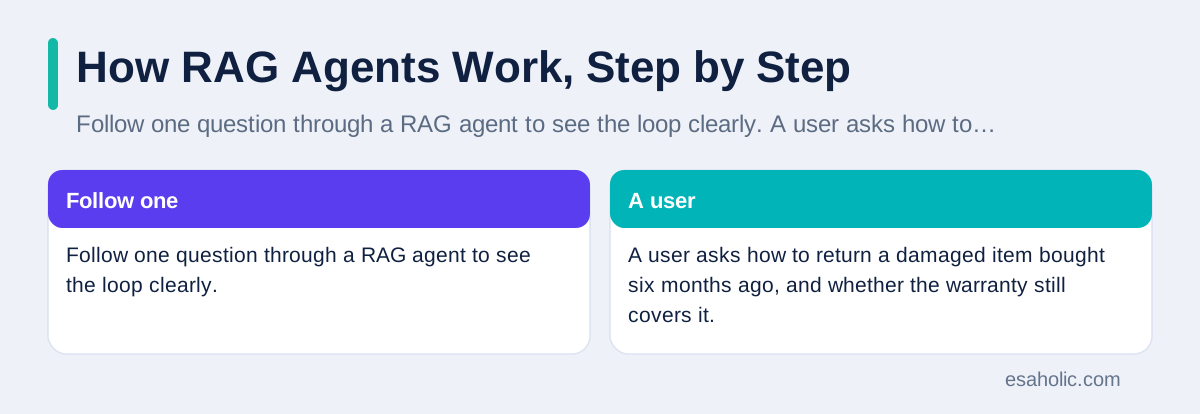
Follow one question through a RAG agent to see the loop clearly. A user asks how to return a damaged item bought six months ago, and whether the warranty still covers it. The planner splits the question into three subquestions: the return rule for damaged goods, the warranty length for this product, and the time limit that applies at six months. The retriever searches the policy documents for each subquestion, and it returns the top passages with their source titles. The reader drafts an answer that cites each passage. The checker then reads the draft, finds that the warranty passage covers twelve months but says nothing about damage, and sends the agent back for one more search on damage under warranty. The retriever finds a warranty exclusion for physical damage, the reader revises the draft, the checker confirms that every key claim now has a source, and the agent answers with citations the user can open.
Notice what the loop bought. A single search would likely have returned the return policy and stopped, leaving the warranty question half answered. A single search might also have returned a general warranty passage and hidden the damage exclusion, giving the user a wrongly optimistic answer. The loop caught both gaps, because the checker compared the draft with the subquestions, not only with the passages. That comparison is the most valuable step in the whole design, and teams should invest more effort in the checker than in any other part. A strong checker with a simple planner beats a clever planner with a weak checker, because the checker is what stops invented or half supported claims from reaching the user.
The agent also shows its work, and showing work matters for trust. A good answer lists the sources it used, quotes the key condition in plain words, and says clearly when a source did not cover a part of the question. A user who can open the source and verify the claim will trust the next answer more, and a reviewer who can trace a wrong answer to a specific passage can fix the document or the search, instead of blaming the model in general. Build source display into the answer from day one, and treat any answer that hides its sources as unfinished, no matter how fluent it sounds.
RAG vs Agentic AI, and Agentic RAG vs RAG
People often mix up three terms, so keep them straight. RAG is a technique: search your documents first, then write an answer from what you found. Agentic AI is a behavior: plan multi-step work, use tools, check progress, and adapt. Agentic RAG combines them: an agent that plans and loops around retrieval, so the search itself becomes multi-step work. RAG vs agentic AI is therefore a false contest, because they answer different questions. RAG answers "where does the answer come from," while agentic AI answers "how does the system work through a task." Agentic RAG vs RAG is the real choice, because it asks whether a question needs one search or a researched loop.
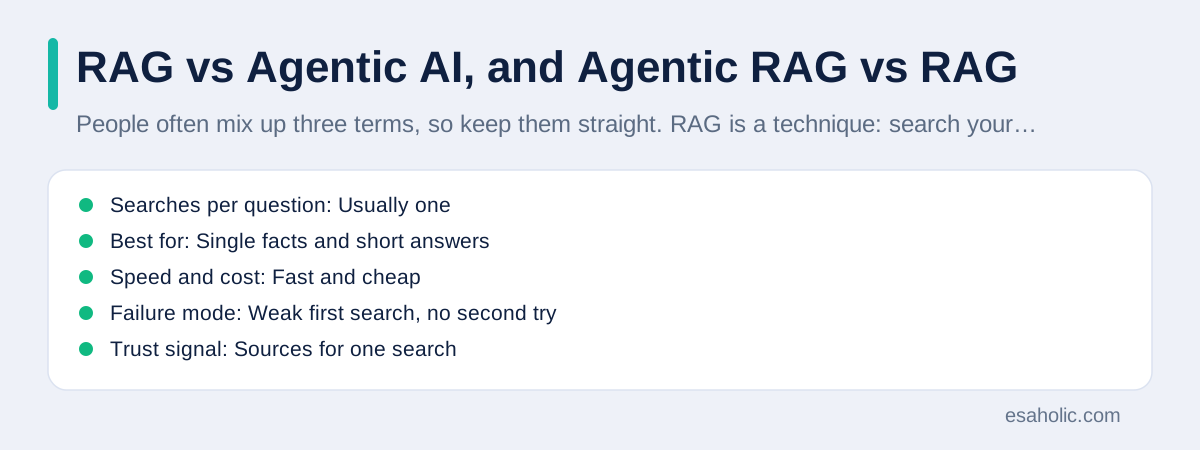
| Feature | Plain RAG | Agentic RAG |
|---|---|---|
| Searches per question | Usually one | Several, guided by gaps in evidence |
| Best for | Single facts and short answers | Comparisons, research, and multi-part questions |
| Speed and cost | Fast and cheap | Slower and more expensive per question |
| Failure mode | Weak first search, no second try | Loops, drift, and higher cost if unchecked |
| Trust signal | Sources for one search | Sources plus a visible plan and checks |
Use plain RAG when a question has one answer in one place, when speed matters more than depth, or when volume is high and cost per question must stay low. Use agentic RAG when a question spans documents, when conditions and exceptions change the answer, when the user needs a comparison, or when a wrong answer carries real cost, such as a policy, a medical, or a financial question. Many successful systems use both: plain RAG answers the quick questions, and the system escalates hard questions to an agent when the first search looks weak or when the user asks a follow up that needs more research. That hybrid design gives users speed where speed suffices and depth where depth matters.
Building RAG Agents With LLMs
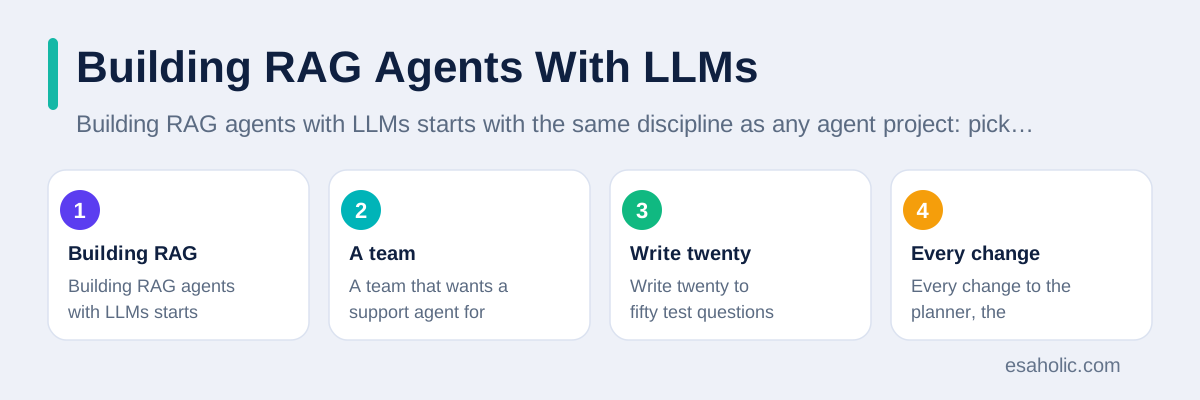
Building RAG agents with LLMs starts with the same discipline as any agent project: pick one question type, one document set, and one measurable goal before you write code. A team that wants a support agent for returns should start with returns only, not with every support topic at once. Write twenty to fifty test questions with human approved answers and source citations, and use that set as your scoreboard. Every change to the planner, the retriever, or the checker must improve the score on that set, or at least not harm it, before it ships. Without a scoreboard, teams argue about quality from anecdotes, and anecdotes always favor the newest demo.
Choose tools that keep the loop visible. A framework that logs each plan step, each search query, each retrieved passage, and each check result will save you days of debugging, because you can see exactly where a wrong answer began. A framework that hides its steps behind a single "answer" button will frustrate you the first time it fails, because you cannot tell whether the planner, the search, or the checker broke. Prefer tools with clear logs, clear limits on loops and cost, and a simple way to inject your own checker rules, such as "every price claim needs a source dated within the last year." Our guide on building agent applications around one clear problem covers the pilot discipline that pairs with this build, and our AI agent development services use the same staged approach for client systems.
Test the agent on hard cases on purpose. Feed it questions with missing documents, conflicting documents, and tricky wording, and watch whether it says "I do not know" when the sources run out. An agent that admits a gap is far more valuable than one that fills gaps with fluent guesses, because users can act on an honest gap by asking a human, while a fluent guess can mislead them into a wrong decision. Reward honest gaps in your scoreboard, and treat a confident answer without a source as a failure, even when the answer happens to be right. That strict rule trains the team to value evidence over fluency, which is the whole point of retrieval in the first place.
Best Practices for Integrating Agentic RAG With Search
Best practices for integrating agentic RAG with search start with query quality. An agent should rewrite the user's question into sharper search queries for each subquestion, instead of sending the whole question verbatim to the index every time. A question such as "Can I return this and does the warranty cover damage" becomes two queries: one for return rules for damaged goods, and one for warranty exclusions for physical damage. Sharper queries return sharper passages, and sharper passages make the checker’s job easier. Log the rewritten queries, because they show you how the agent understood the question, and they reveal misunderstandings early.
Rank results by meaning first, then by freshness and authority, and filter by metadata before you rank, so a search for a US policy does not return a European policy that happens to share words. Use hybrid search when your tool supports it, which means combining meaning based search with keyword search, because keyword search catches exact terms such as product codes and policy numbers that meaning search can miss. Re-rank the top results with a second, stricter pass when the question is high stakes, and drop passages that score below a threshold instead of feeding weak evidence to the model. A model given weak passages will still write a confident answer, so the filter in front of the model matters more than the model's own caution.
Search again when confidence is low, and say so in the answer trail. A second search with different wording, a search in a second document set, or a search filtered to a newer version can rescue a question that the first search fumbled. Cap the total searches per question, and show the user a short note when the agent searched several times, such as "Checked the return policy and the warranty terms." That note builds trust, because it shows work instead of hiding it. Also refresh the index on a schedule that matches how fast your documents change. A policy index updated once a quarter will mislead users for months after a policy change, no matter how good the agent is. Google Cloud's introduction to agentic AI covers agent tool patterns that pair well with these search practices.
Evaluation, Cost, and Honest Limits
Evaluate an agentic system on four measures, not only on whether answers sound good. First, answer accuracy against your human scoreboard, which means the share of test questions answered correctly with correct sources. Second, citation accuracy, which means the share of key claims that a reviewer can verify in the cited passage. Third, abstention quality, which means how often the agent correctly says it does not know when sources run out, instead of guessing. Fourth, cost and time per question, including every search and model call in the loop. A system that scores well on accuracy but costs ten times more per question than plain RAG may still be worth it for high stakes questions, and worthless for routine ones, so report cost beside accuracy, always.
Watch for three failure modes that only agents show. Loop drift means each search moves slightly off topic, so the final answer answers a different question from the one the user asked. Tool misuse means the agent calls the wrong tool, or calls the right tool with the wrong arguments, and then treats a bad result as evidence. Checker blindness means the checker approves a draft because it shares words with the passages, even though it misstates a condition, such as turning "within 30 days" into "within 90 days." Catch these failures with logs, with test questions designed to trigger them, and with a weekly human review of a random sample of live answers. Random review catches drift that scoreboards miss, because live users ask questions your test set never imagined.
Cost deserves a frank paragraph. Every loop step adds a model call, a search, or both, so an agentic answer can cost several times more than a plain RAG answer, and a runaway loop can cost far more. Set a cost cap per question, alert when the average cost rises week over week, and route simple questions to plain RAG automatically when the first search already covers them. That routing, sometimes called a router, checks question difficulty first and picks the cheapest system that can answer it well. A router turns a cost problem into a design choice, and it keeps the agentic system focused on the hard questions where it earns its price.
When Plain RAG Still Wins
Plain RAG still wins for most everyday questions, and teams should not feel behind for choosing it. A help center that answers "What is your return window" from one policy page does not need a planner, a checker, and five searches. A product search that returns a spec sheet does not need an agent to debate the spec. A high volume chatbot that answers thousands of simple questions a day needs speed and low cost far more than it needs research loops. Choosing plain RAG in those cases is not settling. It is matching the tool to the task, which is the core skill of good engineering.
Plain RAG also wins when the team is small, when logs and monitoring are thin, or when the document set is small and stable. An agentic system needs an owner who reads logs, updates the scoreboard, and fixes drift, and a team without that owner will watch an agent slowly degrade while nobody notices. A plain system degrades more visibly and more slowly, because its single search either returns the right passage or it does not, and a weekly spot check catches the problem fast. Start with plain RAG, build the scoreboard and the document hygiene, and add agentic loops for the question types where plain RAG measurably fails. That path gives you evidence for every extra cost, and it keeps the system trustworthy at every stage.
The future of this field points toward better routers, better checkers, and smaller, cheaper loops, not toward agents that search forever. Expect tools that decide in milliseconds whether a question needs one search or five, checkers that verify numbers and dates with rules instead of vibes, and agents that show their plan in a few lines the user can actually read. Those improvements will lower the cost of agentic systems and widen the set of questions where they pay off. Until then, the wise rule stays simple: use the simplest retrieval system that answers the question with sources you can check, and add agency only where the evidence shows it helps.
Conclusion
Agentic RAG turns retrieval into research: an agent plans a question, searches several times, checks each claim against sources, and answers only when the evidence supports it. That loop helps with comparisons, multi-part questions, and high stakes answers where a single search falls short. It also costs more, runs slower, and needs stronger checks, so plain RAG still wins for simple, high volume questions. Start with clean documents and a human scoreboard, add agency for the question types where plain retrieval measurably fails, and keep showing sources, so users can trust the answer because they can verify it. Teams that need this pattern in production usually start from AI agent development rather than a generic chatbot build.
Frequently Asked Questions
What is agentic RAG in simple terms?
Agentic RAG is a system where an AI agent plans a question, searches your own documents several times, checks the results against sources, and only then writes an answer. Plain RAG searches once and answers once, while an agentic system loops through search and checking until the evidence supports the answer.
When should you use agentic RAG instead of plain RAG?
Use agentic RAG when a question needs several steps, several documents, or a comparison across sources, such as a research summary or a policy question with conditions. Use plain RAG when a single fact from a single document answers the question, because the simpler system costs less and fails less often.
How do you stop an agentic RAG system from inventing facts?
You stop invented facts by forcing the agent to cite sources for key claims, by checking each claim against the retrieved passages, and by making the agent say it does not know when the sources do not support an answer. Human review of high stakes answers adds a final safety layer.
Written by Ahmad Jajja
Senior AI Research Engineer and Generative AI Specialist
Ahmad Jajja is a senior AI research engineer at Esaholic who specializes in generative AI and data systems grounded in real documents.
Reviewed by Umar Abbas
Founder, Principal AI Architect and Operator
Umar Abbas is the founder of Esaholic and a principal AI architect who designs reliable large scale AI systems for regulated industries.
Relevant blogs
Who Is a Generative AI Data Scientist? A Simple Guide
What a generative AI data scientist does, the skills the role needs, and how to start this career.
Building Agentic AI Applications with a Problem-First Approach
Start with one clear problem, measure it, pilot on real cases, and scale only when the evidence supports it.
Natural Language Processing Explained Simply
How computers read, understand, and reply to human language, where you meet NLP daily, and its honest limits.
How to Use an AI Agent to Sort Emails: A Simple Guide
Set rules, connect your inbox safely, and review the first week before you trust an email agent.
Back to all blog guides · Back to Generative AI and Agentic AI guides · Explore Generative AI Development Services