
Blockchain in Intellectual Property: A Plain Guide
Imagine you write a song, design a logo, or invent a small device, and later someone else claims the work was theirs. You need a way to show what you created, when you created it, and what permissions you gave to others. For most of history, creators relied on dated drafts, sealed envelopes, registration offices, and lawyers to settle those questions. Blockchain in intellectual property promises a new kind of evidence for the same old questions: a shared record that many computers hold at once, where new entries are added in order and old entries are very hard to change without everyone noticing.
A blockchain, in plain terms, is a chain of blocks, where each block is a bundle of records, and each block carries a fingerprint of the block before it. That fingerprint is a short code produced from the contents of the previous block, so changing an old record would change its fingerprint and break the link to every block after it. Many independent computers, called nodes, keep copies of the chain and check new blocks against shared rules before accepting them. This design makes the record hard to rewrite quietly, but it does not make the record true. A blockchain can faithfully record a false claim, because computers check format, not ownership.
This guide explains blockchain in intellectual property without hype and without legal advice. You will learn what a blockchain record actually proves, how creators use it for protection, licensing, and royalties, where blockchain patents and trademark questions get complicated, and where the technology cannot help at all. If you are a creator, a small business owner, or a team choosing tools, read this guide as a map of honest uses and hard limits, and treat any vendor who promises that a blockchain entry alone secures your rights as a vendor to avoid.
What a Blockchain Actually Records
The most useful mental model is a public notebook with numbered pages. When someone records a work, the system usually stores a fingerprint of the file, not the file itself. That fingerprint is called a hash, which is a fixed length code produced from the file's contents, so even a one letter change in the file produces a completely different hash. The notebook entry therefore proves that a file with exactly that fingerprint existed at the time of the entry, because anyone can hash their own copy of the file later and compare the result. The work itself can stay private, which matters for unpublished drafts, trade secrets, and client work that must not leak.
That distinction between a fingerprint and the file explains both the power and the limit of the idea. A timestamped fingerprint answers a narrow question: did this exact file exist at this time, according to this record? It does not answer who created the file, whether the file was original, or whether the person who recorded it had the right to do so. A thief can record a stolen manuscript before the true author records it, and the chain will happily preserve the thief's earlier entry. Courts, registration offices, and contracts still decide ownership, and the blockchain entry is at best one piece of evidence among others, such as drafts, emails, and witness statements.
Teams that use blockchain well treat it as a better filing cabinet, not as a judge. They record fingerprints at each stage of a project, keep the original files in safe storage, and keep written agreements that name the owner, the licence, and the payment terms in plain language. They also choose their chain with care, because a record on a small chain is far easier to rewrite than one on a large chain.
Blockchain and IP Law: What a Record Proves and What It Does Not
Blockchain and IP law meet at a simple tension. The law cares about people, intent, and territory, while a blockchain cares about codes, order, and rules that run the same way for everyone. Copyright, which is the legal right that protects original creative work, usually arises when a work is created and fixed in some form, such as written down or recorded, not when it is registered or recorded on a chain. Registration can strengthen a claim in some countries, for example by allowing certain damages in the United States, but the right itself does not come from the chain. The United States Copyright Office explains how copyright works and what registration adds, and its guidance is a better starting point than any vendor's marketing page.
Patents work differently, and the difference matters. A patent, which is a time limited exclusive right over an invention, is granted only after an office examines an application and decides the invention is new, useful, and non obvious, which means not an obvious step for a skilled person in that field. Most countries now use a first to file system, which means the first person to file a valid application generally wins, not the first person to invent. A blockchain timestamp may help show when an inventor held a document, but it is not a patent filing, and it cannot replace the examination process. Inventors who delay filing while relying on a chain record risk losing the right entirely if someone else files first.
Trademarks add a third pattern. A trademark, which is a sign such as a name or logo that identifies the source of goods or services, gains strength through use in trade and through registration in each country or region where protection is wanted. A token or chain entry that claims a brand name proves nothing about use in trade, and it can collide with a registered mark owned by someone else. The World Intellectual Property Organization publishes plain guides to how these rights differ across countries, and teams working across borders should read them before building any blockchain product around a brand, because rights that look clear in one country may not exist in another.
Blockchain Intellectual Property Protection for Creators
For individual creators, blockchain intellectual property protection works best as a dated evidence trail. A photographer can record a fingerprint of each photo on the day of a shoot, a writer can record each draft as it changes, and a musician can record a demo before sending it to producers. If a dispute later arises, the creator can show the chain of fingerprints alongside the original files, emails, and contracts, and the other side must explain why that trail exists if the work was truly theirs. The trail is strongest when it is continuous, meaning every version is recorded in order, and when the creator's identity is linked to the record through an account, a signature, or a registered identity that a court can follow.
Protection also means controlling copies, and here honesty is essential. A blockchain record does not stop anyone from copying a photo, a song, or a text file, because copying a digital file costs almost nothing and happens outside the chain. What the record can do is make authorized copies easier to tell apart from unauthorized ones, when the system is designed that way. For example, a buyer might receive a signed certificate for a specific edition, checkable against the chain. That check proves the certificate is real, but it does not prove the image beside it was not copied, because the same image can be displayed anywhere with or without a certificate.
Creators should therefore pair chain records with practical steps that actually reduce harm. Watermark preview images, register important works where registration helps, keep original project files with metadata, which is hidden information such as camera settings and creation dates, and use written licences that state what a buyer may do. A buyer who receives both a chain certificate and a clear written licence understands the deal, while a buyer who receives only a token may believe they bought far more than they did.
Blockchain Patents: Filing, Prior Art, and Proof
Blockchain patents raise two separate questions that are often confused. The first question is whether blockchain can help manage patents, and the second is whether inventions about blockchain itself can be patented. On the first question, research teams use chain records to timestamp lab notebooks, invention disclosures, and prototype files, so that a later dispute about who held what document, and when, has a clear trail. This use is modest and honest: it supports the team's own records, and it works best inside a company where the chain is one part of a larger system of signed notebooks, version control, and witnessed disclosures.
The second question is harder, because patent offices examine blockchain inventions like any other software or system invention, and the rules differ by country. In the United States, the United States Patent and Trademark Office examines whether an invention is new and non obvious, and abstract ideas alone, such as a business method described only in general terms, are not enough. In Europe, computer programs as such face their own limits, and an invention usually needs a technical effect beyond running code on a normal computer. Teams that file blockchain patents should therefore describe a concrete technical problem and a concrete solution, such as a new consensus method, which is the rule a network uses to agree on the next block, or a new way to store data, rather than claiming the idea of using a blockchain for a business task.
Prior art, which means all public knowledge that existed before a filing, decides many patent cases, and blockchain creates a new twist. A public chain entry is public knowledge, so recording an invention on a public chain before filing could itself count as prior art against the inventor's own later application. That is a costly mistake, and it is the opposite of the protection the inventor wanted. The safe order for most teams is to file first, or to keep the invention private under a non disclosure agreement, and only then use a chain for internal records. Anyone unsure about the order should ask a patent lawyer before publishing anything on a public chain, because a single public post can destroy novelty, which is the requirement that an invention be new.
Blockchain Patent and Trademark Issues to Watch
Blockchain patent and trademark issues grow sharper when tokens enter the picture. A token, which is a digital unit recorded on a chain, can represent almost anything, from a collectible image to a share in a project, and sellers sometimes describe tokens as if they carried legal rights with them. In most cases they do not, unless a written legal document says so. A token that uses a famous brand name, a band's logo, or a film character without permission can infringe trademark or copyright even if the seller calls it art, a parody, or a community project. Courts look at what buyers are likely to believe, not at the label the seller chose.
Ownership of AI assisted work adds another open question. When a creator uses an AI tool to draft text, generate an image, or suggest an invention, the legal owner may be the person, the tool provider, or nobody, depending on the country and on how much human creativity shaped the result. Recording an AI generated work on a chain does not settle that question, because the chain records the claim without judging it. Teams should keep records of prompts, edits, and human choices, and should check the tool's terms, which often grant the user some rights while keeping other rights for the provider. Those terms, not the chain, decide what the team can sell.
Disputes over chain records also face a practical problem: there is often no one to sue and no office to correct the record. A chain run by many independent participants has no customer service desk, and an entry that names the wrong owner cannot simply be deleted, because the design resists change. Parties who need a correction must usually go to court, and a court order may bind the people involved without changing the chain itself. Before relying on a chain for an important right, ask who can fix an error, and what happens if they refuse.
Licensing and Royalties With Smart Contracts
Licensing is where blockchain earns its most practical praise, and the praise is partly deserved. A licence, which is permission to use a work under stated terms, usually involves tracking who used what, calculating what they owe, and paying the right people. A smart contract, which is code stored on a chain that runs automatically when its conditions are met, can carry out part of that work: when a buyer pays, the code can split the payment between a writer, a performer, and a publisher according to fixed shares, and it can record each payment on the chain for everyone to check. For small payments that would cost more to process by hand than they are worth, that automation is genuinely useful.
The limits matter as much as the benefits. Code cannot read intent, judge fair use, or decide whether a use was within the licence, so any term that needs judgment still needs a human or a court. Code also cannot force a person to pay if the payment happens outside the chain, and it cannot stop a buyer from copying a file after paying for one copy. The strongest setups therefore keep the written licence as the legal document and use the smart contract as the payment machine under it. Our guide to how key pairs prove identity explains the signing idea behind these systems in simpler terms, and teams building licensing tools should understand signatures before they trust automatic payments.
Royalty splits deserve one more warning: automation locks in whatever shares were coded at the start, including mistakes. A typo in a percentage, a missing collaborator, or a share that should change after an advance is recouped, which means paid back from earnings, can keep paying the wrong people until someone fixes the code, and fixing deployed code is often hard. Teams should test contracts on a test network first, keep an upgrade or pause path that is itself governed by a written agreement, and keep the written licence able to override the code when they disagree. Esaholic's automated royalty workflows follow the same principle: automate the routine steps, and keep humans in charge of the decisions that need judgment.
Limits, Risks, and an Honest Checklist
Every honest guide to this topic needs a limits section, because the loudest claims are usually the least true. A blockchain does not prove authorship, it does not stop copying, it does not grant a patent or a trademark, and it does not make a licence valid in every country. It also creates new risks: private keys, which are the secret codes that control an account, can be lost or stolen, and losing one can mean losing control of every record and payment tied to that account, with no password reset desk to call. Public chains also expose account activity patterns, which can leak business relationships.
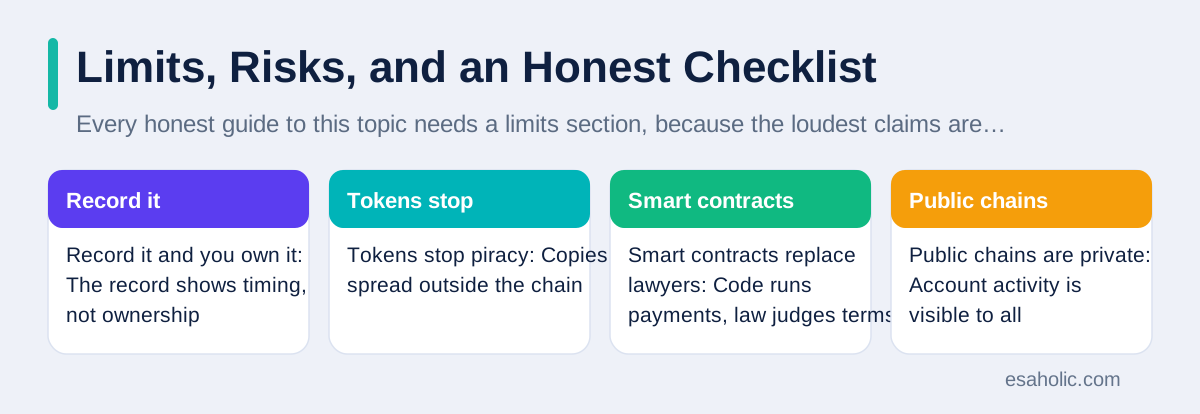
| Claim you may hear | What is actually true | What to do instead |
|---|---|---|
| Record it and you own it | The record shows timing, not ownership | Keep contracts, drafts, and registration where it helps |
| Tokens stop piracy | Copies spread outside the chain | Watermark previews and use written licences |
| Smart contracts replace lawyers | Code runs payments, law judges terms | Pair code with a readable written licence |
| Public chains are private | Account activity is visible to all | Keep sensitive files off chain, record fingerprints only |
| Once recorded, always safe | Small chains can be rewritten | Choose a chain with many independent participants |
Before spending money on any blockchain IP product, run through a short checklist. First, ask what question the product answers that a signed and dated file, a notary, or a registration office cannot answer better and cheaper. Second, ask who runs the chain, how many independent participants check it, and what happens if the vendor closes down. Third, ask who can fix an error, who holds the private keys, and what happens if a key is lost. Fourth, ask a lawyer to read the terms, especially any line that says the token itself grants rights, because that line is where disputes begin. If the vendor cannot answer these questions in plain language, the product is not ready for your most valuable work.
A Practical Workflow for a Small Team
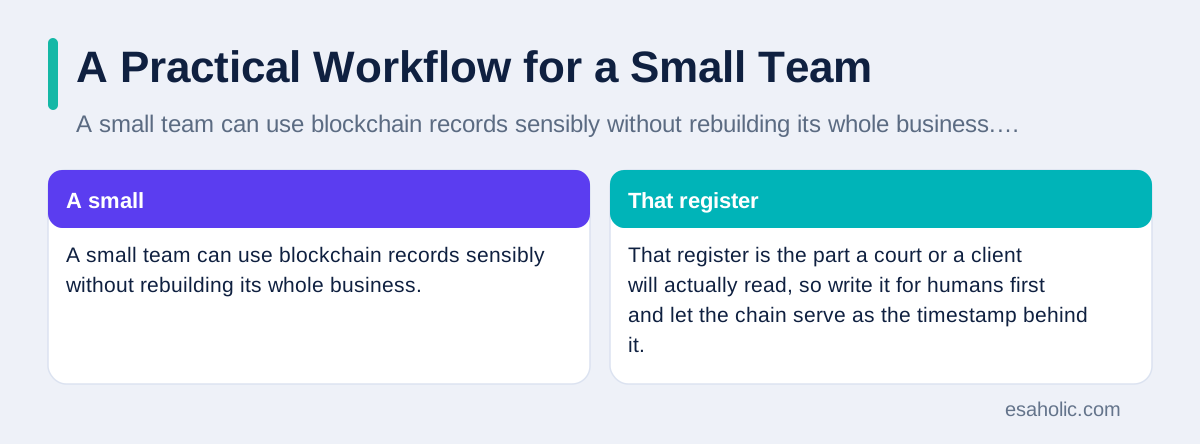
A small team can use blockchain records sensibly without rebuilding its whole business. Start with one kind of work, such as final client deliverables or published articles, and record a fingerprint for each final version alongside the date, the author, and the licence. Keep the originals in backed up storage with clear file names, and keep a simple register, such as a spreadsheet or a document system, that links each fingerprint to its contract and its payment record. That register is the part a court or a client will actually read, so write it for humans first and let the chain serve as the timestamp behind it.
Next, write licence terms that a non lawyer can understand. State who owns the work, what the buyer may do, for how long, in which places, and what happens if payment fails. If you use a smart contract for payments, state in the written licence that the written terms control if the code behaves differently, and name a person who can pause payments when something goes wrong. Good rules for who owns and controls data follow the same pattern: decide ownership and access before choosing tools, not after.
Finally, review the setup once a year. Check that the chain you used still exists and still has many participants, check that your keys are backed up safely, and check that your licences still match how the work is actually used. Technology in this field changes fast, and a record that was easy to verify five years ago may need a new explanation today. Esaholic's custom AI development work takes the same approach with clients: build the smallest system that answers a real question, keep humans in control of the important decisions, and revisit the design as the business and the law change. That discipline turns a fashionable tool into a quiet, useful part of a creator's business.
Conclusion
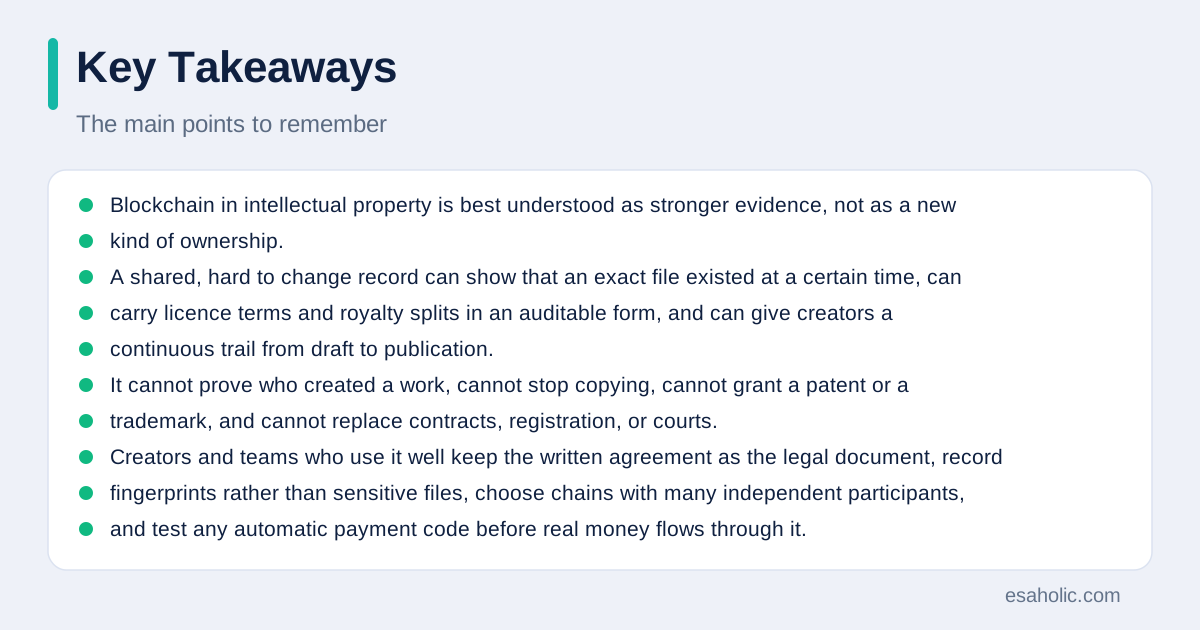
Blockchain in intellectual property is best understood as stronger evidence, not as a new kind of ownership. A shared, hard to change record can show that an exact file existed at a certain time, can carry licence terms and royalty splits in an auditable form, and can give creators a continuous trail from draft to publication. It cannot prove who created a work, cannot stop copying, cannot grant a patent or a trademark, and cannot replace contracts, registration, or courts. Creators and teams who use it well keep the written agreement as the legal document, record fingerprints rather than sensitive files, choose chains with many independent participants, and test any automatic payment code before real money flows through it. Used that way, blockchain becomes a useful witness for creative work. Treated as a replacement for the law, it becomes an expensive misunderstanding, and the misunderstanding usually surfaces only when a dispute arrives. Where IP records need model or data work behind them, AI and ML development is the supporting service.
Frequently Asked Questions
Does putting work on a blockchain give me copyright?
No. Copyright usually arises when you create an original work, not when you record it. A blockchain entry can help show when a work existed and who recorded it, but it does not create the legal right by itself, and registration rules still vary by country.
Can blockchain prove I invented something first?
It can support a claim about timing, because a timestamped record shows a file existed at a certain time. It cannot prove you invented it, that it was new, or that no one else invented it earlier, so patent offices still examine applications on their own evidence and rules.
Is a smart contract the same as a licence?
No. A smart contract is code that runs automatically when conditions are met, while a licence is a legal permission with terms a court can read. The safest setup pairs the two: a written licence people can understand, plus code that carries out payments or access under that licence.
Written by Ahmad Jajja
Senior AI Research Engineer and Generative AI Specialist
Ahmad Jajja is a senior AI research engineer at Esaholic who builds generative AI systems grounded in real documents for accurate answers.
Reviewed by Danish Mustafa
Senior Agentic AI Engineer and Systems Architect
Danish Mustafa is a senior agentic AI engineer at Esaholic who builds AI agents, voice systems, and messaging systems for real customers.
Relevant blogs
Augmented Reality in Accounting: A Simple Guide
How AR overlays help accountants, auditors, and bank customers see numbers clearly and safely.
Latest Breakthroughs in Quantum Computing 2024: A Recap
A dated 2024 recap of error correction milestones, new standards, and honest limits.
Public Key Infrastructure Explained
How key pairs, certificates, and signatures build trust online, in plain language.
Data Governance Frameworks Explained Simply
Who owns data, who may use it, and how teams keep those rules clear.