
Latest Breakthroughs in Quantum Computing 2024: A Recap
This article is a dated recap of 2024, not a report on current news. That distinction matters, because quantum computing announcements age fast, and a 2024 result that once made headlines may since have been repeated, improved, or overtaken. Read this guide as a record of what changed in that year, why researchers cared, and what still stood in the way at the end of it. If you want the present state of the field, treat 2024 as the starting point and check current sources before making any business decision.
The short version of 2024 is a shift from counting qubits to improving them. For years, headlines celebrated machines with more and more qubits, which are the basic units of quantum information, similar in role to bits in ordinary computers but able to hold combinations of values through a property called superposition. By 2024, the field had learned a hard lesson: adding noisy qubits does not add up to a useful machine, because errors pile up faster than results improve. The year's most important work therefore focused on error correction, which is the set of methods that spreads information across many physical qubits so that mistakes can be found and fixed, producing a smaller number of reliable logical qubits.
Two results defined the year for most observers. In April 2024, Microsoft and Quantinuum reported logical qubits built with error correction on a trapped ion machine, and in December 2024, Google announced its Willow chip, which showed error rates falling as correction grids grew. Alongside the hardware, August 2024 brought new encryption standards designed to survive future quantum attacks, which mattered to every organization that stores sensitive data. This recap explains each of those advances in plain language, names the quantum computing challenges that remained, and answers the blunt question readers keep asking: is quantum computing real, in the sense of useful, or still a research project with good press?
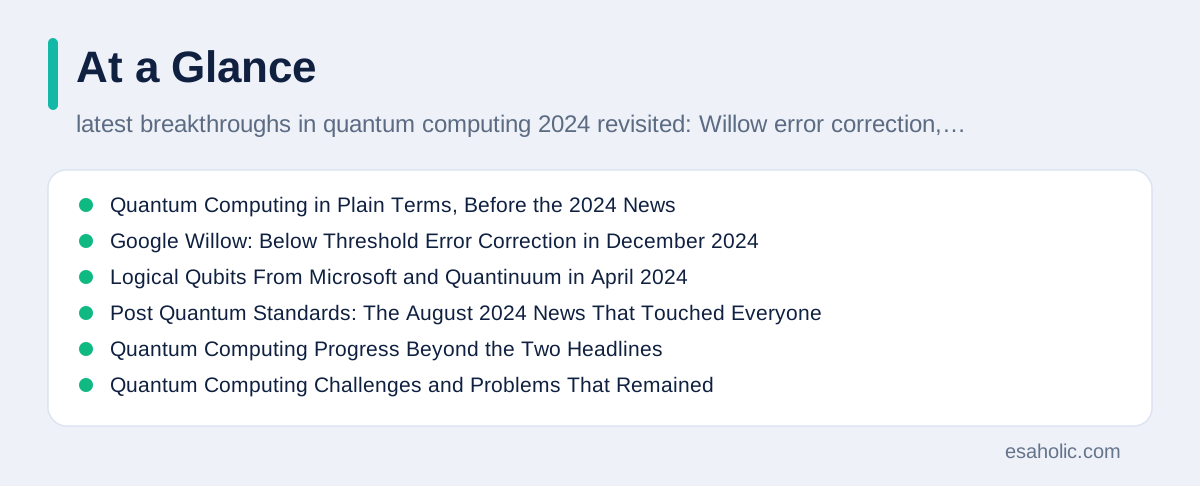
Quantum Computing in Plain Terms, Before the 2024 News
An ordinary computer stores information as bits, which are switches set to 0 or 1, and it runs programs as sequences of steps on those bits. A quantum computer stores information as qubits, which can hold a combination of 0 and 1 at once, and which can be linked together through entanglement, which is a connection that makes the state of one qubit depend on the state of another, even when they are handled separately. Certain problems, such as simulating molecules or searching large mathematical spaces, map naturally onto those combinations, which is why researchers believe quantum machines may one day solve some problems far faster than classical machines, which is the name for today's ordinary computers.
The catch is fragility. Qubits lose their quantum state quickly when disturbed by heat, vibration, or stray electromagnetic signals, a process called decoherence, which means the loss of the delicate quantum behavior that makes the computation work. A computation that needs a thousand steps will fail if the qubits forget their state after a hundred steps, no matter how clever the program. Error correction is the field's answer: instead of trusting one physical qubit, engineers spread one logical qubit across many physical qubits, measure check qubits that reveal errors without reading the protected data, and fix the errors as they appear. The price is steep, because one reliable logical qubit may need hundreds or thousands of physical qubits, but without that price, long programs cannot run at all.
That background explains why 2024 felt different. Earlier years produced machines with impressive qubit counts and short demonstrations, but the demonstrations rarely survived long enough to run a useful program. In 2024, teams began to show that bigger correction codes could actually reduce errors, which is the behavior the theory of fault tolerance, which means computing reliably despite faulty parts, had long predicted but hardware had not yet delivered.
Google Willow: Below Threshold Error Correction in December 2024
Google announced Willow, a 105 qubit superconducting chip, on December 9, 2024. Superconducting qubits are tiny circuits cooled to near absolute zero that behave as quantum bits, and Google built Willow at its fabrication facility in Santa Barbara, California. The headline result was not the qubit count but an error correction test: the team encoded one logical qubit using surface code grids, which are two dimensional patterns of data and check qubits, of 3 by 3, 5 by 5, and 7 by 7 physical qubits, and the logical error rate roughly halved at each step up. Google described this as below threshold operation, which means the hardware had crossed the point where adding more qubits to the code reduces errors instead of adding them.
The details behind that sentence deserve care, because they show both the achievement and its limits. Willow's qubits held their state for nearly 100 microseconds, which is 0.1 milliseconds, about five times longer than Google's previous chip, and the largest logical qubit in the test, built from 101 physical qubits, lasted longer than the best single physical qubit in the device, a crossing researchers call beyond break even. The error correction also ran in real time, which means the system detected and corrected errors while the computation continued, rather than sorting them out afterwards. Google published the full results as a peer reviewed paper in Nature, and its Willow announcement gives the company's own account of the chip and the test.
Willow also ran a benchmark that drew most of the press coverage, and that benchmark needs context. The chip finished a random circuit sampling task, which is a test that produces random outputs from a quantum circuit and is used to compare machines, in under five minutes, while Google estimated that the Frontier supercomputer would need about 10 septillion years for the same task. That estimate is Google's, it rests on generous assumptions about classical methods, and the task itself has no known commercial use. Earlier supremacy claims faced the same pattern, with classical researchers later shrinking the estimated classical time. The lasting part of Willow was therefore not the benchmark number but the error correction scaling, which addressed a real obstacle to useful machines, while the benchmark addressed a race for headlines.
Logical Qubits From Microsoft and Quantinuum in April 2024
Months before Willow, April 2024 produced the year's other landmark error correction result. Microsoft and Quantinuum reported that, working together, they had built four logical qubits from 30 of the 32 physical qubits on Quantinuum's H2 processor, which uses trapped ions, meaning electrically charged atoms held in place by electromagnetic fields and manipulated with lasers, rather than superconducting circuits. The teams reported logical error rates about 800 times lower than the corresponding physical error rates, a striking improvement that showed error correction working on a different hardware platform from Google's.
The two results complemented each other, and the contrast is instructive. Google's test showed scaling, meaning errors falling as the code grew, on one logical qubit stored as a quantum memory. The Microsoft and Quantinuum work showed several logical qubits with much lower error rates than their physical parts, on a trapped ion system known for high quality operations but slower speeds. Neither result, on its own, was a working fault tolerant computer, because a useful machine also needs reliable operations between logical qubits, including expensive operations that are hard to perform on encoded data. Together, though, the two results showed that error correction progress in 2024 was not a single lab's trick but a direction shared across platforms.
Readers should also note what these results did not claim. Neither team claimed a useful business application, a speedup on a real problem, or a machine that customers could buy and run. The logical qubits stored information and ran small tests, and the error rates, while far better than before, still sat far above the levels a long program would need. That honesty is part of why 2024 mattered: the field's leading teams reported their limits alongside their records, and the limits pointed to the next problems, which were scaling to many logical qubits, making logical operations reliable, and cutting the enormous physical overhead that error correction demands.
Post Quantum Standards: The August 2024 News That Touched Everyone
The 2024 advance with the widest practical effect did not involve a quantum computer at all. In August 2024, the United States National Institute of Standards and Technology, usually shortened to NIST, finalized the first post quantum cryptography standards, which are encryption methods designed to resist attacks from future quantum computers. The three standards were ML-KEM, for establishing shared keys, ML-DSA, for digital signatures, and SLH-DSA, for signatures based on hash functions. Organizations that handle long lived secrets, such as health records, state archives, and infrastructure designs, gained approved methods they could start planning around, rather than waiting for a breakthrough machine to appear.
The reason to act early is a threat called harvest now, decrypt later. An attacker can record encrypted traffic today, store it cheaply, and decrypt it years later if a powerful quantum computer arrives, because today's widely used public key methods, which protect most internet traffic, rest on mathematical problems that a quantum algorithm could solve far faster than a classical one. Data with a short life, such as a lunch order, faces little risk from that threat, but data that must stay secret for decades faces real risk now. The NIST standard for ML-KEM is the technical document behind one of the new methods, and migration guides from NIST and vendors explain how organizations inventory their cryptography before changing it.
Migration itself is slow work, and 2024 marked its beginning rather than its end. Systems must find every place old cryptography is used, from website certificates to VPN tunnels to stored backups, test the new methods for speed and compatibility, and update hardware and software that cannot support them. Our guide to how key pairs prove identity explains the system these new standards protect, and teams that understand that system will find migration far less mysterious. The key lesson of August 2024 is simple: quantum computing progress and quantum safe security advanced together, and the security work could not wait for the hardware work to finish.
Quantum Computing Progress Beyond the Two Headlines
Beyond Willow and the trapped ion result, quantum computing progress in 2024 followed a quieter pattern: better quality across several platforms, without a single dominant winner. Superconducting teams continued to improve qubit lifetimes and connection quality, trapped ion teams continued to show high quality operations on smaller systems, and neutral atom teams, which use individual atoms held by laser light as qubits, continued to scale the number of atoms they could control. Each platform traded strengths against weaknesses: superconducting chips ran fast but lost state quickly, trapped ions ran accurately but slowly, and neutral atoms scaled in number but faced their own control challenges. No honest 2024 recap can declare a winning platform, because the race was still about removing different obstacles, not about crossing one finish line.
Software and hybrid methods also advanced in 2024, though with less drama. Hybrid methods, which split a problem between a quantum processor and an ordinary computer, remained the main way researchers used real machines, because current machines are too noisy for long programs on their own. Error mitigation, which is the set of techniques that cleans up noisy results after a run without fully correcting errors during it, helped researchers squeeze better answers from imperfect hardware, and it deserves a clear distinction from error correction, which fixes errors while the program runs.
Investment and roadmaps in 2024 reflected that sober mood. Companies and governments that had once promised quick commercial returns began to speak in terms of error corrected milestones, logical qubit counts, and years of engineering, rather than qubit counts alone. Teams planning AI development that starts from the problem will recognize the pattern: define the result that matters, measure the obstacle honestly, and fund the work that removes it, instead of celebrating a number that does not predict success.
Quantum Computing Challenges and Problems That Remained
Quantum computing challenges at the end of 2024 were still enormous, and any recap that hides them misleads readers. The first challenge is scale. A useful fault tolerant machine may need on the order of a million physical qubits, judging by the overhead of current error correction codes, while 2024 machines held roughly a hundred to a thousand. Closing a gap of that size requires not just more qubits but better ones, plus the wiring, cooling, and control electronics to run them, all of which grow in cost and complexity with every added qubit. The problems with quantum computing in this area are engineering problems as much as physics problems, and engineering at that scale takes years, not quarters.
The second challenge is operations between logical qubits. Storing one logical qubit reliably is a milestone, but a computer must also perform operations between logical qubits, and some of those operations are far harder to protect than storage. A machine that can store data perfectly but cannot combine it reliably cannot run the algorithms that motivate the field, such as simulating complex molecules or factoring large numbers. The third challenge is software: programmers need tools, languages, and debugging methods for machines that behave probabilistically, which means their outputs are governed by chance and must be repeated and checked, unlike the deterministic, meaning step by step predictable, behavior of ordinary programs. Our guide to how parallel work differs from truly simultaneous work gives a useful mental model for why quantum parallelism, which is not the same as ordinary parallel computing, needs its own way of thinking.
The fourth challenge is cost and access. Quantum machines in 2024 ran in specialized facilities with extreme cooling and shielding, and most users reached them through cloud services rather than owning them. That model works for research, but it limits who can experiment, how fast experiments run, and what data organizations will send to a shared machine. Quantum computing problems in this area are practical: who pays for the machine time, who owns the results, and how does a team test an idea without waiting in a queue behind better funded labs?
Is Quantum Computing Real? What 2024 Answered and What It Did Not
Is quantum computing real? The answer in 2024 depended on what the question meant. If it meant whether quantum computers exist as physical machines that run quantum programs, the answer was yes, and had been yes for years, with machines from several companies and labs running real circuits and producing real, checkable results. If it meant whether quantum computers did useful work better than ordinary computers, the answer in 2024 was still no for practical purposes. Benchmarks and small research tasks showed advantages on narrow tests, but no business, science, or government task of general value ran faster, cheaper, or better on a quantum machine than on the classical systems already in use.
That split answer frustrates readers who want a single verdict, but it is the honest one, and 2024 made it clearer. The year's error correction results strengthened the case that useful machines are possible in principle, because they showed the scaling behavior that fault tolerance requires. At the same time, the gap between one or a few logical qubits and the thousands needed for a useful program stayed vast, and no 2024 result closed it. A fair summary is that 2024 moved quantum computing from a question of whether error correction could ever work on real hardware to a question of how fast it can scale, which is progress, but progress measured in engineering years rather than product launches.
For decision makers, the practical response to 2024 was threefold, and it remains sensible. First, start the post quantum security migration, because that work pays off regardless of when useful quantum machines arrive. Second, follow error correction milestones, especially logical qubit counts and logical operation quality, rather than raw qubit counts, when judging progress. Third, treat quantum computing as research to watch and, for a few fields such as chemistry simulation and materials science, research to pilot, rather than as a purchase to make. Teams building custom software built around real constraints already work this way: they invest where a constraint is understood and a result is measurable, and they wait where the constraint is still being discovered.
What to Watch After 2024
The most useful habit after reading a 2024 recap is knowing which numbers to watch next. Watch logical qubit counts, and whether they grow from a handful toward dozens and then hundreds. Watch logical error rates, and whether they keep falling as codes grow, rather than flattening at a floor set by hardware quality. Watch logical operations, especially operations between two logical qubits, because storage without operations cannot compute. Watch the physical overhead, meaning how many physical qubits each logical qubit needs, because a code that needs ten thousand physical qubits per logical qubit will take far longer to scale than one that needs a thousand. And watch post quantum migration, because it is the one 2024 story with deadlines that organizations control themselves.
Readers should also watch for the same hype patterns that distorted earlier years. A new qubit count without error rates tells you little. A benchmark speedup on a task with no practical use tells you little about business value. A company claim without a peer reviewed paper, which is a study checked by independent experts before publication, should be treated as a claim, not a result. The Nature paper on Willow error correction shows what that standard looks like in practice: methods, numbers, and caveats in one place, open to checking.
Finally, remember the scale of the story. Quantum computing began as theory decades before 2024, and its most important year may still lie ahead, when logical qubits become numerous and reliable enough to run a program that matters. Until then, the field's progress will look like 2024 did: quiet engineering gains, occasional headline results, and security work that matters now. Readers who keep that frame will neither dismiss the field as fantasy nor buy into promises it cannot yet keep, and they will be ready, when the next genuine milestone arrives, to judge it by the same standard 2024 set: does the error rate fall as the system grows, and can the result be checked?
Conclusion
Latest breakthroughs in quantum computing 2024 came down to one theme: quality over quantity. Google Willow showed logical error rates falling as surface code grids grew, crossing below threshold and beyond break even on a quantum memory. Microsoft and Quantinuum showed several logical qubits with error rates far below their physical parts on a trapped ion machine. NIST finalized post quantum standards that gave every organization a reason to start migrating its cryptography now, rather than waiting for a future machine. Those were genuine advances, reported with methods and limits, and they moved the field from asking whether error correction could work on real hardware to asking how fast it can scale. What 2024 did not deliver was a useful quantum computer for everyday work, and its remaining challenges, scale, logical operations, software, and cost, stayed large at year end. The honest verdict on 2024 is therefore hopeful but patient: the road to reliable quantum machines got shorter and clearer, and the journey along it will still take years of careful engineering. For the error-correction side of these results, S-NISQ quantum error correction explains the NISQ problem without inventing a standard definition for the term.
Frequently Asked Questions
What was the biggest quantum computing breakthrough of 2024?
The most cited result was Google Willow in December 2024, which showed logical error rates falling as error correction grids grew larger, a sign called below threshold operation. It was a memory result on one logical qubit, not a finished fault tolerant computer, but it answered a question researchers had chased for years.
Did quantum computers become useful in 2024?
No, not for everyday business work. Machines in 2024 ran research tasks, benchmarks, and small tests, while real business problems still ran better on classical computers. The year's progress was about making future useful machines possible, not about replacing current ones.
Why did 2024 matter for ordinary computer security?
Because NIST finalized the first post quantum encryption standards in August 2024, giving organizations approved methods designed to resist attacks from future quantum computers. That work matters now, since data recorded today could be attacked years later, even before a powerful quantum computer exists.
Written by Danish Mustafa
Senior Agentic AI Engineer and Systems Architect
Danish Mustafa is a senior agentic AI engineer at Esaholic who builds AI agents, voice systems, and messaging systems for real customers.
Reviewed by Ahmad Jajja
Senior AI Research Engineer and Generative AI Specialist
Ahmad Jajja is a senior AI research engineer at Esaholic who builds generative AI systems grounded in real documents for accurate answers.
Relevant blogs
Blockchain in Intellectual Property: A Plain Guide
What a shared record proves about creative work, and where lawyers and registries still decide.
Augmented Reality in Accounting: A Simple Guide
How AR overlays help accountants, auditors, and bank customers see numbers clearly and safely.
Parallel Concurrent Processing Explained Simply
How overlapping tasks and truly simultaneous work differ, and how to choose safe shared data.
What Is a Distributed System? A Simple Guide
How many computers work together as one system and keep running when parts fail.