
EU AI Act News: What The Law Is And What To Watch
When people search for news about the EU AI Act, they usually want one of three answers. They want to know what the law actually says, when each part starts to apply, and whether it affects their own business. This guide gives all three answers in plain language, and it stays careful about the details that change. The Act is a long law, and headlines often flatten it into a single claim, such as a ban on AI or a fine for every company. Neither claim is accurate. The law sorts AI systems by risk, and it gives each level a different set of duties. A spam filter and a hiring tool do not face the same rules, and that difference is the whole point of the design.
The EU AI Act, formally Regulation (EU) 2024/1689, is the European Union's comprehensive law for artificial intelligence. Comprehensive here means the law tries to cover the field in one framework, rather than leaving each sector to write its own AI rules from scratch. It entered into force on August 1, 2024, which means it became law on that date, even though most of its duties apply in later phases. That phased design matters for every news story you read. A story that says a duty "starts now" may be talking about one phase, while another duty in the same law may still be months away. Always ask which phase a story means, and which type of system it covers, before you change a product plan.
This guide is a general explainer, not legal advice. It describes the structure, risk levels, timeline, and practical checks a business can run. Penalties in the Act are stated as maximums, which means the largest amount the law allows, not the amount every violation receives. If a headline claims a specific company was fined a specific amount under the Act, check the regulator's own announcement before you repeat it, because many stories mix up proposals, investigations, and final decisions.
What The EU AI Act Is, In One Clear Picture
Picture the Act as a sorting machine with four exits. Every AI system that falls within its scope goes through the sort, and the exit it takes decides what its provider and its deployer must do. A provider is the party that develops a system or places it on the market, while a deployer is the party that uses it in real work, under its own authority. Those two roles carry different duties, and a company can be a provider for one product and a deployer for another. A software vendor that sells a screening tool is a provider of that tool. A company that buys the tool and uses it to rank applicants is a deployer. News stories often blur those roles, so naming your role is the first step toward reading any update correctly.
The Act also covers general purpose AI models, which are large foundation models that can serve many purposes, such as the models behind chat services and coding assistants. Those models get their own set of duties, separate from the duties for a finished system built on top of them. The distinction matters because a company that only uses a model through an application programming interface, which is a standard way for software to call another service, is not automatically the provider of the underlying model. It still has duties as a deployer, especially around transparency and safe use, but the model level duties sit mainly with the model provider. When a vendor says it handles the Act for you, ask which duties remain yours.
Scope is the third idea to hold in mind. The Act can reach a company outside the European Union when its system is placed on the EU market, put into service in the EU, or when its output is used in the EU. That reach resembles the reach of privacy law, where the location of the user matters as much as the location of the company. A United States company that sells only to United States customers, with no EU users and no EU output use, faces a different question from a United States company whose website serves EU visitors. Our guide to how the UK approached AI regulation in 2025 shows a contrasting model, where guidance played a larger role than a single comprehensive statute, and our guide to Japan's promotion first approach shows another contrast.
The Four Risk Levels, Explained With Examples
The risk levels are unacceptable risk, high risk, transparency risk, which is often called limited risk, and minimal risk. Unacceptable risk covers practices the Act bans outright, because they are seen as a clear threat to safety, livelihoods, or fundamental rights. Examples in the Act include social scoring by public authorities, which means ranking people across many areas of life to grant or deny benefits, and certain manipulative practices that exploit vulnerability. A banned practice is not a practice with extra paperwork. It is a practice a company must not do at all within scope, and the ban phase was among the earliest to apply.
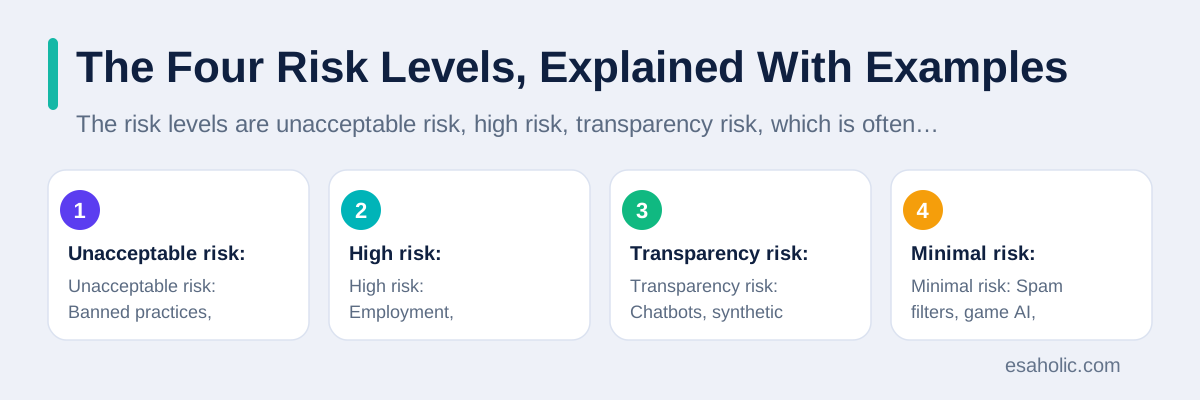
High risk covers uses that can seriously affect health, safety, or fundamental rights. The Act lists these uses in annexes, which are appendices to the law that name categories in detail. Employment is a familiar example: a tool that screens job applicants, ranks workers, or decides who gets a task can change a person's livelihood, so it carries strict duties. Education, access to essential services such as credit, law enforcement, and critical infrastructure, which means systems such as energy and transport networks that society depends on, appear in the same family of uses. High risk does not mean banned. It means permitted only with strong controls, and that distinction is one of the most common errors in news coverage. A headline that calls a hiring tool "banned by the EU" usually means it faces high risk duties, not a ban, unless the tool uses a specifically prohibited practice.
Transparency risk covers systems where the main duty is openness rather than a full control regime. Chatbots, systems that generate synthetic content, and emotion recognition tools sit here in general terms. The duty is to tell people they are interacting with AI, and to label synthetic text, images, audio, and video so readers and viewers can tell what is machine made. That duty sounds simple, and in practice it raises real design questions. A label buried in fine print, or a disclosure that appears only after a user has already acted on the content, may not meet the spirit of the rule. Teams should place labels where a normal reader will actually see them, in plain words, and should test them with real users rather than only with lawyers.
Minimal risk covers most everyday AI, such as spam filters, video game AI, and inventory tools that do not touch high stakes decisions. These systems face no new duties under the risk tiers themselves, though other laws still apply, such as privacy law and consumer protection law. The practical lesson is to spend your compliance energy where the risk sits. A company that treats every tool as high risk will drown in paperwork and still miss the one hiring tool that truly needs controls. A company that treats every tool as minimal risk will miss the same tool from the other direction. Sorting honestly, system by system, is the work that makes the rest of the Act manageable.
| Risk level | What it covers | What the law requires |
|---|---|---|
| Unacceptable risk | Banned practices, such as social scoring | Do not deploy the practice within scope |
| High risk | Employment, education, credit, critical infrastructure, and similar uses | Risk management, records, testing, and human oversight |
| Transparency risk | Chatbots, synthetic content, and emotion recognition | Clear disclosure and labelling |
| Minimal risk | Spam filters, game AI, and ordinary tools | No new tier duties, other laws still apply |
The Timeline: Why Phases Matter More Than A Single Date
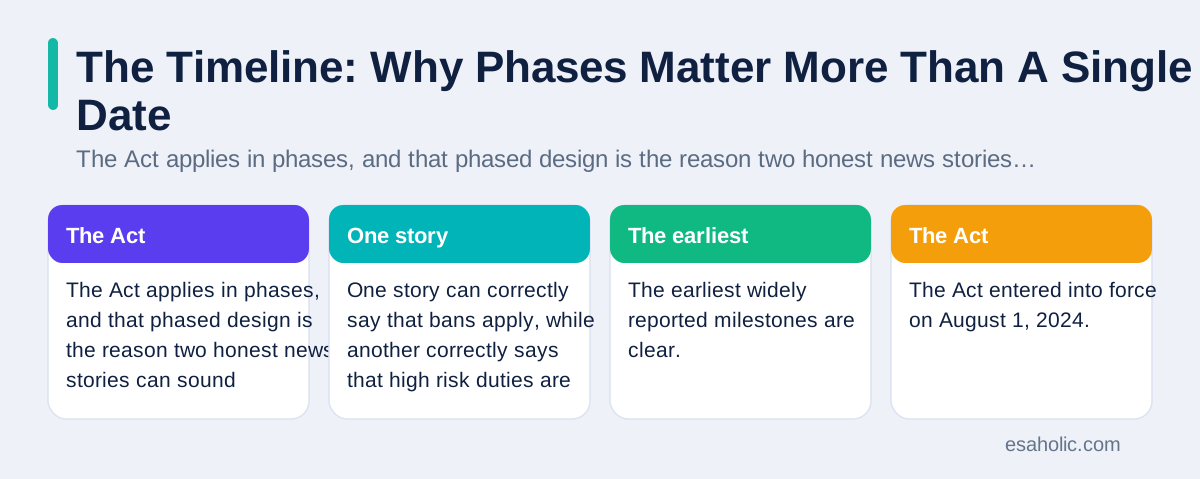
The Act applies in phases, and that phased design is the reason two honest news stories can sound contradictory. One story can correctly say that bans apply, while another correctly says that high risk duties are still coming, because they describe different phases of the same law. The earliest widely reported milestones are clear. The Act entered into force on August 1, 2024. Prohibited practices and AI literacy duties, where literacy means staff understanding what AI can and cannot do, applied from February 2, 2025. Governance arrangements and duties for general purpose AI models followed from August 2, 2025. General application of the Act, including transparency duties, was set for August 2, 2026 in the original schedule.
Later high risk phases have drawn the most reform debate, and readers should treat later dates with extra care. Proposals to move some later deadlines have been discussed and reported, and the final date for a given category can depend on the current version of the law and on transitional rules for systems already on the market. This guide therefore does not present a single later date as settled for every high risk category. The safe habit is to check the current official text and the regulator's guidance for your category, and to record the date you checked, because a guide written months earlier may predate a reform. IBM's explainer on the EU AI Act gives a readable overview of the structure, and the official text remains the authority when an explainer and the law disagree.
What High Risk Duties Actually Ask Teams To Do
High risk duties sound abstract in headlines, so it helps to translate them into team tasks. Risk management means identifying how a system could harm people, estimating how likely and how serious each harm is, and reducing the risk before and after deployment. It is a living process, not a single document written once and filed away. Data governance means knowing where training and testing data came from, checking it for gaps and errors that could skew results, and keeping records that a reviewer can follow. Technical documentation means writing down the system's purpose, its limits, its data, and its test results in a form an auditor can read without guessing.
Human oversight is the duty most teams misunderstand. It does not mean a person glances at an output and clicks approve. It means a competent person with real authority can understand the output, spot a likely error, and override or stop the system. A reviewer who lacks training, time, or power to disagree is not oversight in any meaningful sense, and regulators and courts are likely to see through that arrangement. Logging, which means keeping a record of what the system did, supports oversight, because a reviewer cannot check a decision that left no trace. Accuracy and robustness testing, which means testing whether the system stays correct under realistic conditions, including messy inputs, completes the core set. Teams that already test software carefully will recognize these duties as familiar engineering discipline, applied with extra care because the stakes are human.
Conformity assessment is the formal check that a high risk system meets the Act's requirements before it is placed on the market or put into service. In plain terms, it is the process that earns the right to mark the system as compliant, similar in spirit to safety marks on physical products, though the exact route depends on the category. Registration in an EU database applies to certain high risk systems, so that regulators and, in some cases, the public can see what is deployed. Post market monitoring means watching the system after launch, collecting reports of problems, and acting on them. Launch is not the end of compliance, because the Act expects learning after launch. That ongoing watch is close to compliance monitoring, which tracks whether required checks keep happening after launch.
General Purpose AI Models And Transparency Duties
General purpose AI models sit in their own lane because they are reused across countless systems. The Act asks model providers for documentation about the model, including how it was trained in general terms, and for cooperation with downstream system providers who need information to meet their own duties. Models with systemic risk, which means risk that could spread widely because the model is powerful and widely used, face extra duties around risk assessment, incident reporting, and security. Thresholds and assessment methods are technical and debated, so teams should follow the AI Office's published guidance rather than a summary alone.
Transparency duties deserve a separate paragraph because they touch almost every business, even one with no high risk system. If you run a chatbot, label it as AI. If you publish synthetic images or video, mark them as synthetic. If you use a deepfake, which is realistic synthetic media that can mislead viewers about what a real person said or did, label it clearly. These duties apply to content, not only to models, so marketing teams, support teams, and social media teams all need to know them. Our work on generative AI development treats labelling as part of the product design, not as a footnote added at launch, because a label added late is often a label users never see.
Who Enforces The Act, And What Penalties Really Mean
Enforcement is shared, not held by one office alone. The AI Office within the European Commission handles general purpose AI models with systemic risk, while national authorities in each member state handle market surveillance, which means checking products on their national market, and complaints and penalties for many other cases. That split means a company may deal first with a national authority where it operates, and enforcement practice can vary by country in the early phases. News about a single country's action should not be read as an EU wide crackdown, and silence in one country should not be read as permission everywhere.
Penalties are stated as maximums tied to global annual turnover, which means a company's total worldwide revenue for the year, or to a fixed euro amount, whichever is higher in the relevant band. The highest band, for prohibited practices, reaches 35 million euros or 7 percent of global annual turnover. Other bands are lower, for example 15 million euros or 3 percent for many high risk and general purpose model breaches, and lower again for supplying incorrect information. Those numbers explain why headlines focus on fines, but they do not predict what any company will pay. Regulators consider gravity, duration, cooperation, and corrective action, and many early outcomes are likely to involve guidance and correction rather than a maximum fine. Treat a penalty story as a signal about enforcement priorities, not as a price list.
What Businesses Outside The EU Should Watch
For a United States business, the useful question is not whether the Act is "an EU problem." The useful question is where your systems touch the EU, and in what role. Start by listing every AI system, including tools bought from vendors, features embedded in software you already use, and models called through an interface. Many companies discover systems they did not count, such as a recruitment add on inside a human resources platform, or a fraud check inside a payment tool. Vendors should be asked, in writing, which duties they accept and which duties they leave to you, because a vendor's marketing page rarely answers that question with enough precision.
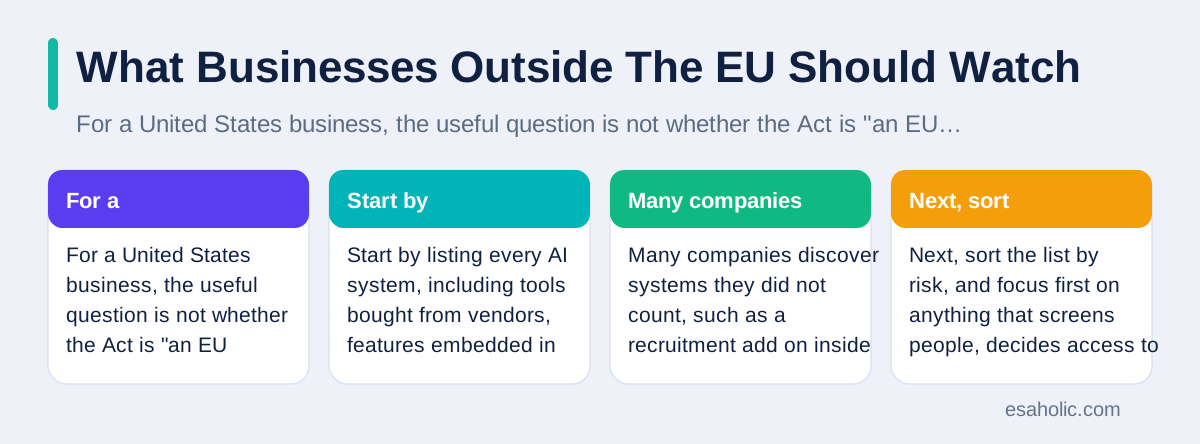
Next, sort the list by risk, and focus first on anything that screens people, decides access to money or services, grades students, or monitors workers. Those categories carry the heaviest duties, and they are also the categories where a mistake harms a real person quickly. Then check transparency duties for everything customer facing, because those duties are broad and relatively cheap to meet.
Teams building new products can use the Act as a design checklist even before any duty formally applies to them. Risk management, documentation, testing, and human oversight are good engineering whether or not a regulator asks for them, and they make later compliance far cheaper. The NIST AI Risk Management Framework offers a widely used, voluntary structure for the same ideas, organized around governing, mapping, measuring, and managing risk, and the OECD AI Principles set out shared values such as transparency, robustness, and accountability. A team that follows those frameworks will find the Act's duties familiar, because the Act turns many of the same principles into legal duties with dates attached.
How To Read EU AI Act News Without Being Misled
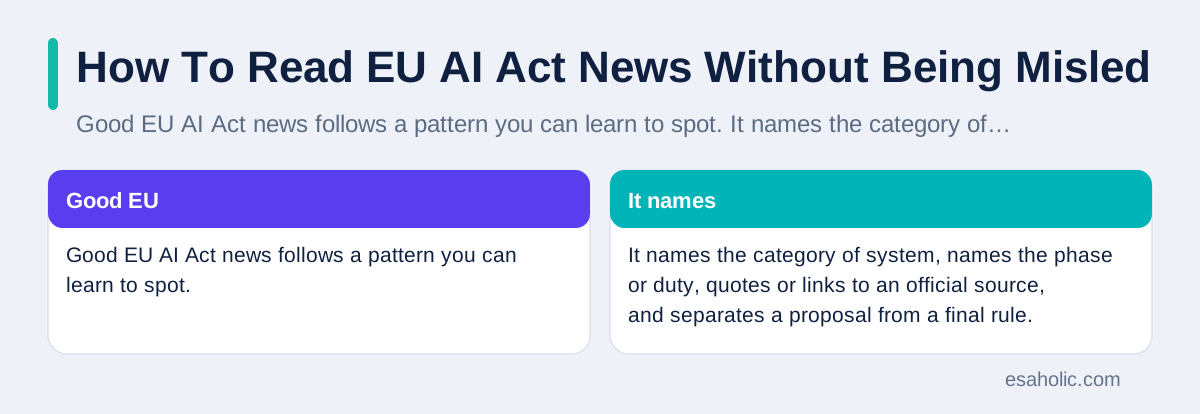
Good EU AI Act news follows a pattern you can learn to spot. It names the category of system, names the phase or duty, quotes or links to an official source, and separates a proposal from a final rule. Weak news does the opposite: it says "the EU bans AI," it quotes a fine without naming the violation, or it treats a trade body's warning as a regulator's decision. A second warning sign is a story that applies one court case to every company in every sector.
A third habit is to watch what changes after a headline. Guidance documents, codes of practice, and regulator statements often matter more than the first headline, because they explain how a duty will be interpreted in practice. A code of practice is a voluntary set of detailed practices that helps providers show compliance, and while it is not the law itself, following a recognized code can shape how a regulator judges a company. Conversely, a loud industry warning about a deadline may be lobbying, which means advocacy to change a rule, rather than a statement of the current law. Keep a short log of updates for your own categories, with the source and the date, and review it quarterly. That log will serve you better than a feed of breaking news alerts.
Conclusion
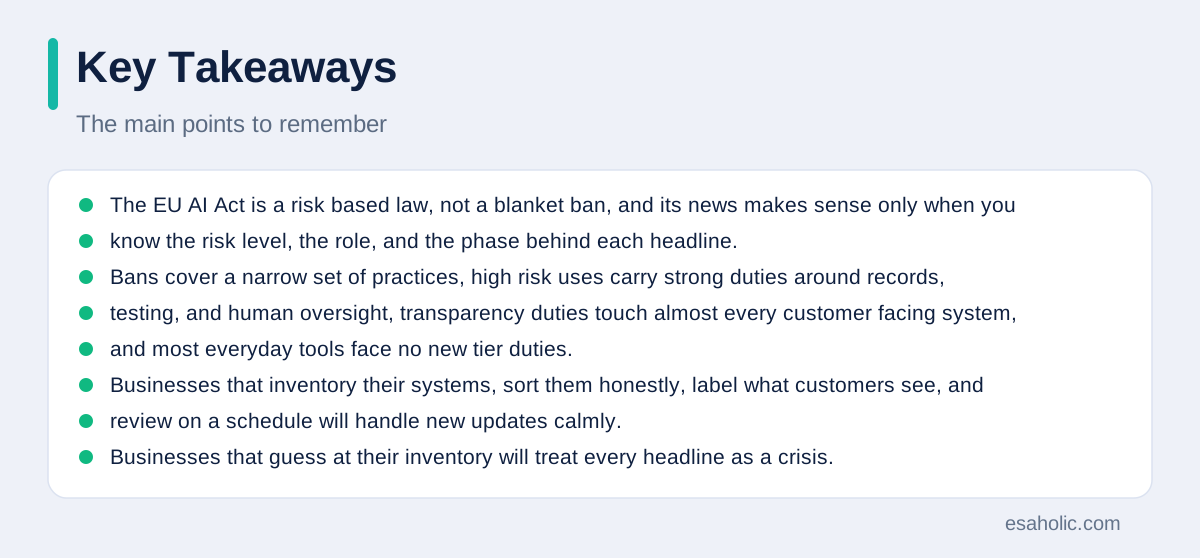
The EU AI Act is a risk based law, not a blanket ban, and its news makes sense only when you know the risk level, the role, and the phase behind each headline. Bans cover a narrow set of practices, high risk uses carry strong duties around records, testing, and human oversight, transparency duties touch almost every customer facing system, and most everyday tools face no new tier duties. Businesses that inventory their systems, sort them honestly, label what customers see, and review on a schedule will handle new updates calmly. Businesses that guess at their inventory will treat every headline as a crisis. Start with the list, and let the law's structure do the rest of the work.
Frequently Asked Questions
Does the EU AI Act apply to a company outside the European Union?
It can apply when a system is placed on the EU market, put into service in the EU, or when its output is used in the EU, even if the company sits elsewhere. Location alone does not settle the question, so a company should check where its users are and where its outputs are used.
What is the simplest first step for a small business under the EU AI Act?
The simplest first step is a list of every AI system the business uses, with its purpose, its owner, and its risk level. That list turns a large law into a short set of decisions, and it shows which systems need extra records, human review, or transparency labels.
Is a chatbot automatically a high risk system under the EU AI Act?
No. A general chatbot usually falls under transparency duties, which means telling people they are talking to AI and labelling synthetic content. It becomes higher risk only when its use matches a high risk category in the Act, such as screening job applicants or deciding access to a regulated service.
Written by Umar Abbas
Founder, Principal AI Architect and Operator
Umar Abbas is the founder of Esaholic and a principal AI architect who designs reliable large scale AI systems for regulated industries.
Reviewed by Amir Iqbal
Senior AI Systems Architect and Lead Technical Reviewer
Amir Iqbal is a senior AI systems architect at Esaholic who reviews code and architecture and keeps live AI systems fast and reliable.
Relevant blogs
Uk Ai Regulation News Today 2025: A Review
How the UK approached AI regulation in 2025, and what stayed guidance rather than hard law.
Japan Ai Regulation News Today 2025: A Guide
Japan's promotion first approach to AI, and where its rules stopped short of hard law.
Ai Governance Business Context Strategic Visibility Guide
How leaders set rules, see risk clearly, and keep AI work honest in plain language.
AI Contextual Governance Business Evolution Adaptation
Rules that change with context, risk, and growth, with practical steps for teams at every stage.
Back to all blog guides · Back to AI News and Regulation guides · Explore AI and ML Development Services