
Ai Governance Business Context Strategic Visibility Guide
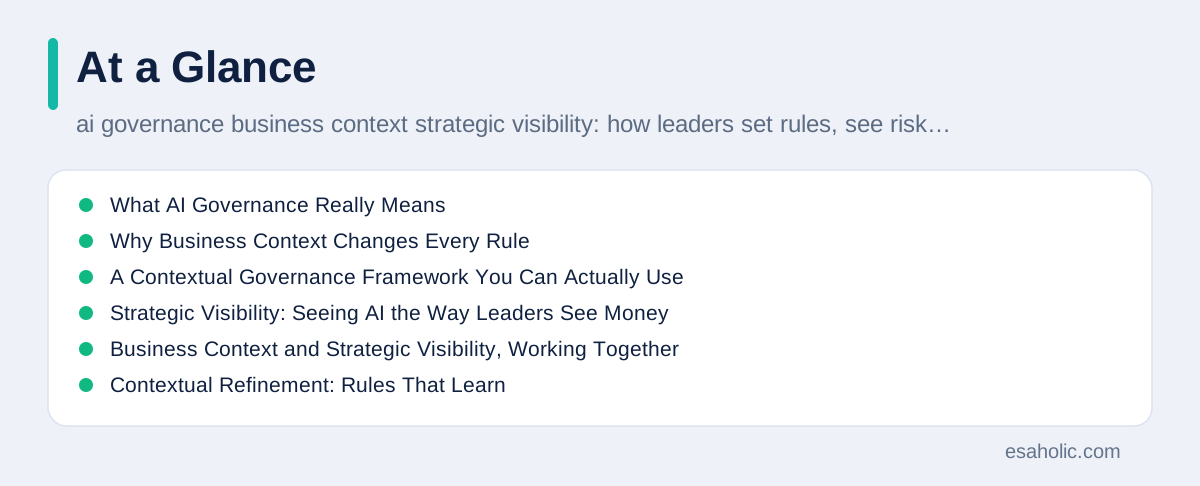
Most companies do not have an AI problem. They have a visibility problem. Teams adopt a chatbot here, a writing tool there, and a forecasting model in finance, and nobody holds a single list of what is running, who owns it, or what could go wrong. Leaders then make big decisions about AI with partial facts, and small problems grow quietly until a customer, a regulator, or a news story brings them into the open. This guide explains ai governance business context strategic visibility in plain language: governance means the rules and owners for AI use, business context means the real work, customers, and risks those rules must fit, and strategic visibility means leaders can actually see what is happening and act on it.
Think of governance as the operating system for AI in a company, not as a pile of paperwork. A good system answers five simple questions for every AI tool. What is this tool for? Who owns it? What data may it use? Who checks its output before it affects a customer? And what happens when it makes a mistake? If a team cannot answer those questions in one minute, the tool is not governed yet, even if a policy document exists somewhere. The goal is not to slow useful work. The goal is to make useful work safe to scale, so a successful pilot can grow into a trusted product without a crisis in the middle.
Business context is what keeps governance honest. A rule that fits a bank will not fit a small retailer, and a rule that fits a marketing team will not fit a hiring team. The stakes change with the decision. A tool that drafts social posts can be wrong and still be fixed cheaply. A tool that screens job applicants, sets prices, or approves credit can harm real people if it is wrong, biased, or opaque. That difference, which people call risk, must shape how strict the checks are. This guide walks through that judgment step by step, with examples a manager can use in a meeting, not only in a compliance file.
What AI Governance Really Means
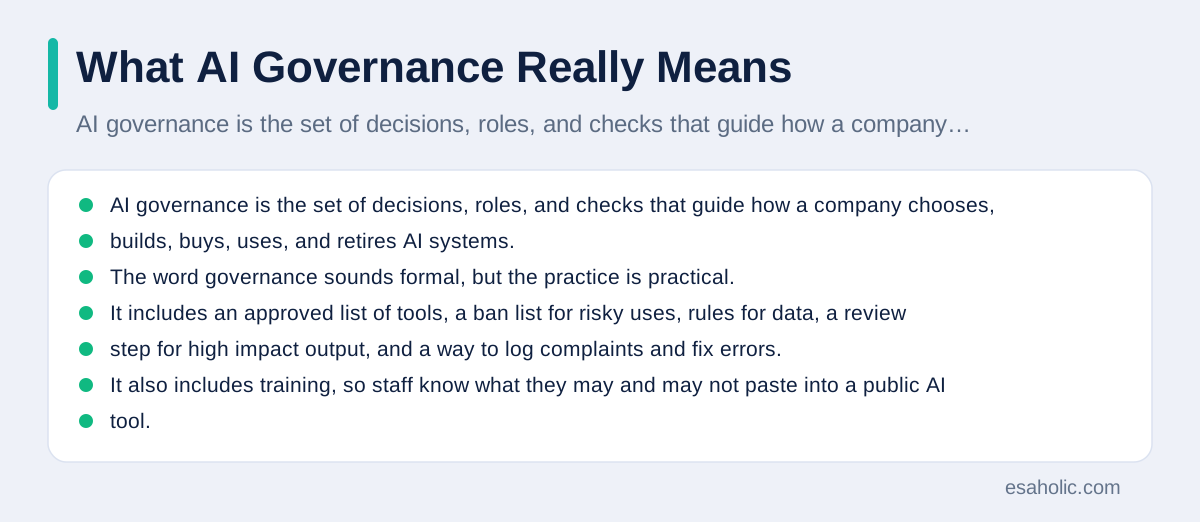
AI governance is the set of decisions, roles, and checks that guide how a company chooses, builds, buys, uses, and retires AI systems. The word governance sounds formal, but the practice is practical. It includes an approved list of tools, a ban list for risky uses, rules for data, a review step for high impact output, and a way to log complaints and fix errors. It also includes training, so staff know what they may and may not paste into a public AI tool. Without those basics, governance is only a slogan, and staff will improvise, which is where most incidents begin.
A useful way to test your governance is to ask for the AI inventory, which is a simple list of every AI system in use, its purpose, its owner, the data it touches, and its risk level. In many companies, that list does not exist, or it lists only the systems the IT team bought, while missing the tools individual teams adopted on their own. That gap is often called shadow AI, which means AI use that leaders cannot see. Shadow AI is not always malicious. A support agent may use a chatbot to draft replies faster, with good intent. But if that chatbot receives customer names, order details, or health information, the company has a privacy risk it never approved. Visibility starts by finding that hidden use without punishing the people who reveal it.
Governance also covers the full life of a system, not only its launch. A model that worked well in January may drift, which means its performance slowly changes as customer behavior, language, or data changes. A vendor may update a model without telling you, changing its answers. A rule may change, making a once legal use risky. Good governance therefore includes scheduled reviews, a named owner who watches for drift, and a retirement plan for tools that no longer earn trust. A system without an owner and a review date is a system waiting for a surprise.
Why Business Context Changes Every Rule
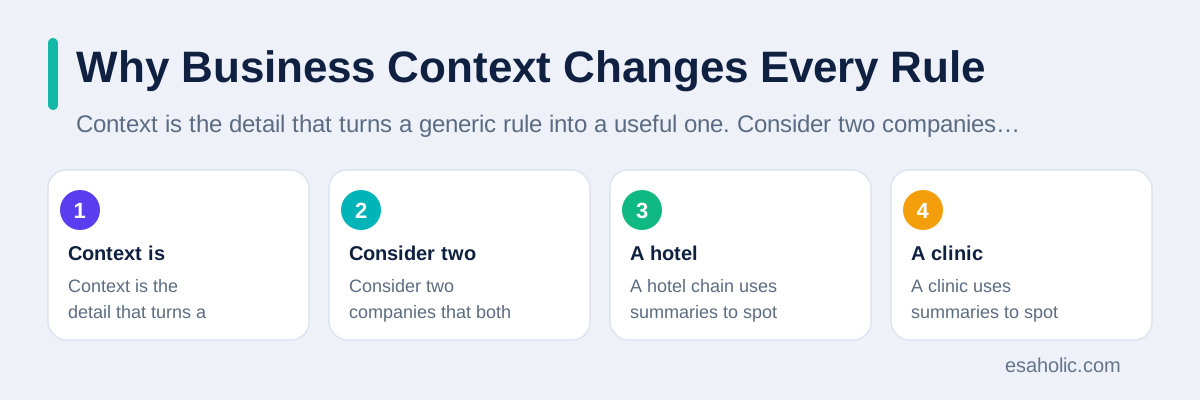
Context is the detail that turns a generic rule into a useful one. Consider two companies that both use AI to summarize customer feedback. A hotel chain uses summaries to spot broken showers and slow check in, and the main risk is a wrong summary that wastes a maintenance visit. A clinic uses summaries to spot patients who need urgent follow up, and the main risk is a missed warning that harms a patient. The same technology needs different checks, different human review, and different speed, because the business context, meaning the purpose, the people affected, and the harm if the system fails, is different. A framework that ignores that difference will either over control the hotel or under control the clinic.
Ai governance contextual business reality also means understanding how work really happens, not how an org chart says it happens. If a policy says every AI draft needs manager approval, but managers approve hundreds of drafts a day without reading them, the policy creates the appearance of control while adding delay. A contextual approach asks a better question: where does a human check actually change the outcome? For low risk drafts, a spot check and a clear correction path may be enough. For high risk decisions, a real review with access to the underlying data is required, and the reviewer must be able to overrule the system without penalty. That honesty about real work is what makes governance stick.
Context also includes your customers, your contracts, and your regulators. A company that serves customers in Europe, California, or a regulated industry faces different duties about data, disclosure, and automated decisions. A company that promises clients that their data will never train a vendor model must check vendor terms, not only its own policy. A company that uses AI in hiring must think about fairness, which means checking whether the system treats groups of people differently for reasons unrelated to the job. Writing those context notes into each system record takes minutes, and it saves hours of argument later, because the reason for a strict check is visible next to the system it protects.
A Contextual Governance Framework You Can Actually Use
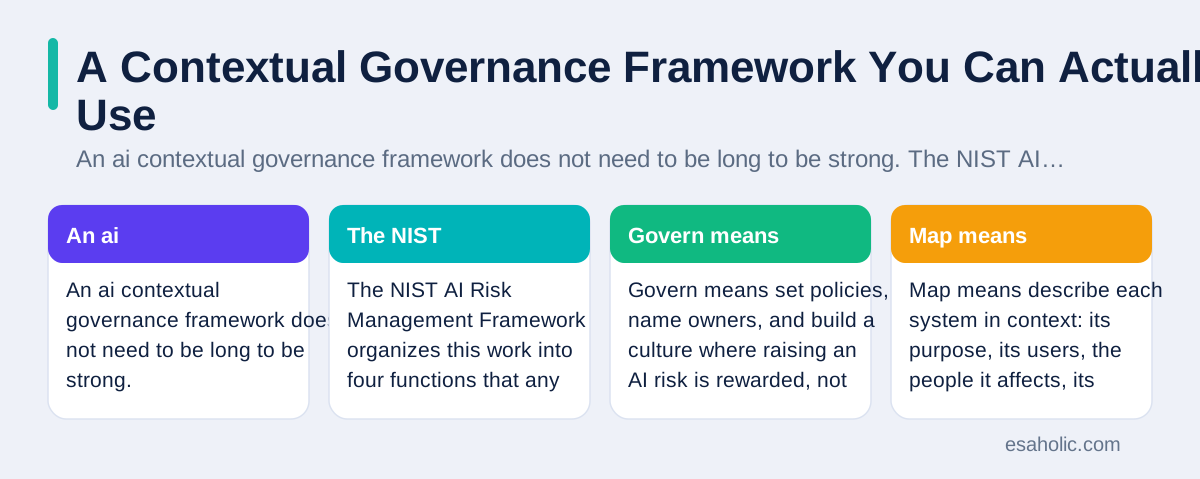
An ai contextual governance framework does not need to be long to be strong. The NIST AI Risk Management Framework organizes this work into four functions that any team can learn: Govern, Map, Measure, and Manage. Govern means set policies, name owners, and build a culture where raising an AI risk is rewarded, not punished. Map means describe each system in context: its purpose, its users, the people it affects, its data, and its possible harms. Measure means test the system with real cases, including hard cases, and track accuracy, fairness, and failure rates. Manage means act on what you find: fix, limit, monitor, or retire the system, and keep records of the decision.
For a small or mid sized company, translate those four functions into a one page routine. Govern: write a short AI policy, name an AI owner, and list approved and banned uses. Map: fill in one record per system, with purpose, owner, data, and risk level. Measure: run a small test set each quarter, review complaints and overrides, and check a sample of outputs by hand. Manage: hold a short monthly review, close open risks, and update the inventory. That routine is not a watered down version of governance. It is governance, at the scale the business can actually run. A framework that nobody follows is weaker than a short routine that everyone follows.
Larger companies add structure on top of the same routine: a cross functional committee with legal, security, product, and operations members; a risk register, which is a log of known risks and their owners; and approval gates for high risk systems. The key discipline stays the same. No high risk system ships without a named owner, a context record, test evidence, and a monitoring plan. IBM's guide to AI governance makes a similar point: governance works when accountability, transparency, and lifecycle checks are built into everyday product work, not added as a final review. If your committee meets only to approve documents, it is not governing. It is filing.
Strategic Visibility: Seeing AI the Way Leaders See Money
Strategic visibility means leaders can answer, at any time, what AI the company runs, what value it creates, what risk it carries, and what needs attention next. Compare that with money. A chief executive would never accept a finance report that listed only half the accounts, with no owner for each account and no warning for overdue items. Yet many executives accept exactly that for AI. Ai governance strategic visibility closes that gap. It turns scattered AI use into a clear picture that a board, a regulator, or a customer can understand, and it lets leaders shift money and attention to the systems that deserve it.
A practical visibility page has five parts. First, the inventory: every system, its owner, and its status. Second, risk: each system marked high, medium, or low, with a one line reason. Third, value: what the system saves, earns, or improves, in plain numbers where possible. Fourth, health: recent test results, complaint counts, and override rates, which show how often humans disagreed with the system. Fifth, actions: open risks, their owners, and their due dates. When those five parts sit together, a leader can spot the pattern that matters: a high risk system with no recent test, a low value system with high cost, or a team using an unapproved tool for a critical job. Without that page, leaders govern by anecdote, and anecdotes always favor the loudest demo. That health view pairs with compliance monitoring, which tracks whether required checks actually happened.
Business Context and Strategic Visibility, Working Together
Ai business context strategic visibility is the combination that matters most, because context without visibility stays local, and visibility without context stays shallow. A dashboard that lists fifty systems without their business purpose tells a leader nothing about which system deserves attention. A team that understands its own context but never reports it leaves leaders blind. The fix is simple: every inventory record carries its context in plain words. Purpose in one sentence. People affected in one sentence. Harm if wrong in one sentence. Data used in one sentence. Review date in one line. That record, repeated for each system, is what turns a list into a strategy.
This combination also helps with vendor choices. When a vendor offers a new AI feature, context asks whether the feature fits a real business need and a real risk profile. Visibility asks whether the company already owns a tool that does the same job, and whether the new tool would add a new data risk. Many companies buy overlapping tools because no single view showed the overlap. A visible inventory, with context notes, stops duplicate spending and duplicate risk at the same time. It also strengthens negotiation, because the company can show a vendor exactly what data protections and audit rights it needs, instead of accepting standard terms by default.
Contextual Refinement: Rules That Learn
Ai governance business context contextual refinement means improving rules in small, regular steps as tools, work, and risks change. A policy written once and never updated will drift away from reality within months. New tools arrive, old tools change, teams reorganize, and customer expectations shift. Refinement is the habit of asking, after each incident, complaint, or review: what did we learn, and what rule, check, or training should change? That question, asked monthly, keeps governance close to real work, while a yearly rewrite leaves long gaps where outdated rules mislead staff.
Refinement works best when it uses evidence, not opinion. Keep three simple logs: incidents, where AI output caused harm or near harm; overrides, where a human disagreed with the system; and questions, where staff were unsure whether a use was allowed. Review those logs together each month. If overrides cluster around one system, its data or its instructions need work. If questions cluster around one rule, the rule needs clearer words or better examples. If incidents repeat, the system needs a stronger check or a pause. This evidence loop is what separates a living framework from a document that everyone ignores, and it gives staff a reason to report problems, because reporting leads to visible fixes.
Continuous Improvement and a Simple Dashboard
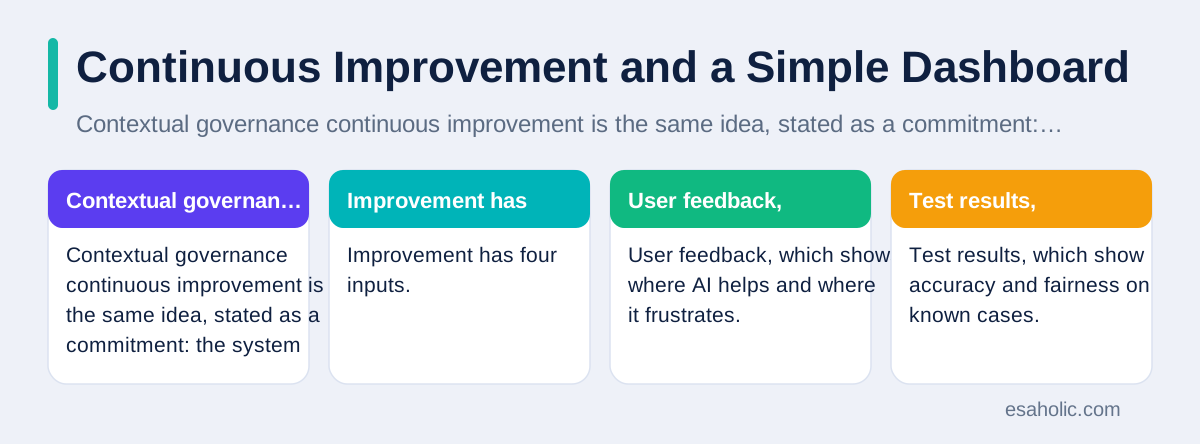
Contextual governance continuous improvement is the same idea, stated as a commitment: the system gets better every month, in small steps, rather than waiting for a crisis. Improvement has four inputs. User feedback, which shows where AI helps and where it frustrates. Test results, which show accuracy and fairness on known cases. Incident reviews, which show what went wrong and why. And external change, which includes new laws, new vendor terms, and new attack methods. A team that reads those four inputs together will rarely be surprised, because surprises usually announce themselves first as a small rise in complaints or a small drop in test scores.
Build the dashboard before you need it, using tools you already own. A spreadsheet works for a small company. A simple internal page works for a larger one. The dashboard needs only the five parts described earlier: inventory, risk, value, health, and actions. Add one more part for accountability: the date of the last review and the name of the reviewer for each high risk system. That single field changes behavior, because nobody wants their name next to a system that has not been reviewed in a year. Google Cloud's overview of AI governance stresses the same lifecycle view: governance covers data, models, deployment, and monitoring together, not one stage in isolation.
For teams that build AI for clients, the dashboard also becomes a delivery asset. Our AI and ML development services follow the same discipline: name the system, record its context, test it on real cases, and monitor it after launch. Clients do not need to learn framework jargon to benefit. They need to see, in plain words, what was built, what data it uses, how it was tested, and who watches it now. If your vendor cannot show you that page for your own system, ask for it before the next phase, because that page is the difference between buying a demo and buying a system you can run.
Common Mistakes That Undermine Good Governance
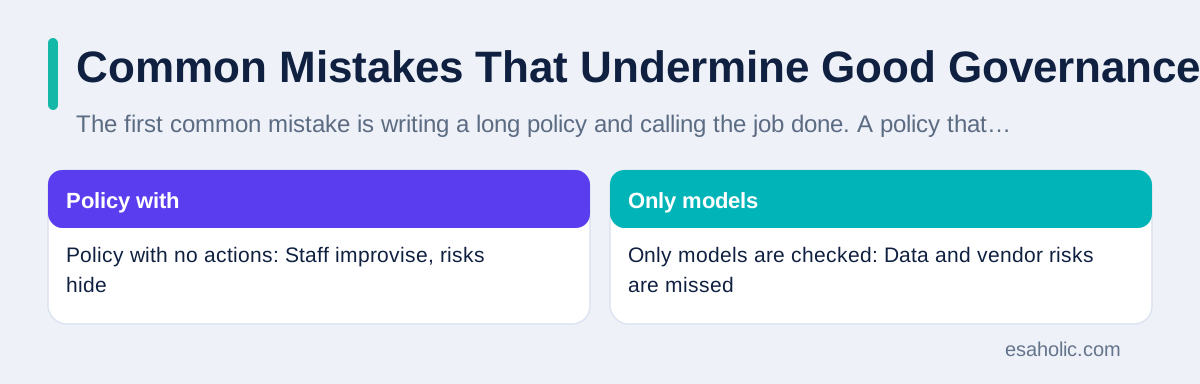
The first common mistake is writing a long policy and calling the job done. A policy that nobody reads, nobody trains on, and nobody checks is not governance. It is a liability, because it proves the company knew the risk and did nothing practical about it. The fix is to turn each policy sentence into an action: a list, a check, a training note, or a review date. If a sentence cannot become an action, rewrite it until it can, or delete it.
The third mistake is treating governance as a project with an end date. A launch review is useful, but it is not enough, because models, data, and rules keep changing. Governance needs an owner, a calendar, and a budget, like security or finance. When leaders fund governance as ongoing work, teams keep the inventory current and the dashboard honest. When leaders fund it once, the inventory rots, and the next incident finds the company unprepared. Ongoing governance costs less than one serious incident, in money, in trust, and in time.
| Governance mistake | What happens | Simple fix |
|---|---|---|
| Policy with no actions | Staff improvise, risks hide | Turn each rule into a list, check, or review date |
| Only models are checked | Data and vendor risks are missed | Check data permission and vendor terms for every system |
| One time launch review | Drift and rule changes go unnoticed | Quarterly tests and a monthly risk review |
| No visible inventory | Leaders govern by anecdote | One page dashboard with owner, risk, and review date |
| Reporting is punished | Problems stay hidden until they explode | Reward early reports and show the fix that followed |
Getting Started This Week
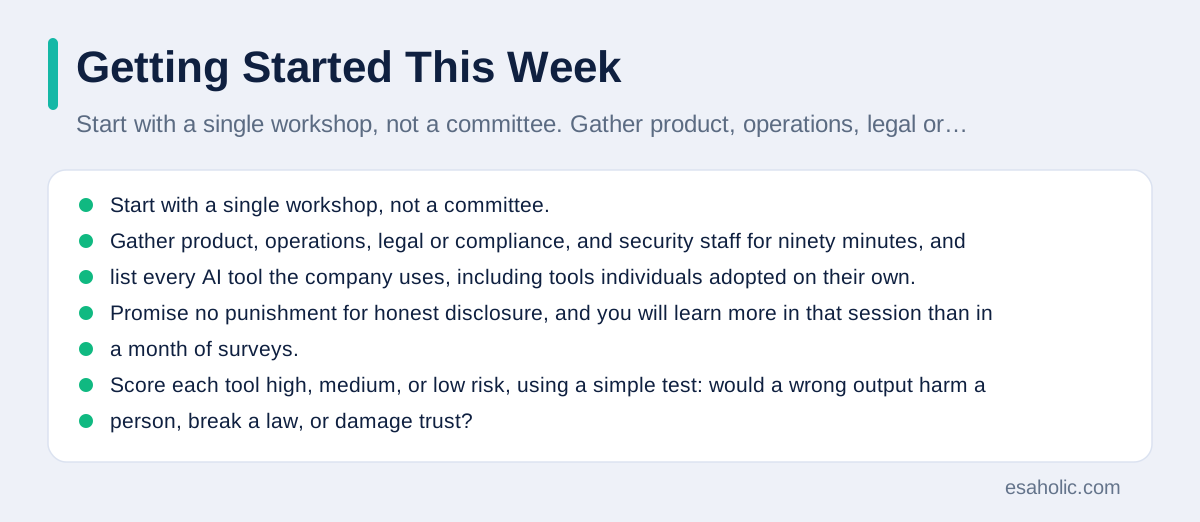
Start with a single workshop, not a committee. Gather product, operations, legal or compliance, and security staff for ninety minutes, and list every AI tool the company uses, including tools individuals adopted on their own. Promise no punishment for honest disclosure, and you will learn more in that session than in a month of surveys. Score each tool high, medium, or low risk, using a simple test: would a wrong output harm a person, break a law, or damage trust? Name an owner for each high risk tool before the meeting ends, and set a review date within thirty days.
In week three, test one high risk system on hard cases and review the results with its owner. Check a sample of outputs by hand, check fairness across groups where that matters, and check what happens when input data is messy or incomplete. Log the findings, fix the worst issue, and schedule the next test. By the end of the month, the company will have something most companies lack: a visible inventory, a named owner for each risky system, a tested system, and a calendar for the next review. That is a strong start, and it is a start any business can afford. For a deeper look at how agent systems need the same discipline, read our guide on teams of AI agents and how they are checked, and for the wider agent picture, read our guide on what agentic AI systems do.
Conclusion
Good AI governance fits the business it serves, and it stays visible to the leaders who must act on it. Name every system, record its context in plain words, test it on real cases, review it on a calendar, and improve the rules in small steps when evidence points to a change. That routine protects customers, satisfies regulators, and lets useful AI scale without a crisis. Start this week with one inventory, one owner per risky system, and one dashboard that leaders actually read, and build from there.
Frequently Asked Questions
What is AI governance in a business, in simple terms?
AI governance in a business is the set of rules, owners, and checks that decide which AI tools a company may use, what data may go into them, who reviews the output, and how problems are fixed. It turns good intentions into named responsibilities and regular reviews, so AI work stays safe, legal, and useful.
Why does strategic visibility matter for AI governance?
Strategic visibility matters because leaders cannot manage AI they cannot see. When leaders can see every AI system, its owner, its risk level, and its recent checks on one page, they can stop risky work early, fund work that helps customers, and answer regulators and customers with facts instead of guesses.
How can a small business start AI governance without a large team?
A small business can start with a one page AI inventory, one named owner for each tool, a short list of approved and banned uses, and a monthly review of mistakes and complaints. That small routine covers the most important risks, and it can grow into a fuller framework as the business grows.
Written by Umar Abbas
Founder, Principal AI Architect and Operator
Umar Abbas is the founder of Esaholic and a principal AI architect who designs reliable large scale AI systems for regulated industries. He writes about AI governance, system design, and practical controls in plain language.
Reviewed by Amir Iqbal
Senior AI Systems Architect and Lead Technical Reviewer
Amir Iqbal is a senior AI systems architect and lead technical reviewer at Esaholic. He reviews Esaholic guides for technical accuracy and clarity before publication.
Relevant blogs
Multi-Agent AI News: Teams Of AI Agents Explained
What teams of AI agents are, where they are used, and what to watch, in plain language.
What Is Agentic AI? A Simple Explanation
AI systems that set goals, plan steps, use tools, and check their own work.
Agentic RAG Explained: Architecture, Agents, and Uses
How retrieval grounded agents plan searches, check sources, and answer from your own documents.
Building Agentic AI Applications with a Problem-First Approach
Start with one clear problem, measure it, pilot on real cases, and scale only when the evidence supports it.
Back to all blog guides · Back to AI News and Regulation guides · Explore AI and ML Development Services