Machine Learning Algorithms Explained Simply
Written by Ahmad Jajja · Reviewed by Umar Abbas ·
Machine learning algorithms are the step by step methods that help computers learn patterns from data. Instead of a programmer writing a rule for every possible case, the programmer picks a method, feeds it examples, and lets the method find the pattern itself. Once it has learned the pattern, it can make a prediction or a decision about new data it has never seen before. That simple idea powers spam filters, product recommendations, price forecasts, and many tools you use every day.
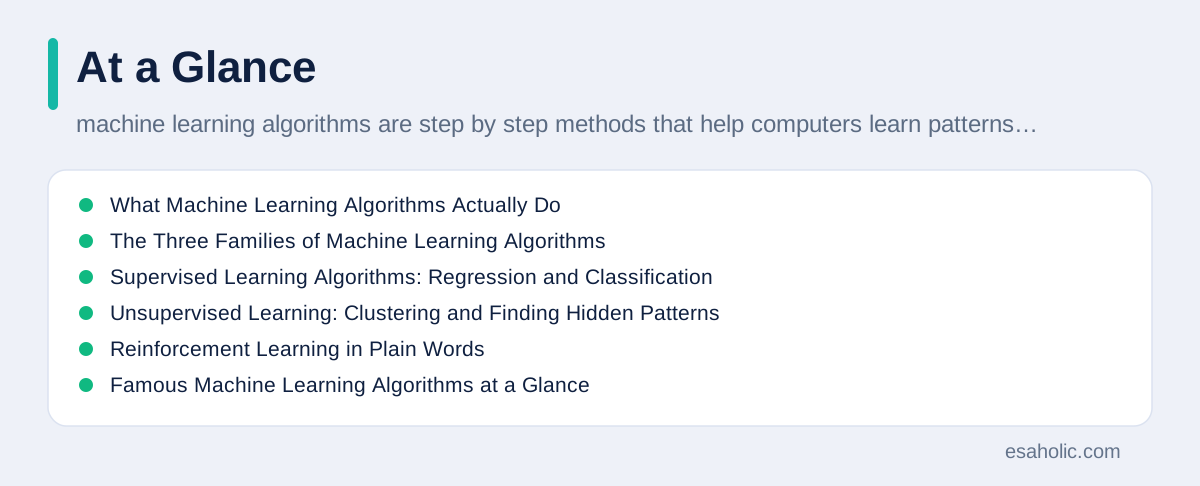
The word algorithm sounds technical, but the idea is familiar. A recipe is an algorithm: a set of steps that turns ingredients into a meal. A machine learning algorithm is a recipe for learning. It says how to look at examples, how to measure mistakes, and how to adjust so the next guess is better. Different recipes suit different jobs, just as a soup recipe does not help you bake bread. This guide explains the main families of machine learning algorithms, the famous methods inside each family, and how to choose one without getting lost in jargon.
One important note before we start: this is one overview guide, not a separate article for every method. Each famous method gets a plain explanation and a typical use, so you can see the whole map at a glance. If you later need depth on one method, you will know its name, its family, and the kind of problem it solves, which makes deeper reading far easier.
What Machine Learning Algorithms Actually Do
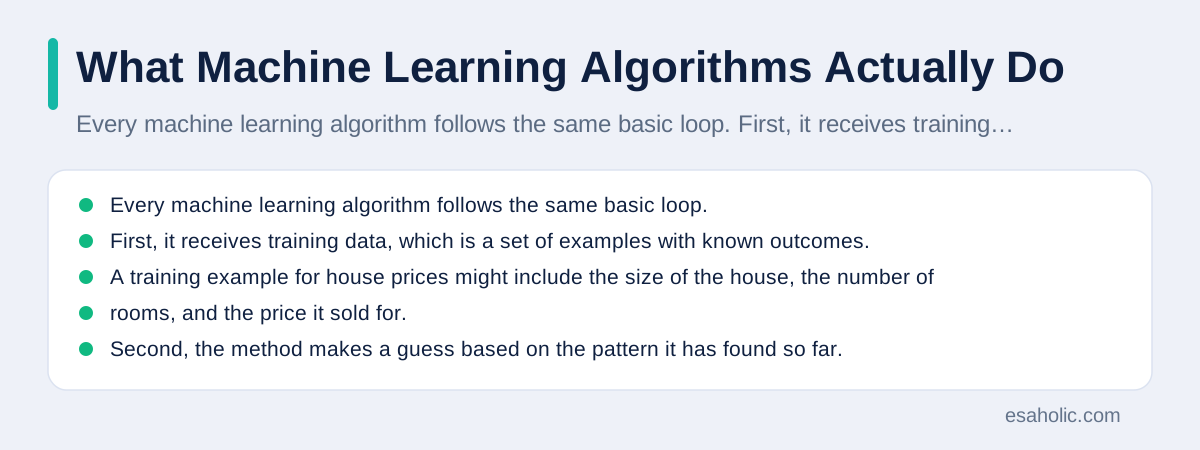
Every machine learning algorithm follows the same basic loop. First, it receives training data, which is a set of examples with known outcomes. A training example for house prices might include the size of the house, the number of rooms, and the price it sold for. Second, the method makes a guess based on the pattern it has found so far. Third, it compares its guess with the real outcome and measures the error, which is simply how far off it was. Fourth, it adjusts its internal settings to reduce that error, and repeats the loop many times.
Those internal settings have a name: parameters. A parameter is a number the method tunes during training, like the weight it gives to house size when predicting price. Some methods have only a few parameters and are easy to understand. Others have millions, and their reasoning becomes hard to follow. In general, simple machine learning algorithms are easier to explain and debug, while complex ones can capture trickier patterns but need more data and more care.
After training, the method faces a test: new examples it has never seen. Good performance on new examples is the whole point. A method that memorizes the training examples but fails on new ones has a problem called overfitting, which means it learned the noise, the random quirks of the training set, instead of the real pattern. Testing on fresh data is how teams catch overfitting before a method reaches real users.
The Three Families of Machine Learning Algorithms
Machine learning algorithms fall into three broad families, based on what kind of guidance they get during training. Supervised learning works with labeled data, which means each example comes with the correct answer. The method learns by matching inputs to their labels. Unsupervised learning works with unlabeled data, which means examples come with no answers, so the method must find structure on its own. Reinforcement learning works by trial and error: an agent, which is a program that acts in an environment, tries actions and learns from rewards and penalties.
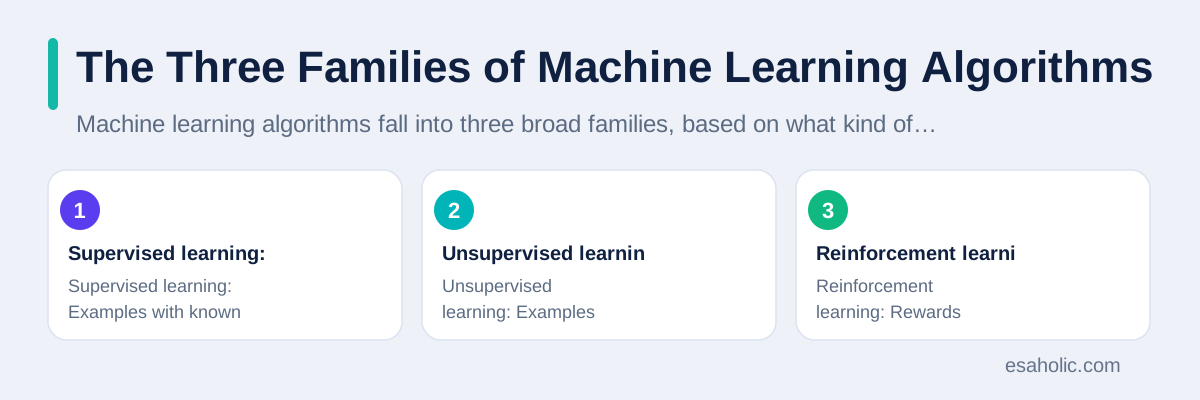
Most business problems use supervised learning, because most business data comes with outcomes: past sales, past fraud cases, past customer churn. Unsupervised learning shines when you want to explore data you do not yet understand, such as grouping customers or finding odd transactions. Reinforcement learning suits problems where a program must make a sequence of decisions, such as playing a game or controlling a robot. The table below gives a quick map before we look at each family in detail.
| Family | What the data looks like | Typical question it answers |
|---|---|---|
| Supervised learning | Examples with known answers | What will the price be, or which category is this? |
| Unsupervised learning | Examples with no answers | What groups or patterns exist in this data? |
| Reinforcement learning | Rewards for actions over time | What sequence of actions earns the best long term result? |
Supervised Learning Algorithms: Regression and Classification
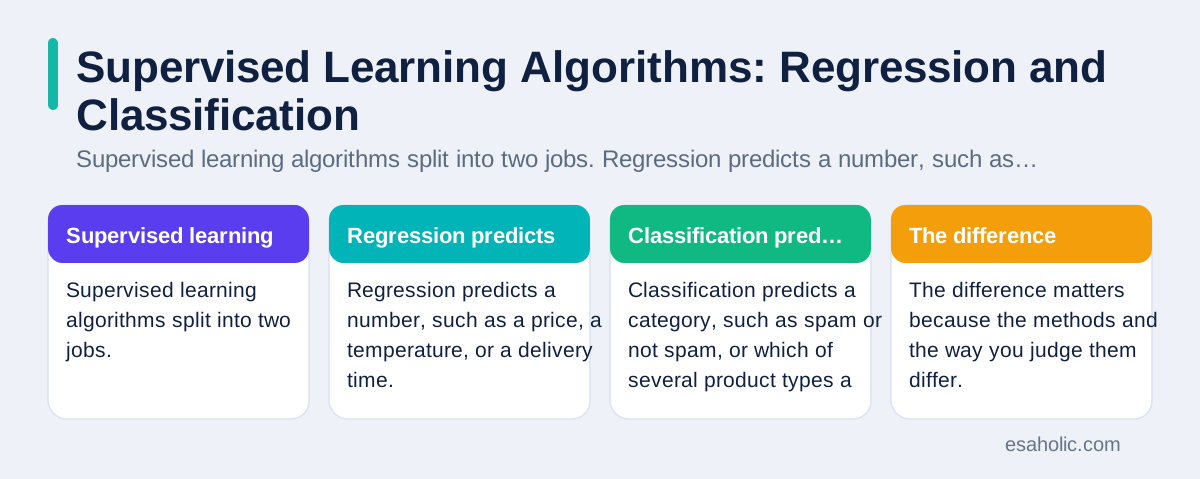
Supervised learning algorithms split into two jobs. Regression predicts a number, such as a price, a temperature, or a delivery time. Classification predicts a category, such as spam or not spam, or which of several product types a customer will buy. The difference matters because the methods and the way you judge them differ. A regression method is judged by how close its numbers are. A classification method is judged by how often its categories are right.
Linear regression is the simplest regression method. It draws the best straight line through the data, so it can predict one number from another. For example, it might predict house price from floor area. It is easy to explain, fast to run, and a great starting point, but it fails when the true relationship curves or bends. Logistic regression, despite its name, is a classification method. It estimates the probability, which is the chance, that an example belongs to a category, and it works well for yes or no questions like whether a customer will leave.
Decision trees are among the easiest supervised learning algorithms to understand. A decision tree asks a series of yes or no questions: is the income above a threshold, is the customer under thirty, and so on, until it reaches a prediction. You can draw the tree and follow the reasoning step by step. A random forest builds many decision trees on slightly different slices of the data and lets them vote. The vote usually beats any single tree, because the errors of individual trees cancel out, though the combined result is harder to explain than one tree.
Support vector machines, often shortened to SVM, draw a boundary between categories in a way that leaves the widest possible gap. That gap makes the method robust, which means it handles new examples well, especially when the data has many features. Features are the individual measurements the method uses, such as age, income, or word counts. A close cousin, k-nearest neighbors, skips training almost entirely: to classify a new example, it looks at the k closest examples it has seen, where k is a number you choose, and copies the majority category. It is simple and intuitive, but it slows down when the dataset grows large.
Naive Bayes is a classification method based on probabilities. It counts how often each feature appears in each category and combines those counts to guess the most likely category. It is called naive because it assumes features act independently, which is rarely strictly true, yet it often works surprisingly well for text, such as spam detection. Our guide to how computers learn to read human language shows where such text methods fit into wider language tools.
Unsupervised Learning: Clustering and Finding Hidden Patterns
Unsupervised learning starts without answers, so its job is discovery. The most common unsupervised task is clustering, which means grouping similar examples together. K-means clustering is the classic method. You choose how many groups you want, the method places a center point for each group, assigns each example to the nearest center, moves the centers to the middle of their groups, and repeats until the groups settle. Shops use clustering to find customer segments, such as bargain hunters, loyal regulars, and occasional buyers, and then tailor offers to each group.
Another unsupervised task is finding associations, which are rules like "customers who buy bread often buy butter too". Association methods scan large transaction records for items that appear together more often than chance would suggest. Stores use these rules to plan shelf layouts and bundle offers. A third task is reducing dimensions, which means shrinking many measurements into fewer, more useful ones, so data becomes easier to plot and faster to process. Principal component analysis, often called PCA, is the best known method here. It finds the directions in the data that carry the most variation and keeps those.
Unsupervised learning also powers anomaly detection, which means spotting examples that do not fit the usual pattern. A bank might use it to flag a transaction that looks nothing like a customer's normal spending, even without labeled fraud cases to learn from. The warning is that unsupervised results always need a human check. A group the method finds may be a real segment or a quirk of the data, and only domain knowledge, which means knowledge of the actual business, can tell the difference.
Reinforcement Learning in Plain Words
Reinforcement learning works like training a pet with rewards, except the learner is a program and the rewards are numbers. The program, called an agent, observes a situation, takes an action, and receives a reward or a penalty. Over many rounds, it learns a strategy, called a policy, that maximizes total reward over time. The catch is that the best immediate action is not always the best long term action, so the agent must balance exploring new actions against exploiting, or reusing, actions that already work.
Famous uses include game playing, where programs learned to beat human champions by playing millions of games against themselves, and robotics, where a controller learns to walk or grasp by trial and error in simulation before touching a real machine. Business uses are growing too, such as testing pricing strategies or delivery routes in simulation. Reinforcement learning is powerful, but it is also the hardest family to set up well, because designing fair rewards takes care. A badly designed reward teaches the program to cheat the scoring system instead of solving the real problem.
Famous Machine Learning Algorithms at a Glance
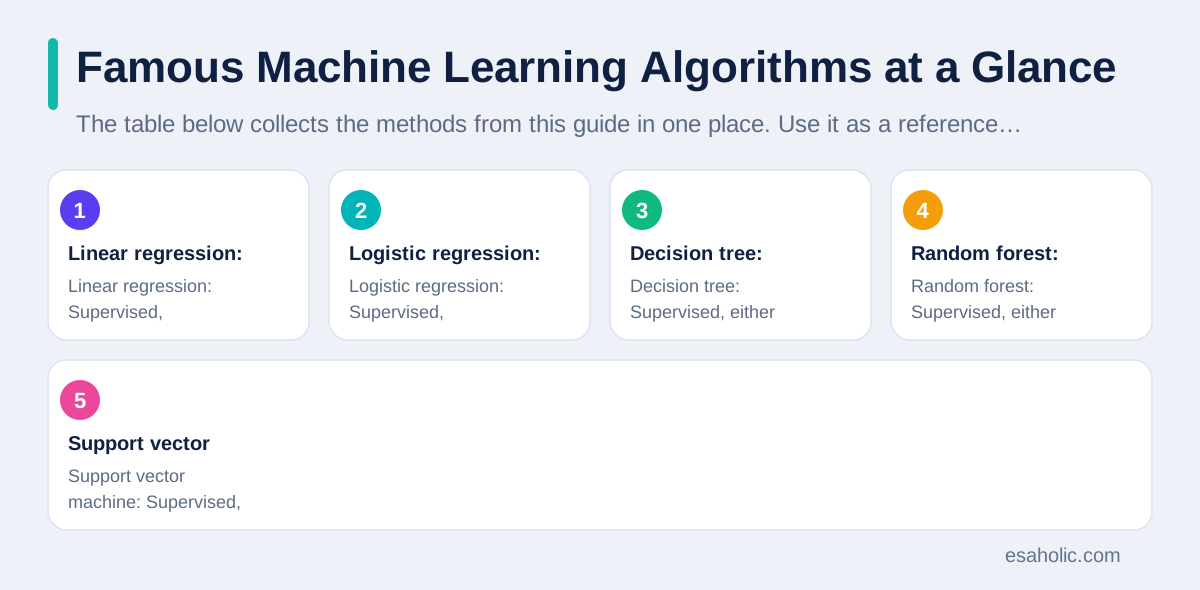
The table below collects the methods from this guide in one place. Use it as a reference when you read tutorials or vendor claims. If a tool says it uses a method, you can now ask what family it belongs to, what kind of data it needs, and whether that fits your problem.
| Method | Family | Best for |
|---|---|---|
| Linear regression | Supervised, regression | Predicting a number from a clear, straight line relationship |
| Logistic regression | Supervised, classification | Yes or no decisions with explainable probabilities |
| Decision tree | Supervised, either | Rules a human can read and follow |
| Random forest | Supervised, either | Strong accuracy when explanation matters less |
| Support vector machine | Supervised, classification | Clean boundaries in data with many features |
| K-nearest neighbors | Supervised, classification | Small datasets where similar cases should decide |
| Naive Bayes | Supervised, classification | Fast text sorting like spam detection |
| K-means clustering | Unsupervised | Finding customer or data groups |
| Neural networks | Supervised, often | Complex patterns in images, speech, and text |
Neural networks deserve a special note, because they sit at the heart of modern deep learning. A neural network is a layered method inspired loosely by the brain, and our separate guide to how neural networks work in plain language explains neurons and layers without jargon. For now, remember this: a neural network is one powerful family of machine learning algorithms, not a synonym for all of them, and simpler methods often win on small or well understood problems.
How to Choose a Machine Learning Algorithm
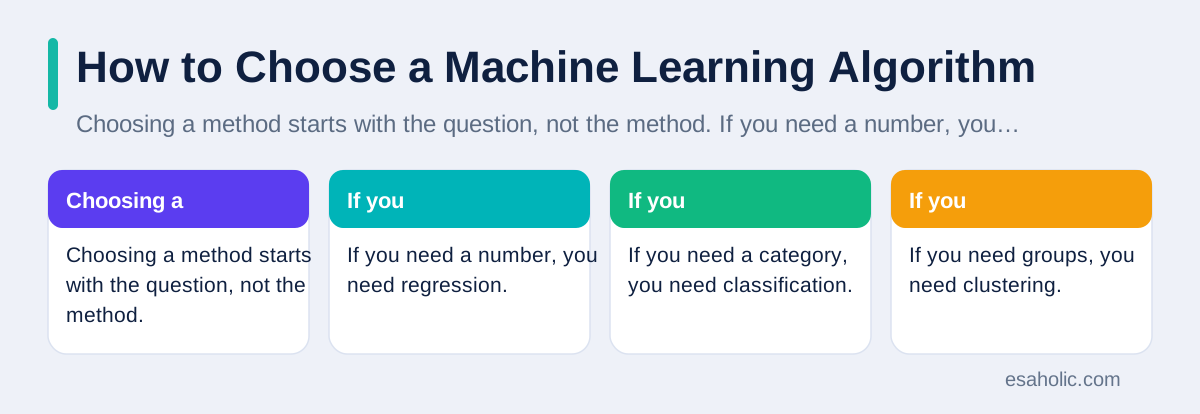
Choosing a method starts with the question, not the method. If you need a number, you need regression. If you need a category, you need classification. If you need groups, you need clustering. If you have labeled data, supervised methods apply. If you do not, unsupervised methods are the honest starting point. Teams that pick a method first and then hunt for a problem usually waste time, while teams that state the question first narrow the choice quickly.
Next, weigh three trade offs. First, accuracy versus explanation: a random forest or neural network may score higher, but a decision tree or linear regression can explain each decision, which matters in finance, hiring, and health. Second, data size versus complexity: simple methods work with hundreds of clean examples, while complex methods need far more. Third, speed versus power: a method that takes hours to train may be fine for a weekly forecast but useless for a live recommendation that must answer in milliseconds.
The practical workflow used by good teams is simple. Start with a simple baseline method, such as logistic regression or a decision tree, and measure it on fresh data. Then try one or two stronger methods and see whether they beat the baseline by enough to justify their complexity. If they do not, keep the simple one. That discipline prevents a common failure: a complex model that impresses in a demo but costs more, breaks more often, and explains less than the simple method it replaced. For trusted background, IBM's guide to machine learning explains these trade offs well, scikit-learn's supervised learning documentation lists the major methods with examples, and Google's machine learning crash course teaches the same ideas with exercises.
Data quality deserves a final warning. Machine learning algorithms learn whatever pattern the data contains, including its mistakes. If your labels are wrong, your measurements are biased, or one group is missing, the method will learn those flaws faithfully. Cleaning data, checking labels, and testing on varied examples is not glamorous work, but it decides whether the method helps or harms. Our guide to how scattered data becomes one trusted view covers that cleanup step, and our AI and ML development services describe how teams handle it in client projects.
Machine Learning Algorithms in Real Products
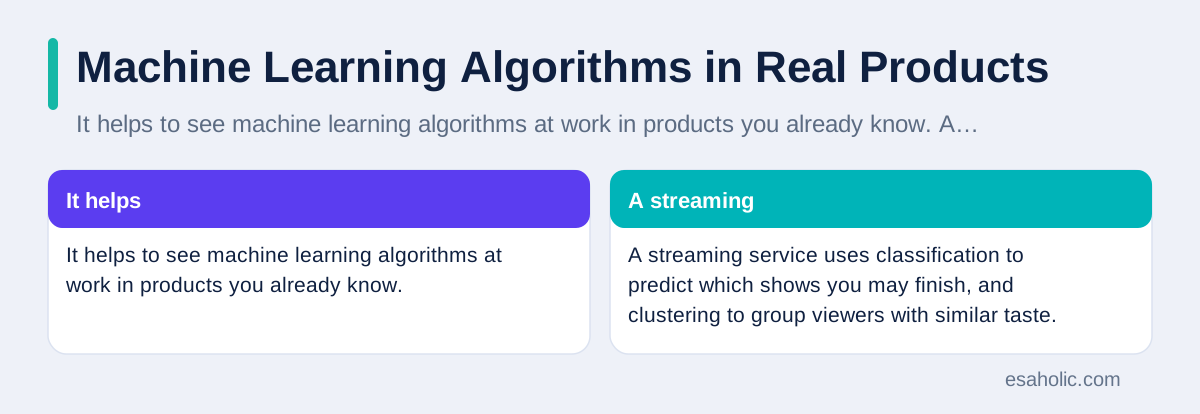
It helps to see machine learning algorithms at work in products you already know. A streaming service uses classification to predict which shows you may finish, and clustering to group viewers with similar taste. An online shop uses regression to forecast how many units of a product it will sell next week, so it can order stock in time. A bank uses classification to flag payments that look unlike a customer's normal pattern, and a human reviews the flagged cases before any account action is taken. In each case, the method is ordinary, the data is specific, and the human check is part of the design.
Notice what these products do not do. They do not hand the whole decision to the method. They use the method to sort, rank, or flag, and then a person or a simple rule makes the final call where the stakes are high. That pattern, machine learning algorithms as a sorting and ranking helper, is the most common and most successful use in business today. When a vendor promises full automation with no human check, ask which decisions the system makes alone, and what happens when it is wrong. The answer tells you whether the product is mature or merely ambitious.
How to Test an Algorithm on a Small Project Before You Trust It
Pick one small problem you already understand well. A good first test is a question you can check by hand, such as sorting a short list of past customer messages into two groups, or predicting a simple number from one clear input. When you understand the answer yourself, you can spot a wrong prediction at once, and you learn what the method actually does instead of taking its output on faith.
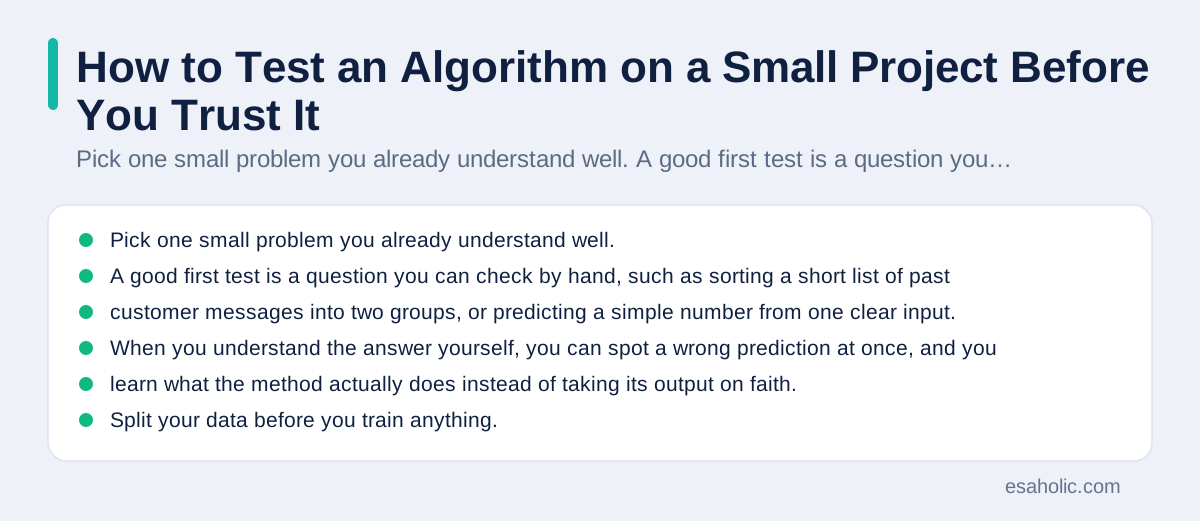
Split your data before you train anything. Keep most of it for training, and hold back a smaller part that the method never sees. A holdout set is simply that reserved part, kept aside for an honest final check. Train on the first part, test on the second, and read the mistakes closely. If the method does well on training data but poorly on the held back data, it has memorized quirks instead of learning a real pattern, and you should simplify it or gather cleaner data before you go further.
Try a simple baseline first, then compare. A baseline is a plain, easy method you run first so you have a score to beat. If a simple method scores almost as well as a complex one, keep the simple one, because it is easier to explain, cheaper to run, and less likely to break. Only adopt the complex method when it beats the baseline by a margin that matters for your decision, not just by a tiny amount on one test. A guide to how a trained model is tested explains the honest checks that help you judge that margin without fooling yourself.
Write down what you tested, what scored best, and what you will check again when fresh data arrives, so your small test becomes a record you can trust and repeat.
Conclusion
Machine learning algorithms are step by step methods for learning patterns from data, and they fall into three families: supervised learning from labeled examples, unsupervised learning that finds structure without labels, and reinforcement learning that improves through rewards over time. Inside supervised learning, regression predicts numbers and classification predicts categories, with methods like linear regression, decision trees, random forests, and support vector machines covering most everyday jobs. Unsupervised methods like clustering find groups and odd cases, while reinforcement learning tackles sequences of decisions.
The best method for your problem is rarely the most famous one. It is the one that matches your question, fits your data, and can be explained and tested honestly. Start simple, measure on fresh data, and add complexity only when it earns its place. Learned that way, machine learning algorithms stop being a confusing list of names and become a practical toolkit: a set of recipes you can pick from with confidence, knowing what each one does, what it needs, and where it can go wrong.
Frequently Asked Questions
What are machine learning algorithms in simple words?
Machine learning algorithms are step by step methods that help a computer learn patterns from examples. You feed the method data, it finds the pattern, and then it uses that pattern to predict or decide on new data it has not seen before.
Which machine learning algorithm should a beginner learn first?
Linear regression and decision trees are good first choices, because their reasoning is easy to follow. Linear regression shows how one number relates to another, and a decision tree splits data with simple yes or no questions, so you can see why it made each choice.
Do machine learning algorithms need a lot of data?
It depends on the method. Simple methods can work with a few hundred clean examples, while deep learning methods often need far more. In all cases, clean and representative data matters more than a huge pile of messy data.
Written by Ahmad Jajja
Ahmad Jajja is a senior AI research engineer who specializes in generative AI and data systems. He writes Esaholic guides that explain AI work in plain language, with a focus on accuracy and real examples.
Reviewed by Umar Abbas
Umar Abbas is the founder of Esaholic and its principal AI architect. He reviews Esaholic guides for technical accuracy and for whether the advice holds up in real systems.
Relevant Blogs
Natural Language Processing Explained Simply
How computers read, understand, and reply to human language.
Machine Learning Models Explained Simply
What a trained model is, how training works, and how to test it.
Predictive Analytics in Supply Chain
How data models help teams plan stock, routes, and demand.
Back to all blog guides · Explore AI and ML Development Services