What Is a Neural Network? Explained Simply
Written by Ahmad Jajja · Reviewed by Amir Iqbal ·
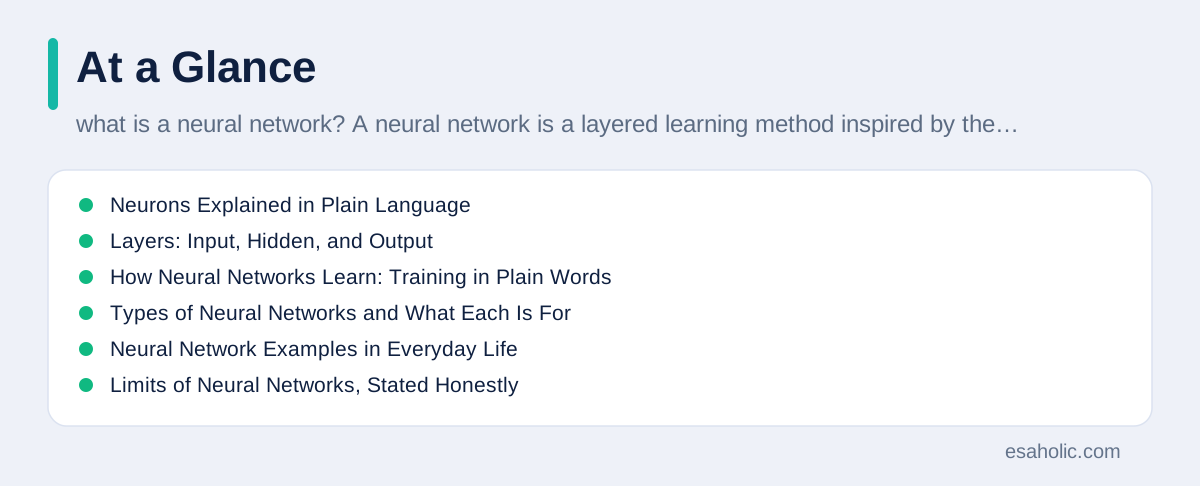
What is a neural network? A neural network is a learning method built from layers of small units that work together to find patterns in data. It powers face recognition on your phone, voice assistants, translation apps, and the large language models behind modern chatbots. Yet most explanations jump straight to math, and readers are left with diagrams of circles and arrows but no real understanding. This guide fixes that. It explains neurons and layers in plain language, shows how a neural network learns, and states honestly what it cannot do.
The name comes from a loose analogy with the brain. In a brain, neurons, which are nerve cells, receive signals, combine them, and pass a signal onward if it is strong enough. An artificial neuron does something similar with numbers: it takes several numbers in, weights them by importance, adds them up, and decides how strongly to pass the result on. One neuron does very little. Thousands or millions of them, arranged in layers, can learn patterns far too complex for a single rule, such as telling a cat photo from a dog photo.
Keep the analogy in its place, though. A neural network is not a brain. It does not think, feel, or understand in the human sense. It adjusts numbers until its predictions match its training examples, and it knows nothing beyond those patterns. That limit explains both its successes and its failures, and it will return throughout this guide. For the wider map, our guide to learning methods and their families places neural networks among other methods, and our guide to what a trained model is explains how any trained model, including a neural network, is tested before use.
Neurons Explained in Plain Language
An artificial neuron is a tiny calculator with a simple job. It receives inputs, which are numbers, multiplies each input by a weight, which is a number that says how important that input is, adds the results together, and then applies an activation function, which is a rule that decides the output. The activation function is what lets a neuron make non linear decisions, meaning decisions that cannot be drawn as a single straight line. Without it, stacking neurons would be no more powerful than one simple formula, because straight lines combined still make a straight line.
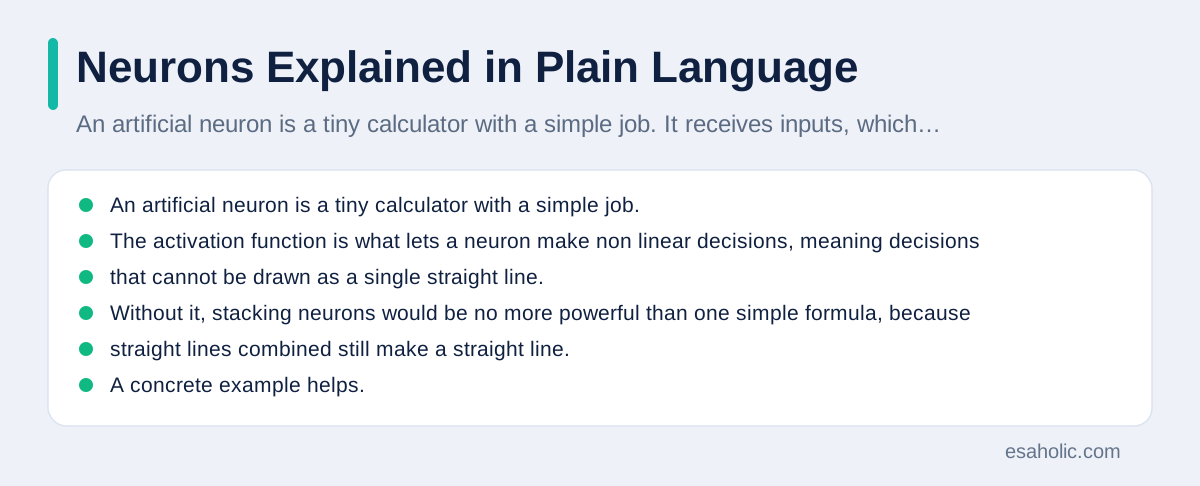
A concrete example helps. Imagine a neuron deciding whether a photo contains a cat. Its inputs might include scores for pointy ears, whiskers, and fur texture. If the weights learned during training say whiskers matter a lot and background color matters little, the neuron's sum will be high for cat photos and low for others. The activation function then turns that sum into a clean output, such as a score between zero and one, where one means "very likely a cat". No single neuron makes the final call in a real system. It passes its score to the next layer, which combines many such clues.
Weights start random and improve through training, which we explain below. Bias is one more number worth knowing: it shifts the neuron's threshold, so the neuron can fire even when its inputs are small, or stay quiet even when they are large. Think of bias as the neuron's personal starting point. Together, weights and bias are the parameters a neural network tunes, and a large network may hold millions or billions of them.
Layers: Input, Hidden, and Output
Neurons are arranged in layers, and each layer has a role. The input layer receives the raw data. For a photo, each input unit might hold one pixel's brightness. For a sentence, each input might hold one word's numerical picture. The input layer does not learn. It simply presents the data to the next layer.
Hidden layers sit between input and output, and they do the real learning. The name hidden only means they are not directly visible as input or output. Early hidden layers learn simple patterns, such as edges in a photo or common word pairs in text. Later hidden layers combine those simple patterns into complex ones, such as eyes and ears, then faces, then a whole animal. That gradual building, from simple to complex, is why layered networks handle images and language so well. A network with many hidden layers is called a deep neural network, and deep learning is simply machine learning with deep neural networks.
The output layer gives the final answer. For a yes or no question, it may have one unit that outputs a probability, which is the chance the answer is yes. For a choice among ten categories, it may have ten units, one per category, and the highest score wins. The shape of the output layer always follows the job: one number for a price, several scores for categories, or a sequence of words for a translation.
How Neural Networks Learn: Training in Plain Words
Training a neural network means adjusting its weights and biases until its predictions match its training examples. The process runs in rounds. First, data flows forward through the network, layer by layer, in a step called forward propagation, which means passing signals forward to produce a prediction. The network compares that prediction with the correct answer and measures the error, which is how far off it was.
Then comes the clever part: backpropagation, which means sending the error backward through the layers to work out how much each weight contributed to it. Weights that pushed the prediction in the wrong direction are adjusted one way, and weights that helped are adjusted the other way. The size of each adjustment is set by the learning rate. Too large a learning rate makes training jump around and miss the best settings. Too small makes training crawl. This forward and backward cycle repeats over many examples, many times, until errors on a validation set stop improving.
That stopping rule matters. A neural network with millions of parameters can memorize its training data if training runs too long, a failure called overfitting, which our guide to trained models and overfitting explains in full. Teams defend against it with more varied data, simpler networks, early stopping, and dropout, which is a technique that randomly switches off some neurons during training so the network cannot rely on any single unit. The goal is always the same: a network that generalizes to new data, not one that memorizes old data.
Types of Neural Networks and What Each Is For
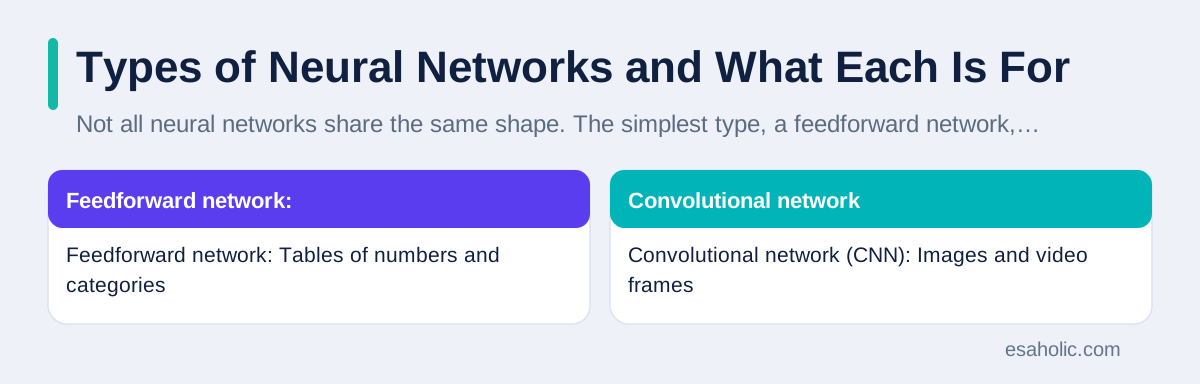
Not all neural networks share the same shape. The simplest type, a feedforward network, passes data in one direction, from input to output, and suits tabular data, such as rows of customer measurements. Convolutional neural networks, often called CNNs, are built for images. A convolutional layer scans small patches of an image for features like edges and textures, and deeper layers combine those features into objects. That scanning design is why CNNs recognize faces, read handwriting, and inspect products on factory lines.
Recurrent neural networks were built for sequences, such as sentences or time series, because they remember earlier steps while reading later ones. In practice, a newer design called the transformer has largely replaced them for language work. A transformer reads a whole sequence at once and uses attention, which is a mechanism that weighs which words matter most for each other word, so it can handle long range links like a pronoun referring to a name many words earlier. Large language models are transformer networks trained on huge text collections, and our guide to how computers learn to read human language explains where they fit.
| Network type | Best for | Why it fits |
|---|---|---|
| Feedforward network | Tables of numbers and categories | Simple, fast, easy to train on structured data |
| Convolutional network (CNN) | Images and video frames | Scans patches for edges, textures, then objects |
| Recurrent network | Short sequences and time series | Remembers earlier steps while reading later ones |
| Transformer network | Language and long sequences | Attention weighs which words matter to each other |
Neural Network Examples in Everyday Life
You meet neural networks constantly. Phone cameras use them to recognize faces, improve low light photos, and sort pictures by person. Voice assistants use them to turn speech into text and to work out what you asked. Translation apps use them to convert sentences while keeping meaning and tone. Email tools use them to sort spam, and shops use them to recommend products based on patterns in past purchases.
Professional uses go further. Hospitals use image networks to flag possible problems in scans, always with a clinician making the final call. Factories use vision networks to spot defects faster than the human eye. Self driving systems use networks to read road scenes, though they still need extensive testing and human oversight. In each case, the pattern is the same: a job where the input is rich and messy, like a photo or a sentence, and where the pattern is too layered for hand written rules. That is where neural networks earn their place. Where data is a small, clean table, simpler methods from our guide to learning methods often win, faster and with clearer explanations.
For trusted deeper reading, IBM's guide to neural networks explains the architecture clearly, Google's crash course on neural networks teaches the same ideas with interactive exercises, and TensorFlow's documentation shows how practitioners build and train networks in code.
Limits of Neural Networks, Stated Honestly
Neural networks have real limits, and buyers should know them. First, they need a lot of data. A network with millions of parameters and only hundreds of examples will memorize rather than learn. Pretraining helps: a network first trained on a large general dataset can be fine tuned, which means retrained briefly, on a smaller task dataset, but fine tuning still needs clean, representative task data.
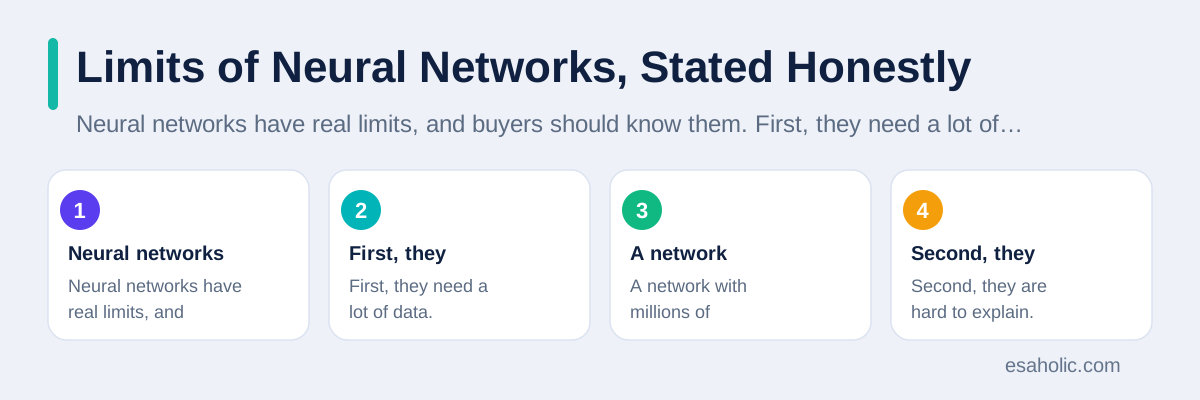
Second, they are hard to explain. A decision tree can show its reasoning as a chain of questions. A deep network spreads its reasoning across millions of weights, so explaining one decision precisely is difficult. That black box quality, meaning inputs go in and an answer comes out without a readable reason, is a genuine problem for loans, hiring, and medical decisions, where people deserve an explanation and a way to appeal.
Third, they can be fooled and biased. Tiny changes to an input, invisible to a person, can flip a network's answer, a weakness called an adversarial example. And a network trained on biased data learns those biases, so it may perform worse for groups underrepresented in training. Fourth, training large networks costs significant computing power and energy, which is a real budget and environmental consideration. None of this makes neural networks useless. It means they are a strong tool for rich, messy inputs, not a universal answer, and they need testing, monitoring, and human oversight like any powerful tool. Our AI and ML development services describe how teams handle that oversight in production systems.
What Is a Neural Network Doing Inside a Chatbot?
Modern chatbots give the clearest everyday answer to what is a neural network doing in real life. When you type a question, a transformer network first turns your words into numerical pictures that capture meaning and context. Words that mean similar things sit close together in that numerical space, and the network weighs which words matter most to each other, so "it" in a later sentence can link back to the right noun earlier. That context step is what lets a chatbot handle follow up questions like "and what about the larger one" without you repeating the whole topic.
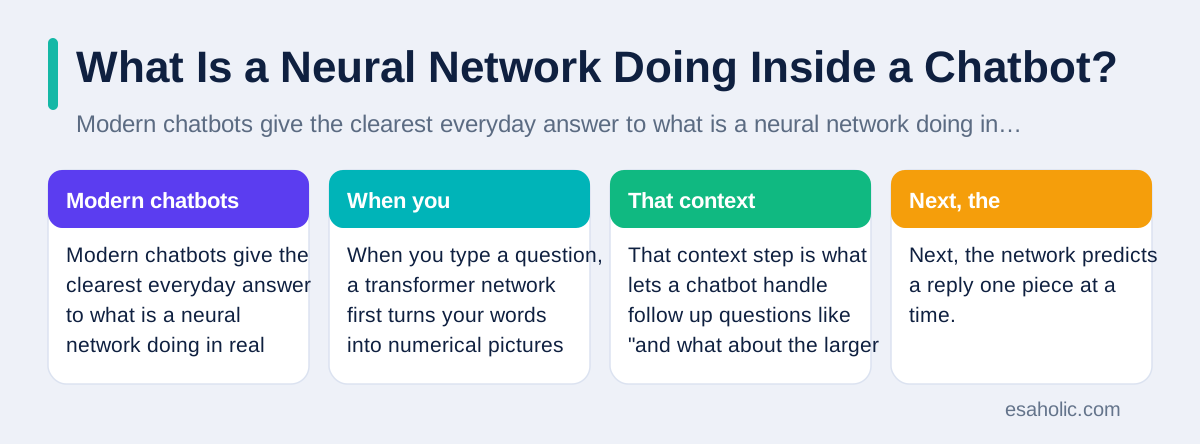
Next, the network predicts a reply one piece at a time. It does not fetch a prewritten answer from a shelf. It generates text by repeatedly asking, given everything so far, which piece is most likely to come next, while sampling, which means picking among likely options rather than always taking the top one, so replies vary and sound natural. When a chatbot answers from your documents, it first retrieves relevant passages, then generates a reply grounded in them, which reduces invention but never removes it fully. That is why a chatbot can sound fluent while stating a false fact, and why checking important answers against a source remains essential.
Training such a network happens in stages. First, it learns general language patterns from huge text collections. Then it is fine tuned, which means retrained briefly, on examples of helpful, honest replies, so it learns tone and format. Then human reviewers rank its answers, and the network is adjusted toward answers reviewers preferred. Each stage shapes behavior, but none gives the network true knowledge or understanding. What is a neural network, in the end, inside a chatbot? It is a powerful pattern machine for language: excellent at fluent, context aware drafting, and still dependent on retrieved facts, testing, and human judgment whenever accuracy matters.
The same pattern explains other language tools. Summarizers compress text by learning which sentences carry the main ideas. Translation systems map sentences between languages by learning shared meaning patterns. Writing assistants suggest phrasing by predicting likely continuations. In all of them, the neural network provides fluency and pattern skill, while the product around it, retrieval, filters, and human review, provides reliability. Judge a language product by that surrounding system, not by the fluency of a single demo reply, and you will judge it fairly.
How should you judge such a system when you meet it as a user? Try it on questions you already know the answers to, including tricky ones with dates, numbers, and names, and watch whether it admits uncertainty or invents a confident reply. A network that says it does not know, or that cites a source you can open, is behaving better than one that always answers smoothly. Also try the same question phrased two different ways. If the answers contradict each other, the system is guessing from patterns rather than reasoning from facts, and you should verify anything important before acting on it. Those two tests, known answers and rephrased questions, take minutes and reveal more than any marketing page.
Common Mistakes Beginners Make With Neural Networks and How to Avoid Them
Beginners rarely fail with neural networks because the math is too hard. They fail because they skip the simple checks that make learning work. The mistakes below show up again and again in first projects, and each one has a practical fix. Learn them now, and you will save yourself weeks of confusion later.
The first mistake is starting with the biggest network you can build. A large network, with many layers and many settings to tune, feels powerful, but it needs a large amount of clean data to learn well. With a small dataset, a large network simply memorizes the training examples and fails on new ones. The fix is to start small. Try a simple network first, and only add layers or units when the simple version clearly underfits, which means it is too simple to capture the real pattern even on training data. A small network that you understand beats a large network that only impresses on paper. When a simpler method fits the data, use it. Our guide to simpler learning methods explains when a plain method wins over a neural network, and that judgment is a skill in itself.
The second mistake is training on messy data and expecting the network to sort it out. A neural network learns whatever pattern the data contains, including errors, duplicates, and mislabeled examples. If labels are wrong, the network learns the wrong answers faithfully. Before training, look at your data by hand. Check a sample of examples, fix obvious errors, remove clear duplicates, and make sure each category has enough examples to learn from. This checking feels slow, but it is faster than debugging a network that was trained on bad data, because a network trained on bad data gives confident, wrong answers with no clue about the cause.
The third mistake is testing on the same data used for training, or tuning the network until it scores well on the test set and then reporting that score as proof. A test set is only honest when the network has not learned from it, directly or through repeated tuning. Keep your data split from the start: one part for training, one part for tuning choices, and one part held back for a final check. When the final check score is much worse than the training score, that gap is the warning sign. It means the network memorized rather than learned, and the fix is more varied data, a simpler network, or earlier stopping, which means halting training when validation performance stops improving.
The fourth mistake is ignoring scale. Scaling means putting inputs on a similar range so no single input dominates learning just because its numbers are larger. A feature measured in thousands, such as income, can drown out a feature measured in small numbers, such as a rating out of five, unless both are scaled. Beginners often skip this step because the network still trains, but it trains slowly and unevenly, and results become hard to reproduce. Scale your inputs with one consistent rule, apply the same rule to new data, and record the rule alongside the model so future predictions use it too.
The fifth mistake is chasing one score. Beginners often tune everything to raise accuracy, which is the share of correct predictions, and ignore everything else. Accuracy can mislead, especially when one category is far more common than another. A model that always predicts the common category can score highly while learning nothing useful. Look at mistakes by category, check performance on different groups, and ask what each kind of error costs. A mistake that blocks a real customer costs more than a mistake that lets one junk message through, and the right balance follows that cost, not a single headline score.
The sixth mistake is trusting fluent output. A neural network that generates text can write smooth, confident sentences that state false facts, because fluency comes from patterns, not from knowledge. Beginners copy that output into reports, code, or answers without checking it. Treat every generated answer as a draft. Check dates, numbers, names, and claims against a source you trust, and be extra careful when the answer sounds certain about a topic you do not know well. The same caution applies to code and summaries. A network speeds up drafting, but the human stays responsible for correctness, and saying "the model said so" is never a defense for an unchecked answer.
The seventh mistake is copying settings blindly from a tutorial. A learning rate, which is the size of each adjustment during training, or a network shape that worked for image data may fail badly on your text or table data, because each dataset has its own scale, noise, and pattern. Use tutorial settings as a starting point, then change one thing at a time and record what happens. Changing one setting at a time is slower than guessing, but it teaches you which setting actually helped, and it leaves a record you can return to. Keep a simple training log: settings, data version, and scores on tuning data. When a later run behaves oddly, that log is the first place you will look, and it will often show you the answer in minutes.
Finally, beginners often work alone and skip review. Show your data checks, your test results, and your worst mistakes to a colleague early, before the project grows large. A second pair of eyes catches a leaked test set, a mislabeled category, or a misleading score far sooner than solo debugging does. Neural networks reward patience, clean data, honest testing, and careful review. Build those habits first, and the impressive results will follow from work you can actually trust.
Conclusion
What is a neural network? It is a layered learning method in which small units called neurons combine inputs, weigh them by importance, and pass results through layers that build simple patterns into complex ones. Input layers receive data, hidden layers learn the patterns, and output layers give the answer. Training adjusts weights by passing signals forward, measuring errors, and sending corrections backward, until the network generalizes to new data instead of memorizing old data. Different shapes suit different jobs: feedforward networks for tables, convolutional networks for images, and transformers for language.
The honest summary is this. Neural networks excel where inputs are rich and messy and patterns are layered, which is why they power vision, speech, and language tools. They need large, varied data, they are hard to explain, and they can inherit bias and be fooled, so they demand testing and human oversight. Understand neurons and layers, and the rest of modern AI stops looking like magic. It looks like what it is: a powerful pattern learner, useful exactly where its strengths fit, and limited exactly where they do not.
Frequently Asked Questions
What is a neural network in simple words?
A neural network is a learning method built from layers of small units called neurons. Each neuron combines its inputs, decides how strongly to pass the result on, and together the layers learn patterns that turn inputs, like pixels or words, into predictions.
Is a neural network the same as the human brain?
No. A neural network borrows a loose idea from the brain, units that combine signals and pass them on, but it is far simpler. It does not think, feel, or understand, and it learns only from the data it is trained on.
Why do neural networks need so much data?
Because a neural network has many settings to tune, and each setting needs evidence. With too little data, it memorizes quirks instead of learning real patterns, so large and varied datasets, or careful reuse of a pretrained network, are needed for reliable results.
Written by Ahmad Jajja
Ahmad Jajja is a senior AI research engineer who specializes in generative AI and data systems. He writes Esaholic guides that explain AI work in plain language, with a focus on accuracy and real examples.
Reviewed by Amir Iqbal
Amir Iqbal is a senior AI systems architect and lead technical reviewer at Esaholic. He reviews Esaholic guides for technical accuracy and clarity before publication.
Relevant Blogs
Machine Learning Algorithms Explained Simply
The main learning methods and their families, in plain words.
Machine Learning Models Explained Simply
What a trained model is, how training works, and how to test it.
Natural Language Processing Explained Simply
How computers read, understand, and reply to human language.
Back to all blog guides · Explore AI and ML Development Services