
Machine Learning Models Explained Simply
Written by Amir Iqbal · Reviewed by Danish Mustafa ·
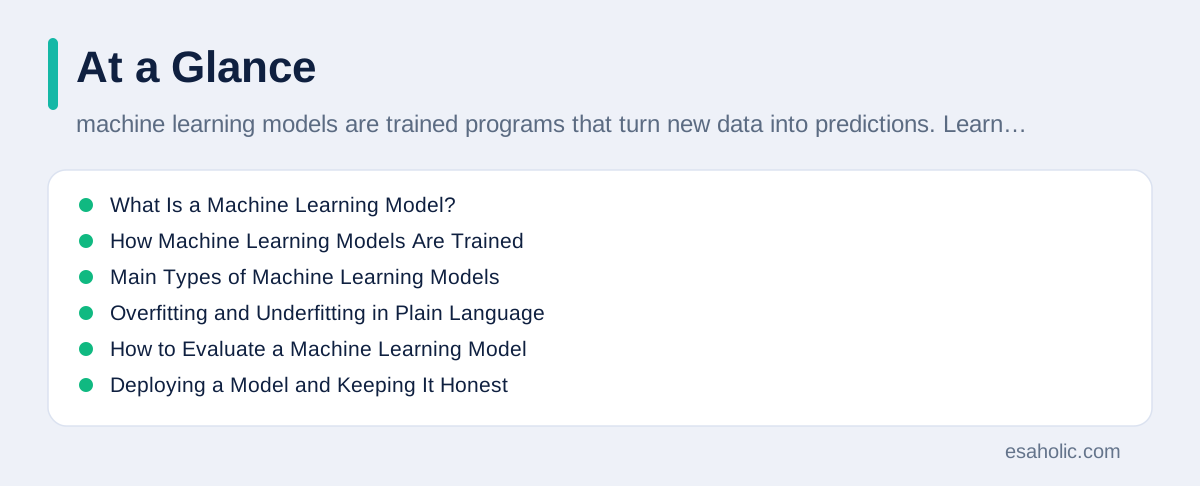
Machine learning models are the trained programs that turn new data into predictions. When a spam filter sorts your mail, a shop suggests a product, or a bank flags a strange payment, a machine learning model is making that call. It is not magic, and it is not a person thinking. It is a set of tuned numbers and rules, learned from examples, that maps an input to an output: this email looks like spam, this customer may leave, this price is likely to rise.
People often mix up two words: algorithm and model. The distinction is simple and worth learning, because it clears up most confusing articles on the topic. The algorithm is the learning method, like a recipe. The model is what you get after you run that method on data, like the finished dish. You train with an algorithm, and you use the model that training produces. Our guide to the main learning methods and their families covers the recipe side. This guide covers the result: what a model is, how it is trained, the main types, and how to tell a good one from a bad one.
Why does this matter to a non technical reader? Because models now sit behind decisions that affect your money, your job applications, and your health care. You may never train a model yourself, but you will buy tools that use them, work with teams that build them, and live with their mistakes. Knowing how machine learning models work helps you ask sharper questions: what data trained this model, how was it tested, and what happens when it is wrong?
What Is a Machine Learning Model?
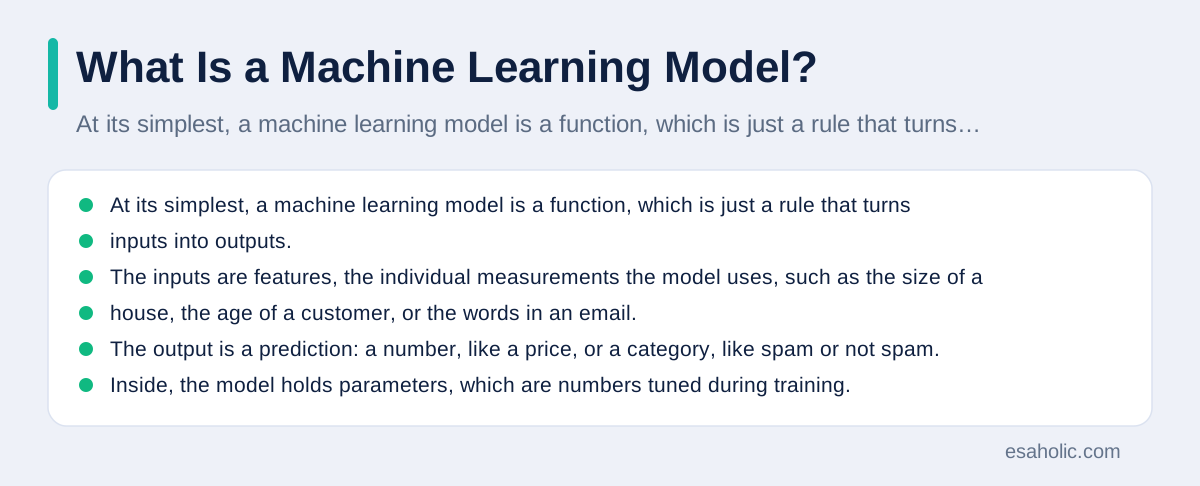
At its simplest, a machine learning model is a function, which is just a rule that turns inputs into outputs. The inputs are features, the individual measurements the model uses, such as the size of a house, the age of a customer, or the words in an email. The output is a prediction: a number, like a price, or a category, like spam or not spam. Inside, the model holds parameters, which are numbers tuned during training. A simple model might hold a handful of parameters. A large language model holds billions, but the idea is the same: inputs go in, tuned numbers shape them, and a prediction comes out.
Think of a model as a student who studied past exam papers. During study, the student learned which patterns lead to which answers. During the exam, the student faces new questions and applies those patterns. A good student generalizes, which means they apply the real pattern to new questions. A bad student memorizes answers, and fails the moment a question changes slightly. Machine learning models face the same test, and the whole training process exists to build generalization rather than memorization.
Models also differ from ordinary software in one key way. Ordinary software follows rules a programmer wrote by hand: if the amount is above this limit, flag it. A machine learning model follows rules it learned from data, so its behavior can surprise even its builders. That is why testing matters so much. You cannot just read the code and know what a model will do. You must run it on fresh examples and watch what happens.
How Machine Learning Models Are Trained
Training a machine learning model happens in a clear sequence. First, the team collects and cleans data. Cleaning means fixing missing values, removing duplicates, and checking that labels, which are the correct answers attached to examples, are right. This step is dull, and it is also where most projects succeed or fail. A model trained on dirty data learns dirty patterns, no matter how clever the method is.
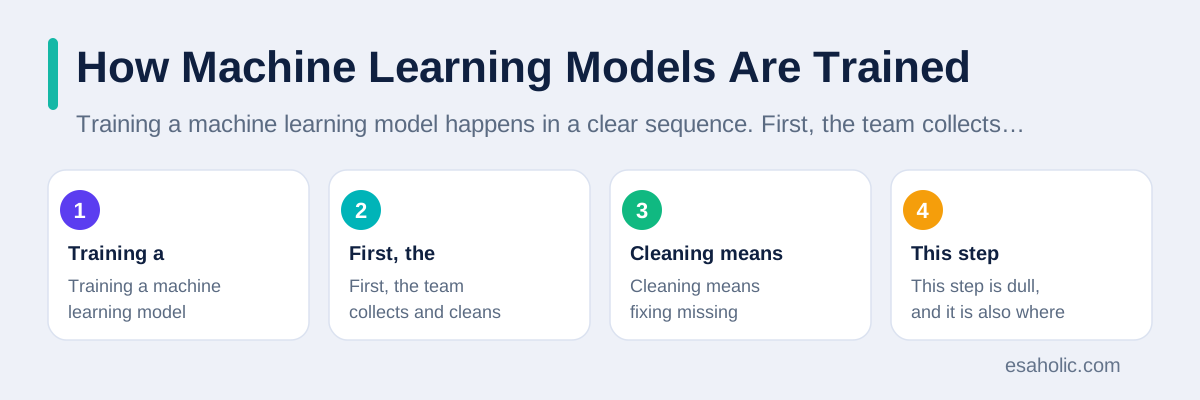
Second, the team splits the data into three parts, and the split is one of the most important ideas in this guide. The training set teaches the model. The validation set helps the team tune settings and pick between candidate models. The test set is kept aside until the end, and it gives an honest final score on data the model never saw during training or tuning. Teams that skip the test set fool themselves, because a model always looks good on data it already studied.
Third, training runs in rounds. The model makes predictions on the training set, measures its errors, and adjusts its parameters a little to reduce those errors. The size of each adjustment is controlled by a setting called the learning rate. Too large, and the model jumps past the best settings. Too small, and training takes forever. After many rounds, the team checks the validation set. If validation performance stops improving while training performance keeps rising, the model is starting to memorize, and training should stop. That stopping point is called early stopping, and it is one of the simplest defenses against overfitting.
Finally, the team evaluates the model on the test set, writes down the results, and only then decides whether it is ready for real use. That final report should include not just an average score, but performance on different groups and on hard cases. A model that scores 95 percent overall but fails for one customer group is not ready, and the test report is where that problem should surface.
Main Types of Machine Learning Models
Machine learning models come in many shapes, but most belong to a few well known types. Linear models draw straight line relationships between inputs and outputs. They are fast, easy to explain, and strong when the true relationship is simple. Tree based models split data with yes or no questions, and they handle mixed data, such as numbers plus categories, very well. Ensemble models combine many smaller models and let them vote, which usually raises accuracy at the cost of explanation. A random forest is an ensemble of trees, and gradient boosting is an ensemble that builds trees one after another, each fixing the errors of the last.
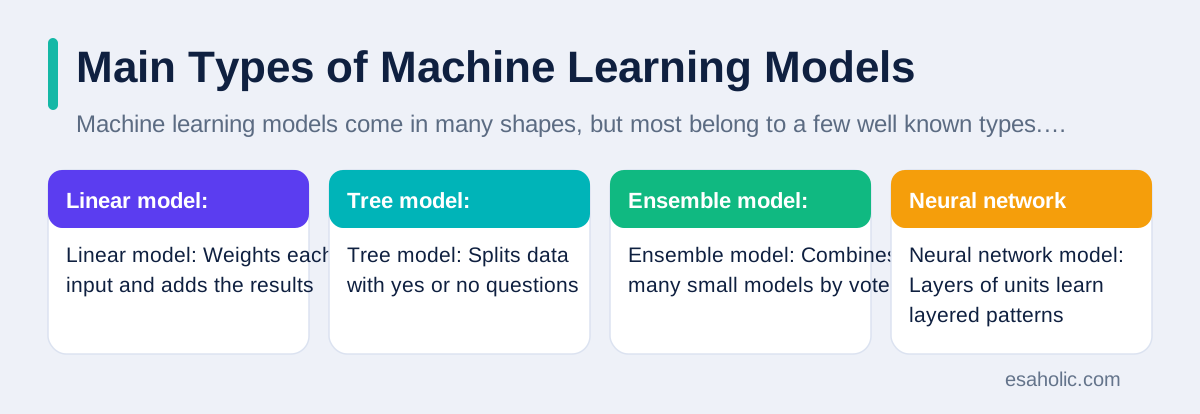
Neural network models use layers of simple units that combine inputs in complex ways, and they excel at images, speech, and text, where patterns are subtle and layered. Our guide to how neural networks work, with neurons and layers explained plainly, goes deeper on this type. There are also specialized types: clustering models that group data without labels, used for customer segments, and sequence models that handle ordered data like time series, used for forecasts. The table below sums up the main types and their natural jobs.
| Model type | How it works, briefly | Natural job |
|---|---|---|
| Linear model | Weights each input and adds the results | Simple price and score predictions |
| Tree model | Splits data with yes or no questions | Rules a human can read and audit |
| Ensemble model | Combines many small models by vote | Strong accuracy on tabular business data |
| Neural network model | Layers of units learn layered patterns | Images, speech, and language tasks |
| Clustering model | Groups similar examples without labels | Customer segments and anomaly spotting |
| Sequence model | Reads data in order, remembering earlier steps | Forecasts and language tasks |
No type wins everywhere. A linear model often beats a neural network on a small, clean table of business data, because the neural network has far more parameters to tune than the data can support. A neural network beats a linear model on photos, because photo patterns are far too layered for a straight line. The honest question is never "which model is best" but "which model fits this data, this job, and this need for explanation".
Overfitting and Underfitting in Plain Language
Overfitting is the most important failure mode to understand, because it looks like success. An overfit model scores brilliantly on its training data and poorly on new data, because it memorized quirks instead of learning the real pattern. Imagine a student who memorizes past exam answers word for word. They score perfectly on old papers and fail a new paper that asks the same ideas in different words. That is overfitting.
Underfitting is the opposite problem. An underfit model is too simple for the job, so it misses the real pattern even in training. Imagine a student who learned only one rule for every question. They fail old papers and new papers alike. Underfitting usually means the model type is too simple, the features are too few, or training stopped too early.
Good teams fight overfitting with several tools. They collect more varied data, so quirks average out. They simplify the model, so it cannot memorize as much. They use regularization, which is a penalty added during training that discourages overly large parameters, pushing the model toward smoother, simpler patterns. And they always test on fresh data, because fresh data is the only honest judge. If a vendor shows you only training scores, ask for test scores. That one question separates serious work from marketing.
How to Evaluate a Machine Learning Model
Evaluation depends on the job. For a model that predicts numbers, teams report how far predictions sit from real values on average, using measures like mean absolute error, which is the average size of the mistake, ignoring whether it was too high or too low. For a model that predicts categories, teams start with accuracy, which is the share of correct predictions, but they rarely stop there.
Accuracy can mislead badly. Suppose a fraud model faces 990 normal payments and 10 frauds. A lazy model that calls everything normal scores 99 percent accuracy and catches zero fraud. That is why teams also report precision and recall. Precision answers: of the cases the model flagged, how many were truly positive? Recall answers: of all truly positive cases, how many did the model catch? A fraud team usually accepts lower precision, meaning more false alarms, to gain higher recall, meaning fewer missed frauds. A spam filter makes the opposite trade, because blocking a real email hurts more than letting one junk email through. There is no universal right balance. The balance follows the cost of each kind of mistake.
A confusion matrix, which is a simple table of correct and wrong predictions split by category, makes these trade offs visible. Teams also test fairness across groups: does the model perform equally well for different ages, regions, or customer types? A model that works for the majority group and fails for a minority group is a liability, not a success, and fairness testing should be part of every evaluation report. For deeper method documentation, scikit-learn's model selection guide explains data splits and evaluation in detail, TensorFlow's documentation covers building and testing neural models, and IBM's machine learning guide explains evaluation concepts for business readers.
Deploying a Model and Keeping It Honest
Deployment means putting a model into a real product, so it answers live requests. That step brings new problems that training never shows. Real data changes over time, a problem called drift. Customer behavior shifts, prices move, and language evolves. A model trained on last year's data slowly goes stale, so teams monitor its live performance, compare its predictions with real outcomes, and retrain on fresh data on a schedule. A model without monitoring is a model quietly going wrong.
Teams also plan for failure. What should the system do when the model is unsure? The safe answer is often to ask a human, or to fall back to a simple rule. Logging every prediction, along with the inputs that caused it, lets teams trace a bad decision back to its cause. Version control for models matters too: when a new model replaces an old one, the team should be able to roll back quickly if live performance drops. These habits separate a demo from a dependable product, and they are a large part of what our AI and ML development services cover when a model moves from experiment to production.
Finally, think about the human side. A model that decides who gets a loan, a job interview, or a medical referral needs explanation, appeal, and oversight. Regulations in many places now require exactly that. Even where no law forces it, explanation builds trust. If a team cannot explain, in plain words, why a model made a decision, that team is not ready to let the model decide alone.
A Worked Example: A Simple Price Model
Imagine a small shop that wants to predict next week's sales of a popular product. The team gathers two years of weekly data: price, promotions, holidays, weather, and units sold. They split the data honestly, training on the first eighteen months, validating on the next three, and testing on the final three. A simple linear model predicts sales from price and promotion, and it scores well on the test set, missing by about eight percent on average. An ensemble model scores slightly better, missing by about six percent, but its reasoning is harder to explain to the shop owner.
Which machine learning model should the shop choose? The answer depends on the decision. If the owner needs to explain a price change to a supplier, the simple model wins, because its logic is transparent: lower price and a promotion lift sales by a stated amount. If the goal is only to order stock, the ensemble model's small accuracy gain may be worth it, provided someone monitors it weekly. This is the everyday reality of machine learning models. The best choice is rarely the highest scoring model in a test. It is the model whose accuracy, explanation, and maintenance cost fit the decision it supports.
The example also shows why machine learning models need care after launch. A new competitor opens nearby, shopping habits shift, and last year's patterns fade. The shop retrains the model each quarter on fresh data and watches its live error. When the error rises for three weeks in a row, the team investigates before trusting the forecasts again. That discipline, test honestly, monitor live, retrain on schedule, is what turns a promising model into a dependable business tool, and it applies whether the model predicts sales, churn, or demand.
How to Keep a Model Useful After Launch
Launch day is not the end of a model. It is the start of its real test. A model that works well on launch day can slowly stop working, because the world it learned from keeps changing. Customers change habits, products change, prices move, and the words people use shift over time. A small team does not need a large monitoring system to catch that change. What it needs is a short, regular routine: check results, compare predictions with real outcomes, and act early when the gap starts to grow.
Start with one simple weekly check. Take a sample of recent predictions and compare each one with what actually happened. Record the error, which is the gap between the prediction and the real outcome, in a plain sheet, and look at the trend over weeks, not just one bad day. A single bad week may mean noisy data. A steady rise in error over several weeks means something real has changed. Break the check down by group when you can, such as by product type or region, because an average can hide a problem that affects only one group badly.
Next, watch the inputs, not only the outputs. Drift is the name for the gradual change in the data a model sees after launch, compared with the data it trained on. New categories appear, values fall outside the old range, and fields that were once filled start arriving blank. Each of those shifts can quietly change predictions even when the model itself has not changed. A quick check of input ranges, missing values, and new categories each week catches most drift early, and it takes far less effort than rebuilding a model after it has already failed.
Keep a human in the routine too. Set aside time each week to review a small sample of predictions by hand, especially for decisions that affect money, access, or safety. Ask a simple question for each case: would a careful person agree with this prediction, and can we explain it in plain words? When the answer is no, log the case, note what looked wrong, and treat it as a warning, not as a one off to ignore. Human review is also how a team spots unfair patterns, such as a model that works well for most customers but poorly for one group, before those patterns become a serious problem.
Retrain on a schedule, not only in a crisis. Decide in advance how often fresh data will be added and the model retrained, whether that is monthly, quarterly, or after a clear change in the business. Before any new version replaces the old one, test it on recent data the old model handled, and compare the two side by side. Keep the old version ready to restore, so a bad update can be undone in minutes rather than days. Version control is simply the habit of saving each model version with its data and settings, so any version can be traced, compared, and restored. That habit turns retraining from a risky guess into a controlled update.
Finally, know when a model needs more than routine care. If error keeps rising after retraining, if the data itself has changed in a way no retraining fixes, or if the decision the model supports has grown more serious, pause and rethink the problem. It may need cleaner data, a different method, or a human decision step added back in. Our guide to learning methods in plain language helps a small team revisit that choice without starting from scratch. A model stays useful not because it was good once, but because a team keeps checking it, retraining it, and questioning it, week after week.
Conclusion
Machine learning models are trained programs that turn new data into predictions, built by running a learning algorithm on examples and tuning its parameters until it generalizes rather than memorizes. The main types, linear, tree, ensemble, neural, clustering, and sequence models, each fit different jobs, and none wins everywhere. Training works only when data is clean, split honestly into training, validation, and test sets, and judged on fresh examples. Overfitting, where a model memorizes quirks, and underfitting, where it misses the pattern entirely, are the two failures to watch for, and evaluation must look beyond headline accuracy to precision, recall, and fairness across groups.
If you remember one idea from this guide, make it this: a model is only as good as its test on data it has never seen, and its honesty after it goes live. Ask for test scores, ask how the model is monitored, and ask what happens when it is unsure. Those questions protect you whether you are buying a tool, building one, or simply living with the decisions models make about you.
Frequently Asked Questions
What is a machine learning model in simple words?
A machine learning model is the trained program that remains after training ends. You give it new data, and it returns a prediction or a decision, based on the patterns it learned from its training examples.
What is the difference between a machine learning algorithm and a model?
The algorithm is the learning method, like a recipe. The model is the result of running that method on data, like the finished dish. You train with an algorithm, and you use the model that training produces.
How do you know if a machine learning model is good?
You test it on fresh data it has never seen and check whether its predictions hold up. A good model performs well on new data, not just on the examples it trained on, and it keeps performing well after it goes live.
Written by Amir Iqbal
Amir Iqbal is a senior AI systems architect and lead technical reviewer at Esaholic. He reviews Esaholic guides for technical accuracy and clarity before publication.
Reviewed by Danish Mustafa
Danish Mustafa is a senior agentic AI engineer and systems architect at Esaholic. He reviews Esaholic guides for technical accuracy and practical use.
Relevant Blogs
Machine Learning Algorithms Explained Simply
The main learning methods and their families, in plain words.
What Is a Neural Network? Explained Simply
Neurons and layers explained without jargon.
Predictive Analytics in Supply Chain
How data models help teams plan stock, routes, and demand.
Back to all blog guides · Explore AI and ML Development Services