
Data Engineering Services Explained Simply
Every business decision that claims to rest on data actually rests on plumbing. Somewhere behind a sales dashboard, a forecast, or an AI answer, a system collects records from many places, cleans them, joins them together, and stores them where analysts can reach them. When that plumbing works, people trust the numbers and act quickly. When it breaks, reports disagree, teams argue about which number is right, and leaders fall back on gut feeling. Data engineering is the work of building and maintaining that plumbing, and this guide explains what outside help in this area usually covers, in plain language, without turning into a sales pitch.
Data engineering services is a broad label, and that breadth causes confusion. One provider might mean a short review of your current setup, while another might mean a full team that builds and runs your pipelines for a year. A pipeline is an automated chain of steps that moves data from a source to a destination, cleaning and reshaping it along the way. A warehouse is a central store designed for reporting, where data from many systems sits in tidy tables. This guide separates the main service types, shows how a typical project runs, explains how to judge quality, and gives you questions to ask any provider, including questions that protect you if you decide to change providers later.
The guide stays informational on purpose. It does not promise prices, because honest prices depend on your data volume, your sources, and your goals, and any article that quotes a flat price for this work should raise suspicion. It also does not claim client results, because results depend on the starting point and on how well the business acts on better data. What it does give you is a clear map: the services, the tradeoffs, the warning signs, and a practical way to choose. If you want the wider data picture first, our guide on how AI data integration joins systems explains the joining step in simple terms, and the IBM guide to data engineering gives a vendor neutral overview of the field.
What Data Engineering Work Covers
Data engineering work covers four jobs that repeat in almost every project. First, engineers collect data from sources such as sales systems, websites, spreadsheets, sensors, and partner files. Second, they clean and reshape that data, which means fixing missing values, standardizing formats, and removing duplicates. Third, they store the cleaned data in a warehouse, a lake, or a lakehouse, which is a store that combines raw file storage with tidy warehouse tables. Fourth, they make the data usable, with clear table names, field descriptions, access rules, and monitoring that proves the data arrived on time and in good shape. A service that skips any of these four jobs leaves a gap that will surface later as a wrong report.
Good providers also handle the work around the pipelines, not only the pipelines themselves. They set up version control for pipeline code, which is a system that tracks every change and lets the team undo a bad change. They write tests that check row counts, date ranges, and key fields after every run. They set up alerts that fire when a source stops sending data, when a job runs far longer than usual, or when a quality check fails. They document the data, so a new analyst can learn what each table means without hunting down the engineer who built it. When you compare providers, ask about these surrounding habits, because they separate a demo that works once from a system that works every day.
The work also includes choices that shape cost for years. Engineers choose between batch processing, which moves data in scheduled chunks, and streaming, which moves data continuously as it arrives. Batch suits daily reports and monthly finance work, while streaming suits fraud alerts, live dashboards, and systems that must react within seconds. Engineers also choose how much history to keep, how often to refresh each table, and how strictly to validate incoming data. Each choice trades cost against freshness and accuracy, and a good provider explains those tradeoffs in business terms, such as what a one hour delay costs versus what a one minute delay costs, instead of hiding behind tool names.
Consulting, Integration, and Big Data Help
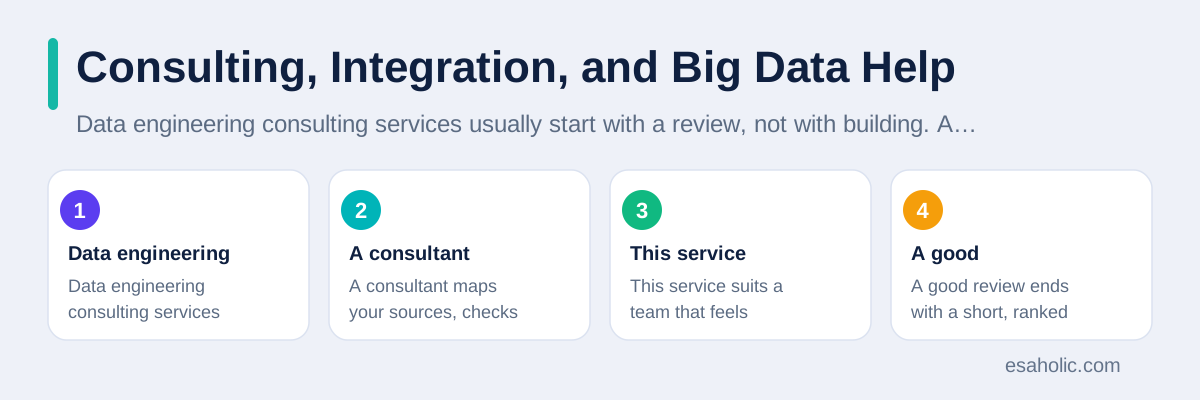
Data engineering consulting services usually start with a review, not with building. A consultant maps your sources, checks data quality, interviews the people who use reports, and writes a plan that ranks fixes by business value. This service suits a team that feels lost, that owns messy data, or that wants a second opinion before a large investment. A good review ends with a short, ranked list, with owners and rough effort for each item, not with a thick report that nobody reads. Be wary of a review that recommends only the consultant's favorite tool, or that skips the hard question of which reports actually matter to the business.
Data integration engineering services focus on joining systems together. Integration means making separate systems share data reliably, so a sale recorded in one system appears correctly in reporting, billing, and inventory. Engineers build connectors, which are small programs that pull data from a specific system, and they handle the messy details: different date formats, different customer codes for the same person, and systems that go offline for hours. They also build a mapping, which is a clear record of which field in one system matches which field in another. Without that mapping, two teams can argue for weeks about why their totals differ, when the real cause is a simple mismatch in how each system defines a sale.
Big data engineering services handle volume, speed, or variety that ordinary tools struggle with. Big data does not mean impressive data, it means data that is large, fast moving, or messy enough to need distributed processing, which is work split across many computers. A provider in this area designs systems that split work into parallel pieces, store raw data before cleaning it, and scale up when traffic spikes. Ask a big data provider to show how the system behaves when data doubles, because a design that works at today's volume and collapses at twice the volume is not a big data design. Also ask how the team will test at realistic scale, because tests on tiny samples hide the very problems big data work exists to solve.
Pipelines, Warehouses, and Analytics Support
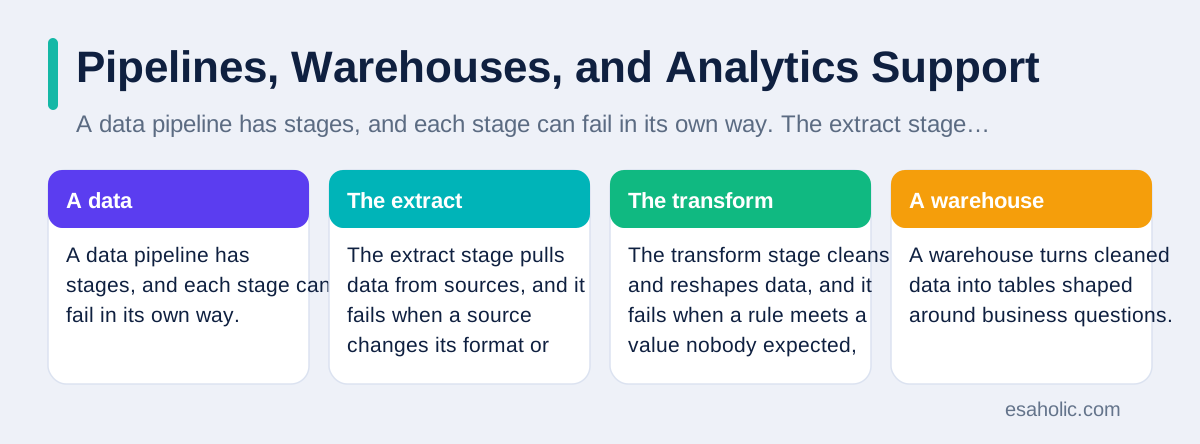
A data pipeline has stages, and each stage can fail in its own way. The extract stage pulls data from sources, and it fails when a source changes its format or blocks access. The transform stage cleans and reshapes data, and it fails when a rule meets a value nobody expected, such as a negative quantity or a date from the year 2099. The load stage writes data to its destination, and it fails when the destination runs out of space or rejects a duplicate key, which is a value that must stay unique, such as an order number. Good pipeline design isolates these stages, so a failure in one stage does not corrupt data in another, and it logs enough detail to show exactly which stage broke and which records it affected.
A warehouse turns cleaned data into tables shaped around business questions. Engineers often build fact tables, which hold measurable events such as sales and visits, and dimension tables, which hold descriptions such as product names, store locations, and customer groups. That split makes reports faster and easier to write, because an analyst can join a small set of clear tables instead of untangling one giant table. Data analytics engineering services sit close to this layer: analytics engineers build the final tidy tables and definitions that analysts and dashboards use, such as a single agreed definition of an active customer. Without that agreed layer, every analyst defines the same term slightly differently, and every meeting starts with a debate about definitions.
Data engineering services and solutions, a phrase providers often use for bundled offers, usually combine pipelines, a warehouse, dashboards, and ongoing support into one package. A bundle can save time, but it can also lock you into tools you did not choose. Before you accept a bundle, ask which parts you own, which parts you can replace, and what happens to your data if you leave. The Google Cloud BigQuery documentation shows how one popular warehouse organizes tables and queries, and reading even a small part of it helps you ask sharper questions about any warehouse a provider proposes. Also ask for a data dictionary, which is a plain language catalog of every table and field, because a warehouse without one is a warehouse only its builders can use.
Pipelines often feed machine learning work, and AI and machine learning development services cover the systems that use that prepared data.
Quality, Monitoring, and Trust
Data quality work deserves its own budget, because clean data does not stay clean on its own. Sources change, people enter data differently, and a small format change can silently break a pipeline that still reports success. Quality checks should test for missing values, duplicate keys, impossible dates, sudden volume changes, and values that fall outside expected ranges. A check that only counts rows will miss a pipeline that delivers the right number of rows with the wrong contents, so checks must look inside the data, not only at its size. When a check fails, the pipeline should stop, alert a human, and keep the previous good data in place, rather than overwriting good data with bad data.
Monitoring turns a pipeline from a black box into a system the business can trust. A good monitoring setup shows, for each pipeline, when it last ran, how long it took, how many rows it moved, and which quality checks passed or failed. It also tracks freshness, which is how old the newest data in a table is, because a dashboard that looks current but shows yesterday's data can mislead decisions. Teams should review these signals daily at first, then weekly once the system stabilizes, and they should treat repeated warnings as a design problem, not as noise to ignore. A provider that hands over pipelines without monitoring hands over a system that will fail quietly, and quiet failures cost more than loud ones.
Trust also comes from access control and lineage. Access control means each person sees only the data their job needs, which protects privacy and reduces accidental damage. Lineage means a record of where each table came from and which steps shaped it, so an analyst can trace a surprising number back to its source and its transformations. When a report looks wrong, lineage turns a blame game into a short investigation: follow the chain, find the step that changed, and fix that step. Providers should build lineage into the system from the start, because adding it later, after dozens of pipelines already exist, is slow and painful work that teams keep postponing.
Quality checks work best inside clear rules, and data governance frameworks explain how ownership and access decisions are made.
How a Typical Project Runs
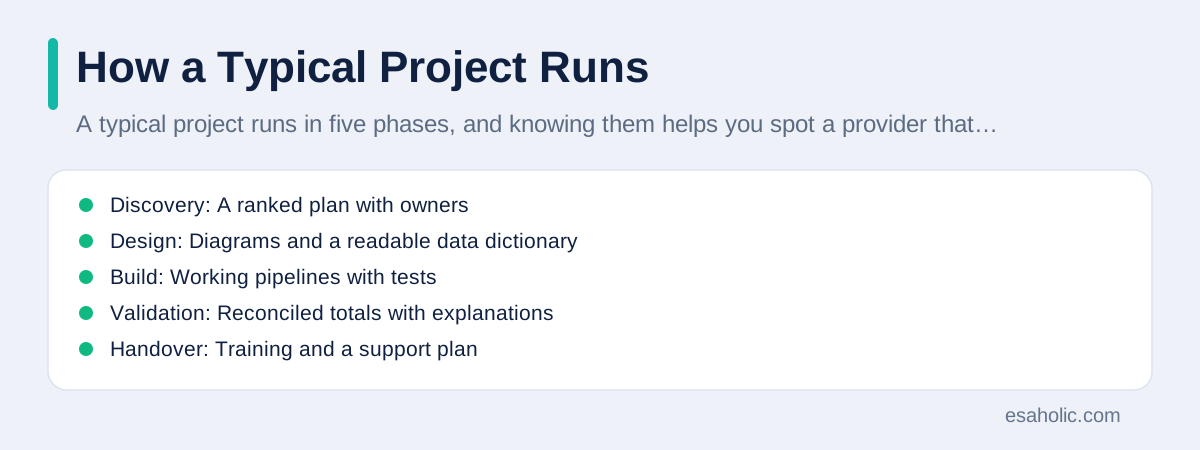
A typical project runs in five phases, and knowing them helps you spot a provider that skips a phase. Discovery maps sources, users, and decisions, and it ends with a ranked plan. Design chooses the pipeline shape, the warehouse model, and the quality checks, and it ends with a diagram and a data dictionary draft that non technical staff can read. Build creates the first pipelines for the highest value data, with tests and monitoring from day one, not as an afterthought. Validation runs the new system beside the old reports, and the team compares totals until differences have explanations, not excuses. Handover transfers ownership, with training, documentation, and a support plan, so your team can run the system without the provider in the room.
Timelines vary, but a useful rule is to judge a project by its first working pipeline, not by its kickoff slides. A provider should deliver a small, real pipeline early, even if it covers only one source and one report, because that early delivery proves that access, tools, and quality checks actually work. If weeks pass with only diagrams and meetings, ask for a working slice, and ask what blocks it. Early delivery also gives the business a quick win, which builds support for the larger work, while a long silent build phase breeds doubt and invites scope changes that nobody can evaluate.
Staffing matters as much as tools. A strong project team includes someone who understands the business questions, someone who understands the source systems, and someone who can build and test pipelines well. A provider that sends only tool specialists, with no one who asks why a report matters, will build technically neat pipelines that answer the wrong questions. Ask who will own data definitions, who will review quality checks, and who will train your analysts, and get those names and roles in writing. Our guide to shared and isolated tenancy designs covers a related ownership question for teams that serve many customers from one platform, and the guide to meaning based search systems shows where prepared data feeds AI search.
| Phase | What it delivers | Warning sign |
|---|---|---|
| Discovery | A ranked plan with owners | A tool recommendation with no business ranking |
| Design | Diagrams and a readable data dictionary | Diagrams only engineers can read |
| Build | Working pipelines with tests | Weeks of slides with no working pipeline |
| Validation | Reconciled totals with explanations | New reports that nobody compares with old ones |
| Handover | Training and a support plan | A handover that needs the provider forever |
Choosing a Provider Without Regret
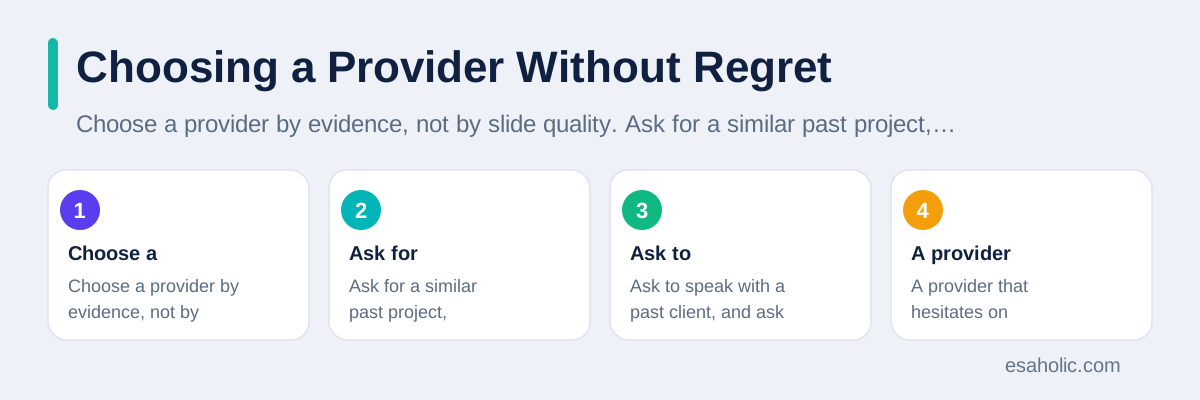
Choose a provider by evidence, not by slide quality. Ask for a similar past project, described in plain terms: the sources, the volume, the hardest problem, and what the team would do differently now. Ask to speak with a past client, and ask that client what broke, how fast the provider responded, and whether the client's own team can now run the system. Ask who owns the code, the pipeline definitions, and the documentation, and get the answer in the contract, because ownership disputes at the end of a project are expensive and avoidable. A provider that hesitates on ownership, references, or past problems is telling you something, even if the sales material looks perfect.
Compare proposals on the same basis, or you will compare apples with oranges. Give every provider the same short brief: your top three decisions, your main sources, your rough data volume, and your deadline for the first working pipeline. Then compare their plans on scope, on quality checks, on monitoring, on handover, and on what they will not do, because a provider that names its limits honestly is usually safer than one that promises everything. Be especially careful with a proposal that promises a fixed price before discovery, because data work hides surprises in source quality, and a fixed price before discovery usually means corners will be cut when surprises appear.
Finally, plan the exit on day one, even if you hope never to use it. Keep your data in open formats where possible, keep pipeline code in your own repository, which is a version controlled store for code, and keep the data dictionary updated as a living document. Test that your own team can run a pipeline, fix a failed job, and add a simple source without calling the provider. A provider that builds toward your independence earns long term trust, while a provider that builds dependence earns short term revenue and long term resentment. The right relationship feels like a good hire: the provider solves a hard problem, teaches your team as it goes, and leaves you stronger than it found you.
Conclusion
Data engineering services cover the full chain from raw sources to trusted tables: consulting that ranks the work, integration that joins systems, big data design that handles scale, pipelines that move data reliably, warehouses that shape data around business questions, and analytics support that gives every term one agreed definition. Quality checks, monitoring, lineage, and access control turn that chain into a system the business can trust, and a disciplined project runs through discovery, design, build, validation, and handover with a working pipeline early. Choose a provider by evidence, by references, and by ownership terms, plan the exit on day one, and insist on handover that leaves your team able to run the system. Done that way, data engineering stops being plumbing that everyone complains about, and becomes a quiet advantage that every decision can rely on.
Frequently Asked Questions
What do data engineering services actually deliver?
Data engineering services deliver reliable pipelines that collect data from many sources, clean and organize it, store it in a warehouse or lakehouse, and make it ready for reports and AI tools. The delivery also includes tests, monitoring, and documentation, so the business can trust the numbers.
How are data engineering services different from data analysis?
Data engineering builds and maintains the systems that move and prepare data, while data analysis uses that prepared data to answer business questions. Engineering comes first in the chain: without clean, timely data, even a skilled analyst cannot produce reliable answers.
Should a small team hire a data engineering provider or build in house?
A small team should hire outside help when data work is urgent, specialized, or larger than the current team can handle, and build in house when data is a lasting core advantage and the team can hire and retain engineers. Many teams start with outside help for the first pipeline, then bring the work in house as skills grow.
Written by Ahmad Jajja
Senior AI Research Engineer and Generative AI Specialist
Ahmad Jajja is a senior AI research engineer at Esaholic who builds generative AI systems grounded in real documents for accurate answers.
Reviewed by Danish Mustafa
Senior Agentic AI Engineer and Systems Architect
Danish Mustafa is a senior agentic AI engineer at Esaholic who builds AI agents, voice systems, and messaging systems for real customers.
Relevant blogs
AI Data Integration Explained
How teams join data from many systems into one reliable view.
Multitenant Database Containers Explained Simply
Shared and isolated tenancy, containers, security, and backups in plain language.
What Is a Vector Database Explained Simply
Embeddings, similarity search, use cases, and honest limits in plain language.
Database Optimization: A Practical Guide
Indexes, query tuning, caching, and monitoring for faster, calmer databases.
Back to all blog guides · Back to Data, Cloud and Databases guides · Explore AI and ML Development Services