
Looking Back At AI News In April 2025
April 2025 was a busy month for artificial intelligence, and this guide looks back at it as a retrospective, which means a review of events after they happened, not a live news report. That distinction matters. If you are reading this guide long after April 2025, some products have changed, some models have been replaced, and some promises have been revised. The value of a retrospective is not to tell you what to buy today. It is to show what changed in that month, why it mattered at the time, and which patterns from that month still shape AI today. April 2025 rewards that kind of reading, because it was a month when reasoning models, everyday apps, hardware, research, and business news all moved at once.
Three themes run through the month. First, reasoning became normal. A reasoning model is a model designed to work through a problem step by step, using tools such as search, code, and image analysis, rather than answering in one quick pass. Second, AI moved out of the chatbot window and into apps people already used, from shopping to voice assistants to social feeds. Third, the business story stayed just as loud as the technical story, with large funding rounds, strong cloud results, and hardware plans that showed how expensive the race had become. Keep those three themes in mind as you read, because they explain why a single month produced so many headlines that still feel familiar.
A note on sources is also important. This guide reports items that were widely reported in April 2025 roundups and in company announcements from that month, and it avoids claims that appeared only in low quality roundups with no supporting announcement. Where a detail is uncertain, the guide says so in plain words, rather than dressing a rumor up as a fact. That caution is part of the lesson of the month itself. April 2025 produced confident headlines every week, and the headlines that aged best were the ones tied to a shipped product, a published announcement, or a filed result that readers could check.
Reasoning Models Took Center Stage
The most important technical story of the month was the release of OpenAI's o3 and o4-mini models in mid April. OpenAI described o3 as its most capable reasoning model to that point, and o4-mini as a smaller, faster model that still handled reasoning tasks well. Both models could use tools directly, which means they could search the web, run code, and analyze images as part of answering, instead of relying only on text they had memorized during training. That tool use is easy to underrate, because it sounds like a small feature. In practice, it changed what a model could verify. A model that can search and run code can check a fact and test a calculation, while a model without tools must guess from memory, and guessing is where many AI errors begin.
OpenAI reported that o3 reduced major errors compared with its predecessor o1, and that o4-mini performed strongly on a well known mathematics benchmark for its size. Benchmarks, which are standardized tests used to compare models, should always be read with care, because a score on one test does not prove a model is best for your task. Still, the direction was clear. Model makers were competing on reasoning quality and on tool use, not only on raw size or on how fluently a model could write. For readers, the practical question shifted from "which model writes best" to "which model checks its work best," and that question still guides model choice today. Our guide to how to read large language model updates explains that shift in more detail, and it remains useful whenever a new model launch promises a leap forward.
Meta released its Llama 4 family in early April, adding multimodal models, which means models that can work with more than one kind of input, such as text and images together. Multimodal ability matters because real work is rarely text only. A support ticket may include a screenshot, a product question may include a photo, and a document may mix charts with paragraphs. A model that can only read text will miss half the problem. Meta also moved toward open weights for parts of the family, which means the trained model files were made available for others to download and build on, subject to license terms. Open models and closed models serve different needs, and April 2025 showed both paths advancing at the same time, rather than one path winning outright.
Alibaba closed the month with Qwen3, a family of open models that mixed reasoning and fast response modes in one system. The hybrid idea was simple and appealing: let the user or the application choose deep thinking for a hard problem and quick answering for a simple one, instead of forcing one mode for everything. Qwen3 was reported on April 29, 2025, alongside strong claims on benchmarks against rival models. As with every benchmark claim, the wise response is to test a model on your own tasks before trusting a leaderboard. The lasting point is not which model topped a chart on one day. It is that by the end of April, reasoning, multimodality, and open availability were all standard parts of a model launch, not exotic extras.
AI Moved Into Everyday Apps
Model releases make headlines, but app releases change habits, and April 2025 had several of those. Meta launched a standalone Meta AI app on April 29, 2025, powered by Llama 4, with voice features and a social Discover feed, where users could see prompts and responses shared by others. The app was a direct attempt to give Meta's assistant a home of its own, rather than living only inside other Meta products. Voice mattered here, because speaking to an assistant feels different from typing to one, and it opens AI to people who prefer to talk while driving, cooking, or walking. The social feed mattered for a different reason: it turned AI use into something people could browse and copy, which spreads new uses fast, and also spreads bad prompts and misleading outputs fast.
OpenAI deepened shopping inside ChatGPT around April 28, 2025, adding product results with structured details, images, and prices drawn from the web, together with memory features that let the assistant remember preferences across conversations. Shopping is a revealing test for AI, because a shopping answer is either useful or it is not, and users notice quickly when a price is stale or a product is out of stock. Memory is a revealing test for a different reason: an assistant that remembers you can save time, but it also holds personal details that need clear controls. The April update therefore raised two questions that still matter. How fresh is the information behind an AI answer, and who controls what the assistant remembers? A good shopping assistant answers both questions openly, and a weak one hides them behind a smooth interface.
Perplexity launched a voice assistant on iOS on April 24, 2025, offering task help across other apps, such as booking related lookups and maps, at a time when Apple's own assistant updates were widely reported as delayed. The contrast was part of the story. Users did not have to wait for one company's roadmap when another company could ship a voice layer on top of existing apps. That pattern explains why platform news and startup news should be read together.
Chips, Cloud, And The Cost Of The Race
Behind every model launch sits hardware, and April 2025 kept that hardware story visible. Reports on April 21, 2025 described Huawei accelerating mass production of its Ascend 910C AI chip, presented as a domestic alternative where access to leading foreign chips was restricted. Whether or not a reader follows chip politics closely, the lesson is general: access to compute, which means processing power for training and running models, shapes which countries and companies can build leading models. A model announcement is also, quietly, a chip announcement, because no model trains or serves itself. Our guide to AI hardware in plain language explains that link, and April 2025 is a good case study for it.
NVIDIA's announcement of United States built AI supercomputers in mid April pointed in the same direction from the other side of the market. Building advanced systems domestically was framed as a manufacturing and jobs story as well as a technology story, and it showed how AI infrastructure had become industrial policy, which means government action that shapes which industries grow and where. Infrastructure news decides prices, availability, and speed for every feature that follows.
Alphabet reported first quarter 2025 revenue of 90.2 billion dollars on April 24, 2025, with cloud and AI growth cited as drivers, while the company also faced major antitrust cases in the United States. Antitrust here means legal action alleging that a company unfairly limits competition, and the combination of strong earnings plus legal pressure is a useful reminder. Financial strength and regulatory risk can rise together. A company can report record revenue and still face a case that could reshape its business. For readers tracking AI news, earnings reports are worth reading alongside model launches, because earnings show whether AI investment is paying for itself, or whether it is still mainly a promise funded by other businesses.
Research, Health, And Education News
April 2025 also produced research news that had little to do with chatbots, and that news deserves space in any honest retrospective. In health care, April roundups reported Mount Sinai launching an AI center for small molecule drug discovery, which means using AI to help find new drug candidates among small chemical compounds, and a university led team using AI to point to a possible early target in Alzheimer's research. Roche secured the first Food and Drug Administration Breakthrough Device Designation for an AI powered companion diagnostic for non-small cell lung cancer, a designation that signals the regulator sees a device as offering a meaningful advance for a serious condition and gives it a faster review path. These items matter because they show AI working as a research tool with human scientists in charge, not as a replacement for science itself.
Health operations news told a parallel story. Plenful raised 50 million dollars to scale AI in health care operations, and other providers expanded ambient AI, which means AI that listens during a clinical visit and drafts notes, after clinicians reported less burnout. Burnout here means exhaustion from workload, and documentation is a large part of that workload in health care. An AI tool that cuts note writing time can therefore feel like a major improvement even if it never makes a diagnosis. That distinction is worth keeping. Many of the most valuable AI tools in April 2025 did not make decisions. They removed paperwork, summarized records, or drafted first versions that a human then checked. Tools that save time without taking authority away from professionals are easier to trust, and easier to govern, than tools that decide alone.
Education news added another angle. On April 2, 2025, the Wharton School at the University of Pennsylvania announced a new undergraduate concentration and MBA major in Artificial Intelligence for Business, with courses on applied machine learning, data science, and statistics, plus a required ethics course on accountable AI. The announcement is useful as a retrospective marker because it shows institutions treating AI as a business skill with ethical duties, not only as a technical specialty. When a business school builds a major around AI, it signals that employers are expected to need managers who can judge AI systems, not only engineers who can build them. That judgment gap, between building and judging, is also the governance theme of the final section of this guide's companion topics, and it runs through much of April 2025.
Funding, Creative Tools, And Culture
Funding news in April 2025 continued at a scale that would have seemed extraordinary a few years earlier. OpenAI's very large funding round, led by SoftBank and reported at 40 billion dollars with a valuation around 300 billion dollars, was widely discussed in April roundups, even though the announcement itself arrived around the turn of March and April. The round was tied to OpenAI's planned move toward a for profit structure, which drew legal debate about the company's original mission. The lesson is that structure and governance questions traveled with the money, not only a price tag.
Creative tools also made news in April, and they showed both the promise and the tension of generative AI. Google's Veo 2 video generation appeared in Gemini Advanced and in the Whisk tool, offering short video clips from prompts, while other video and image tools improved editing quality. On April 21, 2025, reports noted that AI assisted films became eligible for Oscars consideration under a new Academy rule, which clarified that AI assistance alone did not disqualify a film. That rule did not settle the deeper questions about training data, credit, and copyright, which means the legal right to control creative work and to be paid for it. It settled only the eligibility question, and creative workers continued to debate the rest. Readers should be wary of headlines that claim a single rule "settled AI in Hollywood," because it settled one narrow question in a much larger argument. Teams building creative tools of their own can read about generative AI development services.
Anthropic's model welfare initiative, discussed in April roundups, added a stranger and more philosophical note. Model welfare asks whether advanced AI systems could deserve moral consideration, and how companies should study that question responsibly. Most readers will rightly treat that topic as speculative, which means based on ideas about the future rather than settled evidence. Its presence in April news still matters, because it shows how quickly the conversation moved from "can models reason" to "what do we owe models if they can." The practical questions for businesses stayed ordinary: accuracy, cost, privacy, and accountability.
Regulation Signals And What Stayed Undecided
Regulation news in April 2025 was quieter than product news, but it set the context for everything else. In Europe, the EU AI Act was already law, with its phased duties underway, so April coverage focused less on new legislation and more on how companies would meet existing duties. In the United States, debates continued over state rules, platform responsibility, and the use of AI in schools and workplaces, without a single federal AI law emerging in the month. That uneven picture is itself the news. A company operating across borders in April 2025 faced a patchwork, which means a set of different rules in different places, rather than one global standard. Teams that built flexible controls, such as clear labels and human review for high stakes uses, coped better than teams that waited for one rule to settle everything.
Creative rights, data use, and transparency stayed open questions throughout the month. News about training data, about labelling synthetic content, and about who owns AI generated work appeared in many forms, but no April announcement resolved them. That pattern is normal for a fast moving field, and it is a reason to distrust any single month's claim that "the rules are now clear." Rules become clear through laws, court decisions, regulator guidance, and industry practice over time, not through one press release. Our guides to UK regulation in 2025 and to EU AI Act news show how different jurisdictions moved at different speeds, and April 2025 sits inside that longer story, not apart from it.
For readers who want to use April 2025 as a learning tool, the most useful exercise is to compare announcement with outcome. Pick three April launches, and check what each product looks like today. Did the feature ship to everyone, or only to a test group? Did the model stay current, or was it replaced within months? Did the price, the limits, or the terms change? That exercise teaches more than any list of headlines, because it trains the habit that matters most in AI news: separate a launch from a result. April 2025 launched a great deal, and the launches that mattered most were the ones that survived contact with real users, real costs, and real regulation in the months that followed.
How To Use This Retrospective Today
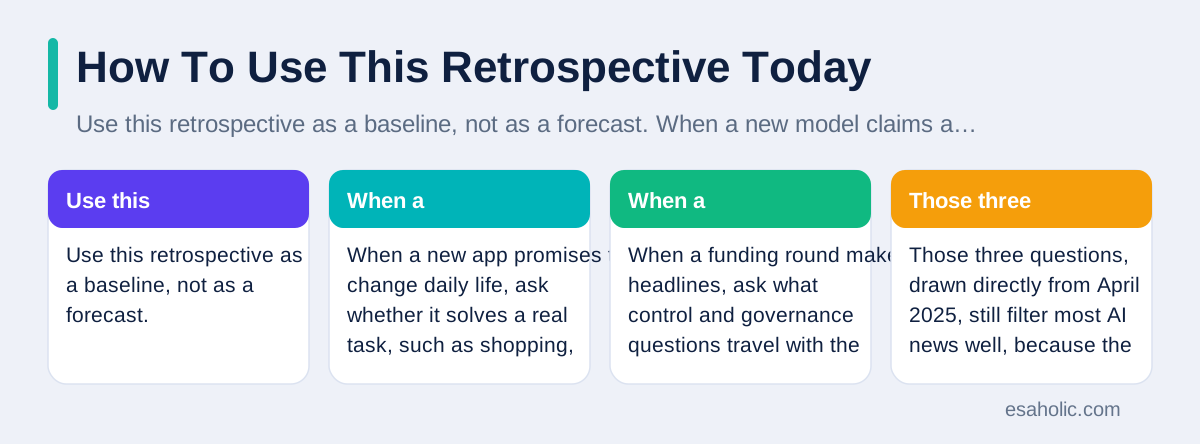
Use this retrospective as a baseline, not as a forecast. When a new model claims a breakthrough, ask whether it improves on the reasoning and tool use that April 2025 made standard, or whether it only repeats that claim with new branding. When a new app promises to change daily life, ask whether it solves a real task, such as shopping, note writing, or scheduling, or whether it only demos well in a short video. When a funding round makes headlines, ask what control and governance questions travel with the money. Those three questions, drawn directly from April 2025, still filter most AI news well, because the field keeps repeating the same three stories with new names.
Also keep a simple rule for old news: check the date before you share it. AI news ages faster than most technology news, because models, prices, and policies change in weeks. A screenshot of an April 2025 announcement, shared without its date, can mislead a reader into thinking a feature is new, a model is current, or a rule is settled. Share the date with the claim, link to the original announcement where possible, and note what has changed since. OpenAI's announcement of o3 and o4-mini, Meta's Llama 4 announcement, and Google Cloud's AI blog are good starting points for checking how model and platform stories were first presented, and how later updates revised them.
Conclusion
April 2025 mattered because reasoning models, everyday apps, hardware, research, and business news moved together, and because the patterns from that month still shape AI today. Reasoning and tool use became standard, assistants moved into shopping, voice, and daily tasks, compute stayed central to cost and access, and regulation stayed a patchwork rather than a single global rule. Read the month as a snapshot, check launches against what actually shipped, and carry its three questions forward: does it check its work, does it solve a real task, and who governs it. Those questions will serve you better than any single headline from the month.
Frequently Asked Questions
What was the biggest AI model news in April 2025?
The most widely reported model news was OpenAI releasing o3 and o4-mini reasoning models, alongside Meta releasing Llama 4 models and Alibaba releasing the Qwen3 family. Together they showed reasoning and tool use becoming standard, rather than a special feature.
Did April 2025 change how ordinary people used AI?
Yes, mainly through apps. A standalone Meta AI app, shopping features inside ChatGPT, and voice assistants on phones put AI into shopping, chatting, and daily tasks, so people met AI in places they already used instead of only in a chatbot window.
How should I read old AI news from April 2025 today?
Treat it as a snapshot, not a current buying guide. Check whether a feature actually shipped, whether a model is still current, and whether a later update replaced it, because AI products change fast and a launch announcement is not the same as a finished product.
Written by Ahmad Jajja
Senior AI Research Engineer and Generative AI Specialist
Ahmad Jajja is a senior AI research engineer at Esaholic who builds generative AI systems grounded in real documents for accurate answers.
Reviewed by Danish Mustafa
Senior Agentic AI Engineer and Systems Architect
Danish Mustafa is a senior agentic AI engineer at Esaholic who builds AI agents, voice systems, and messaging systems for real customers.
Relevant blogs
Llm News Today: A Guide To Model Updates
A calm guide to large language model news, open versus closed models, and how to read updates without hype.
Ai Chip News: A Plain Guide To AI Hardware
What AI chips do, why they matter, and how to read chip announcements without hype.
Latest Ai News October 2025: A Retrospective
A retrospective on DevDay, social video, coding models, agents, and regulation signals.
Agentic AI News: A Plain Guide To What Matters
How to follow agent developments, spot real progress, and ignore hype without missing what matters.
Back to all blog guides · Back to AI News and Regulation guides · Explore Generative AI Development Services