
Agentic AI News: A Plain Guide To What Matters
Agent stories now fill the daily feed. One day a company claims its agent books travel on its own, the next day another company claims its agent writes code, files reports, and answers customers while staff sleep. Readers feel two pressures at once. They fear missing a change that could reshape their work, and they tire of claims that fall apart on a closer look. This guide gives you a calmer way to follow the field. It explains what agents actually do, why the news moves so fast, and how you can judge a story in a few minutes.
Start with a simple definition. An agent is software that plans a task into steps, uses tools, checks its own results, and acts within limits a human sets. A chatbot answers one question and stops. An agent carries a job forward. It might read an inbox, pull figures from a spreadsheet, draft a reply, and then pause for approval before it sends anything. The pause matters as much as the action. Good agents know which steps they may take alone and which steps need a human, and they keep a record of every step they take.
This guide covers the whole reading skill, not one product launch. You will learn how to read a headline, how to spot a real advance, how companies actually use agents today, which safety rules sit behind serious deployments, and how to build a weekly routine that keeps you informed without eating your day. It also warns you about common traps, such as demos that hide human help, announcements that describe plans as if they already shipped, and benchmark scores that test narrow tasks. Use it as a filter for every agent story you meet from now on.
What Agentic AI Means in Plain Language
Picture a careful assistant who follows a written checklist. You hand this assistant a job, such as preparing a weekly sales summary. The assistant first breaks the job into parts: find the sales file, check that the numbers match last week, flag any strange entries, draft the summary, and send it to you for review. At each step the assistant uses a tool, which simply means another program or data source, such as a spreadsheet, a search index, or a messaging system. The assistant checks its work before it moves on, and it stops when it hits a step that needs your judgment. That checklist behavior, plus tool use, plus stopping rules, is the core of agentic AI.
People often confuse agents with ordinary automation. Ordinary automation repeats one fixed path every time, like a factory line that never changes its route. An agent adapts its path when the facts change. If the sales file is missing, a fixed script fails or sends a wrong summary. An agent notices the missing file, searches for a newer version, and tells you that it found a gap instead of guessing. That adaptability helps with messy real work, but it also creates new risks. An agent that adapts badly can take a wrong turn, repeat a costly action, or act on stale data, so serious systems pair freedom with firm limits.
Our guide on what an AI agent really is explains the basic pattern in more depth, and our guide on how retrieval agents search and check documents shows how agents ground answers in real sources instead of memory alone. Keep those two ideas beside every news story: an agent plans and loops, and a trustworthy agent shows its sources and its steps. A story that describes only the exciting result, with no plan, no tools, and no checks, tells you very little about the system behind it.
Why Agent News Moves So Fast
Agent news moves fast because three forces push it at once. First, large model providers compete for attention, and each launch tries to outdo the last one. Second, startups need funding and customers, so they announce early and loudly, sometimes before ordinary users can try the product. Third, the technology itself changes quickly, because better models, better tools, and better evaluation methods arrive every few months. A reader who checks the feed daily sees a blur of launches, while a reader who checks weekly sees the pattern more clearly: a few real shifts, surrounded by many restated promises.
Money also shapes the headlines. Vendors sell agent platforms, consulting firms sell agent projects, and media outlets sell attention. Each group benefits when agents sound urgent and inevitable. That does not make every story false, but it does mean you should read incentives alongside claims. Ask who gains if you believe the story today. A vendor demo gains a sales meeting. An investor post gains funding interest. An independent test, a customer case with named results, or a documented failure gains far less, which is exactly why those sources deserve more weight than a launch video.
Speed creates a second problem: old stories keep circulating as if they were new. A clip from months ago can resurface on social media without its date, and a reader can mistake a prototype for a product. Always check the date on the original source, not on the post that shared it. If a story lacks a date, a named customer, or a way to try the product, treat it as a rumor, not as news. IBM's guide to agentic AI offers a steady reference point, because it explains agent patterns without tying them to one launch or one vendor.
How to Read an Agent Headline
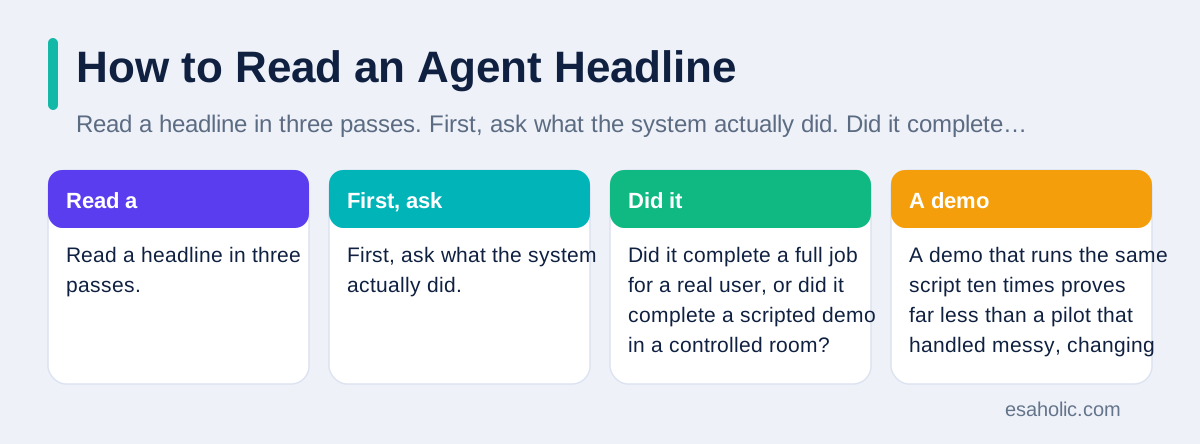
Read a headline in three passes. First, ask what the system actually did. Did it complete a full job for a real user, or did it complete a scripted demo in a controlled room? A demo that runs the same script ten times proves far less than a pilot that handled messy, changing inputs for a month. Second, ask who checked the result. An independent test, a customer name, or a public error rate carries weight. A company grade, meaning a score the company gave its own product, carries much less weight on its own.
Third, ask what the story leaves out. Missing details often matter more than present details. A story that never mentions cost, speed, failure rate, or human review probably hides a weak point in one of those areas. A story that never says who can use the product today probably describes a waitlist or a private test, not a public release. Train yourself to notice these gaps. After a few weeks, you will spot thin stories in seconds, and you will spend your reading time on the few stories that name tasks, tests, and limits.
Watch the verbs too. Words like "unveils," "reveals," and "announces" describe a presentation, not a shipment. Words like "ships," "rolls out," and "now available" describe a product you can try, though you should still check who can access it and in which regions. Words like "fully autonomous" deserve extra care, because most serious deployments keep humans in charge of money, messages, and safety decisions. If a headline promises full autonomy with no human role, read the fine print before you repeat the claim.
What Counts as Real Progress
Real progress in agents looks boring compared with a flashy demo, and that boredom is a good sign. It looks like a pilot that ran for weeks, handled real inputs, and reported both successes and failures. It looks like a tool that cut a clear, measured cost, such as hours spent on invoice checks, with a named starting point and a named result. It looks like a system that failed safely, meaning it stopped and asked a human instead of guessing when it met an unclear case. Those details rarely trend, but they tell you what a system can actually do.
Benchmarks, which are standardized tests that score a model on set tasks, can help or mislead. A high score on a narrow test does not prove skill on your messy job. A model can ace a tidy test set while it stumbles on misspelled names, missing fields, or conflicting instructions, which are exactly the cases real work contains. Good reporting names the test, explains what it covers, and admits what it leaves out. Poor reporting quotes one big number with no context. When a story leads with a score, look for the test behind it before you trust the headline.
A useful test is the "try it yourself" test. Can an ordinary user sign up, run the same task, and see a similar result? If yes, the claim earns trust. If access stays private, the claim stays unproven for everyone outside the company. Our guide on how companies use agents in practice shows what real deployments look like, with pilots, approvals, and limits, and our guide on teams of agents working together explains why multi-agent claims need even stronger evidence than single agent claims.
Agents at Work in Companies
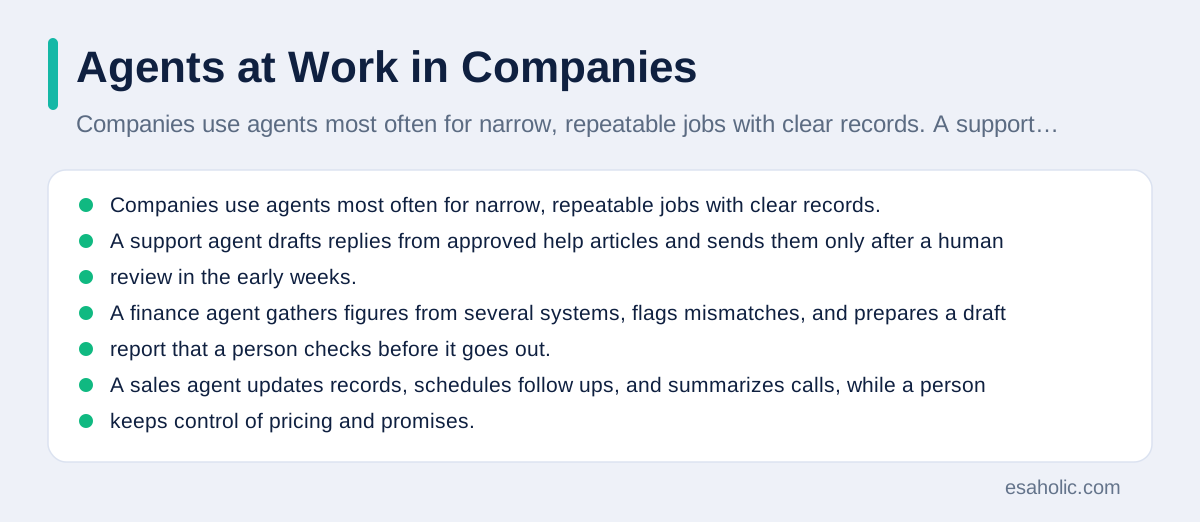
Companies use agents most often for narrow, repeatable jobs with clear records. A support agent drafts replies from approved help articles and sends them only after a human review in the early weeks. A finance agent gathers figures from several systems, flags mismatches, and prepares a draft report that a person checks before it goes out. A sales agent updates records, schedules follow ups, and summarizes calls, while a person keeps control of pricing and promises. Each case shares a pattern: the agent handles the gathering and drafting, and a human keeps the decision.
Pilots teach companies more than launches do. A good pilot starts with one team, one task, and one measure, such as time saved per ticket or errors caught per week. The team reviews a sample of agent actions every week, fixes the instructions that caused mistakes, and widens access only when the error rate stays low. A bad rollout skips the pilot, gives the agent broad access on day one, and discovers problems only after customers complain. News stories rarely describe pilots in detail, so ask about them yourself: which team used it, for how long, and what changed in the numbers?
Cost shapes adoption more than headlines admit. Every agent step can call a model, run a search, or use a tool, and those calls add up. A task that looks cheap in a demo can cost far more at scale, especially when the agent loops through several tries. Smart teams route simple questions to simple systems and reserve agents for hard questions where the extra cost pays off. Our AI agent development services follow that staged pattern, and our workflow automation services cover the simpler jobs that often need no agent at all.
Safety Rules Behind the Headlines
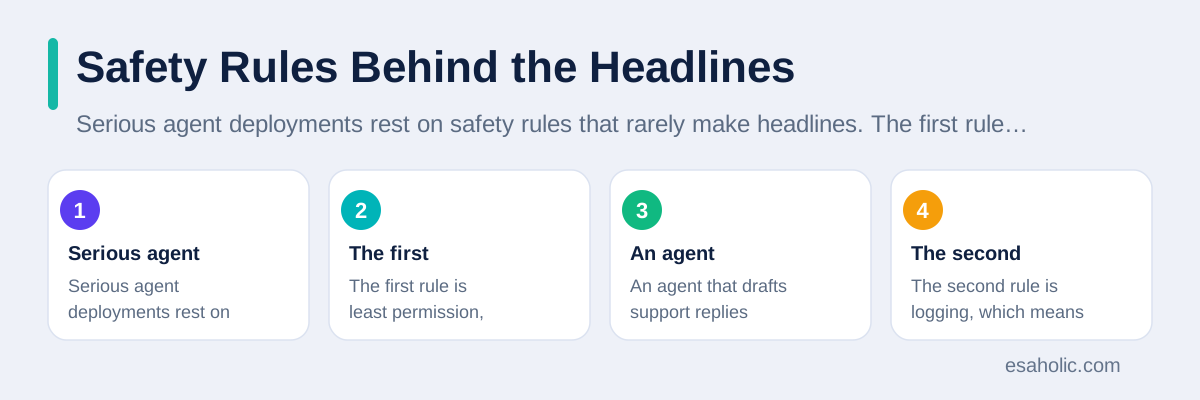
Serious agent deployments rest on safety rules that rarely make headlines. The first rule is least permission, which means the agent gets only the tools and data its task needs, nothing more. An agent that drafts support replies needs no access to payroll data, and an agent that checks invoices needs no power to send payments. The second rule is logging, which means the system records every action, every tool call, and every approval, so a reviewer can trace a mistake to its exact step. The third rule is human approval for high stakes actions, such as moving money, sending messages to customers, or changing records.
Risk frameworks help teams set these rules in a structured way. The NIST AI Risk Management Framework gives organizations a shared language for mapping risks, measuring them, and managing them over time, and Google Cloud's introduction to agentic AI explains how agent tools and guardrails fit together in practice. You do not need to master these documents to read the news well. You only need to ask whether a story mentions permissions, logs, and approvals at all. A story that ignores all three probably describes a demo, not a deployment.
Data handling deserves the same question. Ask which data the agent can read, where that data goes, and how long the provider keeps it. An agent that reads customer messages or internal documents creates a privacy duty, and a company that cannot answer basic data questions has not finished its safety work. Regulation also enters here, because rules on automated decisions, customer data, and workplace monitoring differ by place and sector. A deployment that works in one setting may need new approvals in another, which is why careful companies move in stages instead of flipping one global switch.
How to Follow the News Without Drowning
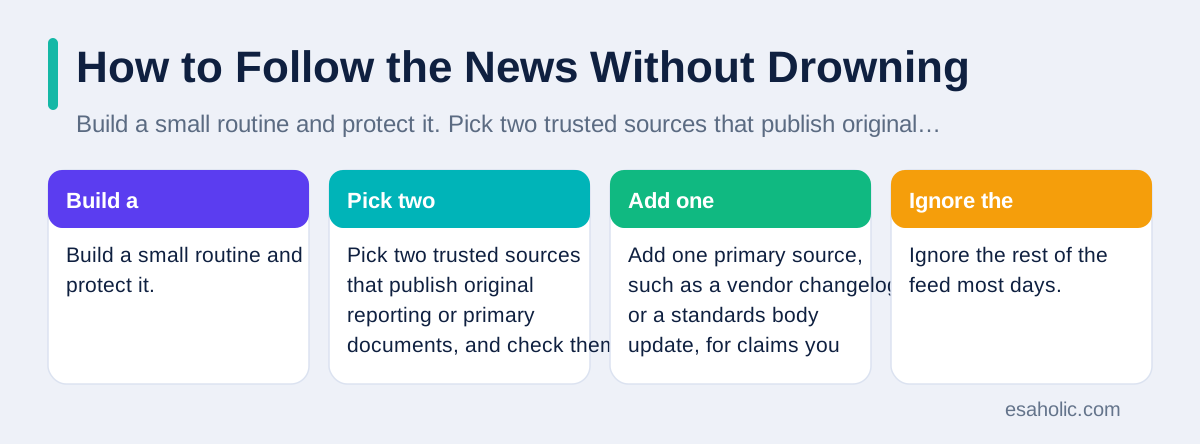
Build a small routine and protect it. Pick two trusted sources that publish original reporting or primary documents, and check them once a week at a fixed time. Add one primary source, such as a vendor changelog or a standards body update, for claims you need to verify. Ignore the rest of the feed most days. This routine sounds modest, but it beats daily scrolling, because daily scrolling rewards speed and shock, while a weekly check rewards accuracy and follow through. You will still catch every real shift, because real shifts stay visible for weeks.
Keep a simple claim file. When a story matters to your work, note the claim, the date, the source, and the promised availability in one line. Revisit the file once a month and mark which claims shipped, which slipped, and which vanished. After two months you will own a personal record of vendor reliability, and you will stop repeating claims that never shipped. Share the file with your team if you work with others, because a shared record stops the same hype from entering through a different colleague each week.
Use social media as a pointer, never as proof. A viral post can point you to a real document, and that document can prove or break the claim. But the post itself proves nothing, because posts strip dates, hide edits, and reward confident wording over careful evidence. When a post excites you, follow it to the source, read the source, and only then decide. That single habit separates readers who stay calm from readers who chase every wave and learn very little.
Questions to Ask Before You Trust a Claim
Keep five questions beside you when you read agent stories. First, what task did the system complete, in plain words? Second, who tested it besides the company that built it? Third, what failed, and how often? Fourth, what does it cost to run at real volume? Fifth, what still needs a human, and where does the human step in? A story that answers three or more of these questions earns a closer read. A story that answers none of them earns a shrug, no matter how exciting its headline sounds.
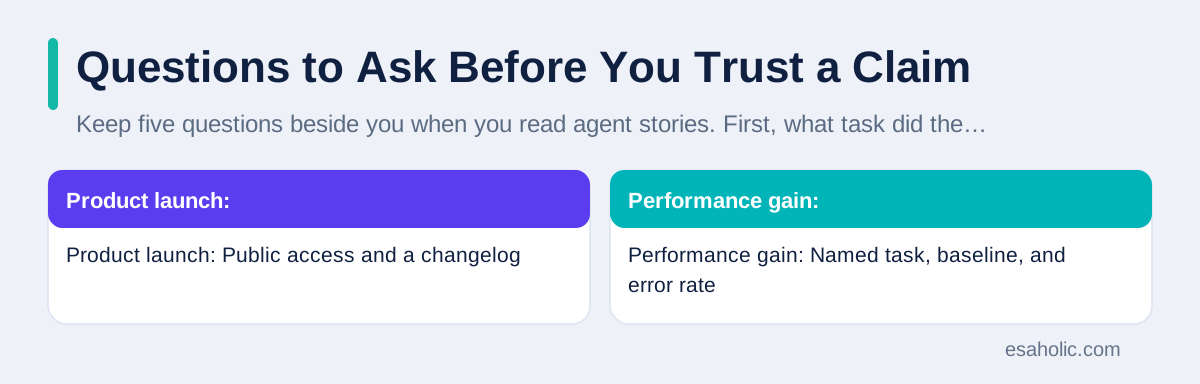
| Claim type | Strong evidence | Weak evidence |
|---|---|---|
| Product launch | Public access and a changelog | A waitlist and a demo video |
| Performance gain | Named task, baseline, and error rate | One big percentage with no baseline |
| Enterprise use | Named customer and measured result | Anonymous praise with no numbers |
| Autonomy | Stated approval rules and logs | "Fully autonomous" with no human role |
Older stories need the same questions, plus one more: what happened since? A story from October 2025 can still teach you about agent design, but its product claims may no longer hold, because tools change, prices change, and pilots end. Check for a newer update before you quote an old claim in a meeting or a plan. Our guide on industry developments from October 2025 models that habit, because it places each claim in its month instead of presenting it as timeless truth. Treat every agent story as dated news, because in this field, it always is.
Conclusion
Agent news rewards patient readers. Agents plan tasks into steps, use tools, check results, and act within human set limits, and real progress shows up as pilots with named tasks, measured results, and honest failure rates. Hype shows up as polished demos, hidden human help, and big numbers with no baseline. Pick two trusted sources, check them weekly, keep a claim file, and ask five plain questions before you trust any story. That routine keeps you informed without drowning you, and it turns a noisy feed into a useful signal for your work.
Frequently Asked Questions
What is agentic AI in simple terms?
Agentic AI is software that plans a task into steps, uses tools such as search or a database, checks its own results, and acts within limits a human sets. A chatbot answers one question and stops, while an agent carries a job forward, asks for approval at risky points, and reports what it did.
How can I tell a real agent advance from hype?
A real advance names the task, the test, and the limits, and it shows the same result more than once. Hype shows a polished demo, hides human help, and skips costs, failures, and approval rules. Ask who can use it today, what it costs to run, and what still needs a human.
How often should I check agent news?
Once a week suits most readers, because daily headlines repeat the same announcements with new wording. Pick two trusted sources, read the full story behind any big claim, and save claims that matter so you can check later whether the product actually shipped.
Written by Umar Abbas
Founder, Principal AI Architect and Operator
Umar Abbas is the founder of Esaholic and a principal AI architect who designs reliable large scale AI systems for regulated industries.
Reviewed by Danish Mustafa
Senior Agentic AI Engineer and Systems Architect
Danish Mustafa is a senior agentic AI engineer who designs multi-step AI systems with clear steps, safe limits, and human approval for high stakes actions.
Relevant blogs
What Is Agentic AI
What an AI agent really is, how it plans steps and uses tools, and where human approval still matters.
Ai Agents Enterprise News: A Practical Guide
How companies use agents today, what changed in tools and rules, and what to watch before you buy or build.
Multi-Agent AI News: Teams Of AI Agents Explained
What teams of AI agents are, where they are used, and what to watch, in plain language.
Agentic RAG
How retrieval agents plan, search, check sources, and answer from your own documents instead of guessing.
Back to all blog guides · Back to AI News & Regulation guides · Explore AI Agent Development Services