
Multi-Agent AI News: Teams Of AI Agents Explained
Headlines about multi-agent ai news often sound like science fiction: teams of AI programs working together, debating, and finishing jobs while humans watch. Strip away the drama, and the idea is simpler and more useful. A multi-agent system is a small team of AI agents that share one bigger job, with each agent owning a clear part and a coordinator keeping the work on track. One agent might gather facts, another might check them, and a third might write the summary. That division of labor can handle work that is too complex, too long, or too varied for a single agent, but it also adds cost, coordination, and new ways to fail. This guide explains the idea in plain language, shows where it is used, and tells you what to watch in future news without hype.
Start with the single agent, because multi-agent only makes sense by comparison. A single AI agent is a program that plans multi-step work, uses tools such as search, databases, or calendars, checks its progress, and acts, within limits set by its owner. A single agent that sorts email, for example, reads a message, decides its category, files it, and drafts a reply for review. That design is simple to build, simple to test, and simple to explain when it goes wrong, because one log shows the whole chain. Multi-agent design becomes attractive only when one agent's job grows too large: when the work needs different skills, different tools, or different data, or when a single agent keeps making the same kind of mistake that a specialist checker could catch. For the basic definition, see what is agentic AI.
Think of a newsroom as an analogy. A single reporter can write a short story alone. A long investigation needs a researcher, a fact checker, an editor, and a writer, each with a different skill and a different check. Multi-agent AI copies that newsroom pattern in software. The researcher agent gathers sources. The checker agent compares claims with sources and flags gaps. The writer agent turns verified facts into a clear draft. A coordinator, sometimes called an orchestrator, which means a program that assigns tasks and tracks progress, moves work between agents and decides when the job is done. The analogy helps, but it has a limit: human newsrooms argue, negotiate, and use judgment in ways that AI agents only imitate, so the checker and the human approval step remain essential, not optional.
How a Multi-Agent System Works, Step by Step
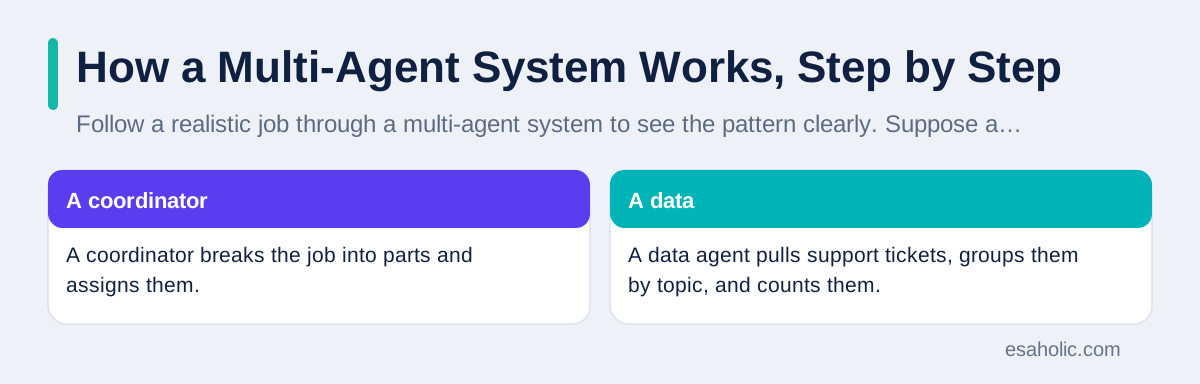
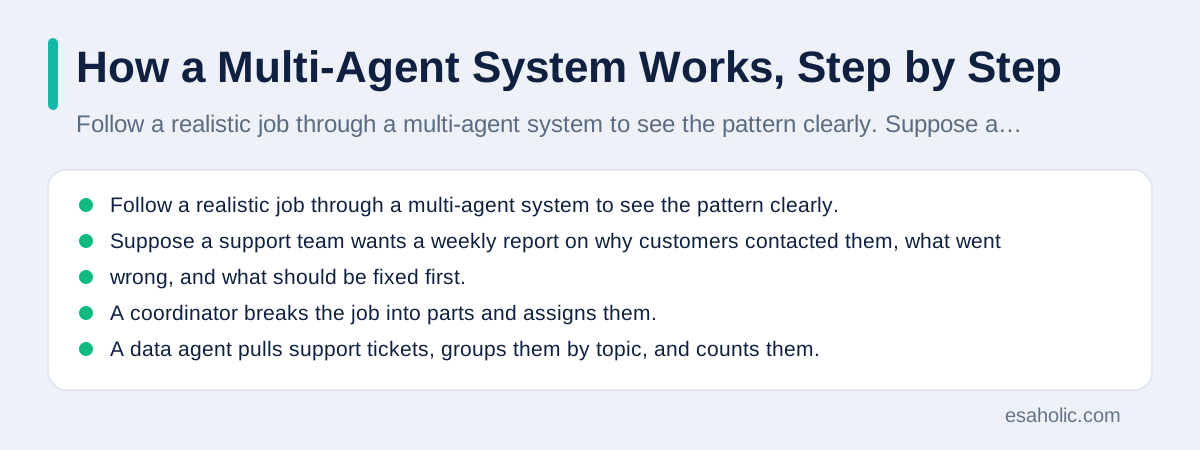
Follow a realistic job through a multi-agent system to see the pattern clearly. Suppose a support team wants a weekly report on why customers contacted them, what went wrong, and what should be fixed first. A coordinator breaks the job into parts and assigns them. A data agent pulls support tickets, groups them by topic, and counts them. A research agent reads the largest groups and finds example tickets that illustrate each problem. A checker agent compares the research agent's claims with the ticket data and flags any claim without support. A writer agent turns the verified findings into a short report with tables. A human manager then reviews the report, approves the top fixes, and sends it to the team. Each agent does one job well, and the checker plus the human provide two layers of safety.
Communication between agents is where the design succeeds or fails. Agents can pass messages in a shared workspace, through a coordinator, or in a fixed sequence, where each agent hands its output to the next. A shared workspace lets agents see each other's work and correct it, but it can also let errors spread, because one agent may copy another agent's mistake as if it were a fact. A fixed sequence is easier to test, because the order is predictable, but it is less flexible when a step needs to loop back for more research. Good systems therefore log every message between agents, limit what each agent can do, and set a stopping rule, which is a clear condition that ends the work, such as a maximum number of steps, a time limit, or a checker approval. Without a stopping rule, agents can loop, repeat, or drift off topic while costs climb.
Memory is the third key part. Each agent needs to remember what it already did, what it found, and what remains open, or it will repeat searches and contradict earlier findings. Some systems give each agent its own short memory for the current job, plus a shared memory for facts all agents need. Shared memory helps coordination, but it also needs care: a fact written by one agent should carry its source, so another agent, and a human reviewer, can check it. A system that treats every agent message as truth, without sources, will amplify mistakes instead of catching them. The strongest multi-agent designs therefore treat sources, not confidence, as the currency of trust.
Where Multi-Agent AI Is Used in Real Work
Customer support is one of the clearest uses. A support system might use one agent to classify a ticket, another to search help articles and past tickets, another to draft a reply, and a checker to verify that the draft matches company policy before a human sends it. That split helps because classification, search, writing, and checking need different prompts, different tools, and different care. A single agent asked to do all four often rushes the checking step, because writing feels like progress while checking feels like delay. A dedicated checker, with no incentive to finish quickly, catches more errors. The result is not a fully autonomous support team. It is a faster team with better drafts and fewer policy mistakes.
Operations and research offer similar patterns. In operations, agents can track a multi-step workflow across tools: one agent watches inventory, another watches orders, another drafts alerts when stock runs low, and a checker confirms the numbers before an alert goes to a manager. In research, agents can gather sources on a topic, compare them, and summarize disagreements, which is valuable when a question spans many documents. In software work, agents can split a task into planning, coding, testing, and review, with a test agent that runs checks a coding agent might skip. In each case, the value comes from specialization and checking, not from the number of agents. A system with three focused agents and a strong checker usually beats a system with ten vague agents and no checker.
Some uses deserve caution, even when vendors present them as ready. Agents that move money, change customer records, send messages to customers, or make hiring decisions should never run without human approval for important actions, because an error by one agent can be copied by the next agent and then acted on at speed. Agents that work with personal data need strict limits on which data each agent may see, because a team of agents can leak data between steps more easily than a single agent can. And agents that browse the web need protection against misleading content, because one agent may treat a planted instruction on a web page as a real instruction. Those risks do not make multi-agent AI unusable. They make human approval, data limits, and content checks part of the design, not an afterthought.
Coordination, Checks, and Honest Limits
Coordination is the hardest part of multi-agent design, and it is where most news claims should be tested. A good coordinator assigns clear roles, tracks which sub tasks are done, and detects when agents disagree or repeat work. A weak coordinator lets agents work in parallel without a shared plan, so two agents may answer different versions of the same question, or one agent may wait forever for input that never arrives. When you evaluate a multi-agent product, ask to see its plan: what are the roles, what is the order, what happens when agents disagree, and what stops the system? A vendor that cannot show a plan has not built a team. It has built a crowd.
Testing a multi-agent system also needs test cases designed to trigger coordination failures, not only cases where the system should succeed. Feed it conflicting documents, a missing tool, and a vague instruction, and watch whether it asks for help, says it does not know, or invents a confident answer. Those hard cases reveal whether the coordinator and checker actually work, or whether they only approve easy jobs. A pilot that passes only easy cases has not been tested at all, because live users will supply hard cases within the first week.
Checks deserve equal attention. The most valuable agent in many systems is the checker, which compares output with sources, tests numbers, and flags claims without evidence. A checker should be independent in the sense that it does not simply repeat the writer's reasoning, and it should have access to the original data, not only to the writer's summary. Some systems add a second checker for high stakes output, or a human review step that samples a share of jobs each week. Those layers cost time and money, but they are what turn a multi-agent demo into a system a business can trust. A demo that shows only the final answer, without its checks, hides the part that matters most.
Limits follow from cost and complexity. Every extra agent adds model calls, which add cost and time, so a multi-agent job can cost several times more than a single agent job, and a looping system can cost far more. Every extra agent also adds a place where misunderstanding can occur, because agents communicate in language, and language is ambiguous. A system that works well on a small test set may fail on live data, where users ask unexpected questions, documents conflict, or tools return errors. Google Cloud's guide to multi-agent systems describes the same trade off in plain terms: multi-agent designs suit complex, multi-step work, but they need orchestration, observability, which means monitoring what the system does, and governance to stay safe. Start with a single agent, and split it only when a specific job measurably improves with a specialist or a checker. IBM's guide to agentic AI makes the same distinction between a single agent that acts and a system of agents that must be coordinated and checked.
What to Watch in Multi-Agent AI News
Future news about multi-agent AI will likely fall into four buckets, and each bucket deserves a different level of trust. The first bucket is tools that make agents easier to build, such as visual builders, shared memory, and standard ways for agents to call tools. Those announcements are useful, but they prove only that building is easier, not that the resulting systems are reliable. The second bucket is evaluation, which means tests that show whether multi-agent systems actually outperform single agents on real jobs, with cost and error rates included. Evaluation news is more valuable than tool news, because it answers the question businesses actually ask: is the extra complexity worth it?
The third bucket is safety and governance, including limits on agent actions, audit logs that show what each agent did, and rules for agents that act on a user's behalf. Safety news matters most for high stakes uses, such as finance, health, and hiring, where an agent error can harm people. The fourth bucket is standards and interoperability, which means common ways for agents from different vendors to work together without custom code for each pair. Standards news is slower and less exciting, but it determines whether multi-agent systems become a lasting infrastructure or a collection of demos that cannot connect. When you read a headline, ask which bucket it belongs to, and judge it by that bucket's standard, not by excitement alone.
Also watch for language that inflates progress. A system described as autonomous may still need human approval for every important action, which is good, but not autonomous in the everyday sense. A team of agents described as collaborating may simply be passing outputs in a fixed sequence, which is useful, but not a debate. A result described as a breakthrough may come from a narrow test, not from live use. None of those word choices proves a claim false, but each one is a reason to look for the test, the cost, and the checker behind the claim. The best multi-agent news will name those three things. The weakest will name only the number of agents.
Getting Started Safely With a Small Multi-Agent Pilot
Choose one small, clear workflow where the job already splits naturally. A good first pilot is a weekly report, a ticket triage draft, or a research summary, where the output is reviewed by a human before it affects a customer. Avoid starting with money movement, customer messaging, or hiring, where an error is costly and hard to reverse. Write the workflow in plain words first: what are the steps, who owns each step, what data may each step use, and what counts as done? If you cannot write that plan on one page, the workflow is too vague for a multi-agent pilot, and a single agent or a human process will serve you better for now.
Build the pilot with three agents at most: a worker, a checker, and a coordinator or a fixed sequence that plays that role. Give each agent a narrow job, a limited set of tools, and a clear output format, such as a table with sources. Log every step, measure time and cost per job, and sample the output by hand each week. Compare the pilot with the single agent version on the same test set, using accuracy, cost, and time, not only fluency. If the multi-agent version does not beat the single agent version on accuracy or on errors caught, keep the single agent. That comparison is the pilot's purpose, and it protects you from paying for complexity that adds no value.
Keep a human approval step for the pilot's entire life, not only for its first week. As agents improve, teams often remove approval to save time, and that is when a drift or a data change can cause a silent failure. Instead, keep approval for high stakes output, and use sampling for low stakes output, where a human reviews a random share of jobs and the system must pass that sample to keep running. That design gives you speed where it is safe and safety where it matters. Our AI agent development services follow the same staged approach for client pilots, and our guide on building agent applications around one clear problem explains how to measure a pilot before you scale it. For the governance side of agent work, read our guide on governance, business context, and strategic visibility.
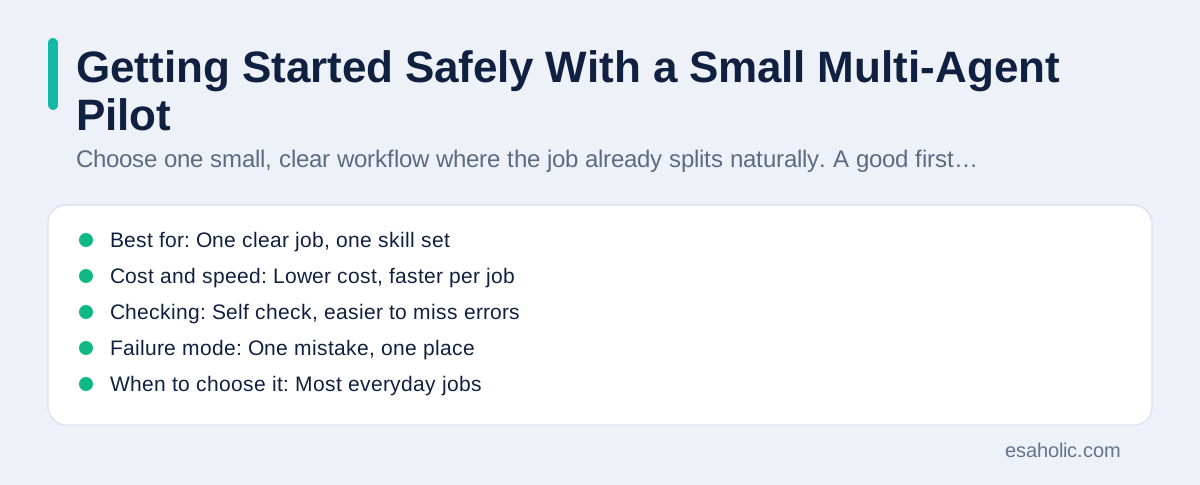
| Design choice | Single agent | Multi-agent |
|---|---|---|
| Best for | One clear job, one skill set | Multi-step work needing different skills |
| Cost and speed | Lower cost, faster per job | Higher cost, slower per job |
| Checking | Self check, easier to miss errors | Dedicated checker, stronger if independent |
| Failure mode | One mistake, one place | Errors can spread between agents |
| When to choose it | Most everyday jobs | When a specialist or checker measurably helps |
Conclusion
Multi-agent AI is a team pattern, not magic: split a hard job into clear parts, give each agent a narrow role, add a checker and a stopping rule, and keep a human in charge of high stakes actions. That pattern helps with complex support, operations, and research work, but it costs more, fails in more places, and needs stronger coordination than a single agent. Start small, measure accuracy and cost against a single agent, and scale only when the team measurably earns its complexity.
Frequently Asked Questions
What is a multi-agent AI system in simple terms?
A multi-agent AI system is a team of AI agents that share one bigger job, where each agent owns a clear part, such as gathering facts, checking facts, or writing a summary, and a coordinator keeps the work on track until the job is done or a human reviews it.
How is multi-agent AI different from a single AI agent?
A single agent does every step itself, which is simpler and cheaper, while a multi-agent system splits the job across specialists, which can handle harder work but costs more, needs coordination, and creates more places where agents can misunderstand each other.
What should a business check before using multi-agent AI?
A business should check that the job is clear enough to split, that each agent has limits on tools and data, that a checker reviews important output, that a human approves high stakes actions, and that cost and time per job are measured, not just guessed.
Written by Ahmad Jajja
Senior AI Research Engineer and Generative AI Specialist
Ahmad Jajja is a senior AI research engineer who specializes in generative AI and data systems. He writes Esaholic guides that explain agent systems and research in plain language, with a focus on accuracy and real examples.
Reviewed by Amir Iqbal
Senior AI Systems Architect and Lead Technical Reviewer
Amir Iqbal is a senior AI systems architect and lead technical reviewer at Esaholic. He reviews Esaholic guides for technical accuracy and clarity before publication.
Relevant blogs
What Is Agentic AI? A Simple Explanation
AI systems that set goals, plan steps, use tools, and check their own work.
Agentic RAG Explained: Architecture, Agents, and Uses
How retrieval grounded agents plan searches, check sources, and answer from your own documents.
Ai Governance Business Context Strategic Visibility Guide
How leaders set rules, see risk clearly, and keep AI work honest in plain language.
On-Device AI News: Phones, Privacy, And Local AI
How phones run AI locally, why privacy and speed improve, and what limits remain.
Back to all blog guides · Back to AI News and Regulation guides · Explore AI Agent Development Services