
Ai Industry News October 2025
October 2025 gave the AI industry a clear theme, even though the headlines arrived in a rush. Companies stopped selling AI mainly as a clever chatbot that answers one question at a time, and they started selling systems that plan work, call tools, check results, and finish multi-step jobs. That shift matters because it changes what buyers should test. A chatbot demo only needs one good answer, while an agent, which is a program that carries out multi-step work on its own, needs good answers across many steps, plus a safe way to stop when it goes wrong. This retrospective looks back at that month with that test in mind, and it separates what companies announced from what ordinary users could actually use.
The month also showed how fast one idea can travel across the whole industry. When one lab shipped a stronger agent toolkit, rivals answered within days with their own tools for building agents, and when one video model added a social feed, every creative tool faced new questions about consent, credit, and realistic fakes. Readers who followed only one company missed the pattern, because the pattern lived in the competition itself. Developers gained cheaper and faster building blocks, creators gained more realistic media tools and more risk, and business buyers gained a harder choice between many similar sounding platforms. The rest of this guide walks through those threads one by one, in plain language, and it ends with a practical way to read any busy AI month without panic.
A note on method matters before the details. This article treats an announcement as verified only when the company itself or a major news outlet reported it at the time, and it avoids prices, benchmark scores, and user counts that cannot be checked from a public source. Where a rollout reached only some users at first, this guide says so, because availability shapes the real story more than the launch headline does. If a claim in this guide sounds surprising, check the linked source and the date on it, since AI news ages fast and old demos often resurface as if they were new. That habit protects readers far better than any single summary can.
October 2025 Themes at a Glance
Three themes ran through the month, and each one still shapes buying decisions today. First, agents became the main product story, not a side feature. Companies packaged agent building into kits, templates, and hosted services, so a developer could assemble an agent from parts instead of wiring every step by hand. Second, creative tools moved from single clips and images toward feeds, profiles, and sharing, which made AI media feel more like social media and less like a private editing desk. Third, smaller and faster models earned serious attention, because teams realized that many daily jobs do not need the biggest and most expensive model on the market. A model that answers quickly and cheaply can win a routine job, while a large model stays reserved for hard reasoning.
The themes connected in useful ways. Agent kits needed good models underneath them, and smaller models made agents cheaper to run at scale, which means across many users and many jobs. Creative feeds needed strong video models, and those video models raised governance questions, which is a plain word for the rules, roles, and checks that decide who may do what with a system. Governance questions then fed back into enterprise sales, because a company cannot deploy a creative or agent tool widely until it can explain who approved an action, what data the tool touched, and how a mistake gets undone. Readers who track only model quality will miss half the story, since deployment rules often decide whether a good model ever reaches real users.
October also rewarded patient readers. Early reports often repeated vendor language without testing it, while later reports checked availability, limits, and failure modes, which are the ways a system breaks in real use. A video tool that looked flawless in a launch clip might struggle with hands, text, or consistent characters across scenes, and an agent toolkit that looked simple in a demo might need careful guardrails, which are limits that keep a system inside safe behavior, before it touches customer data. This guide leans on that later, calmer coverage wherever possible, and it flags the places where a launch promise still needed proof.
DevDay and the Agent Toolkit Race
OpenAI held its developer conference, called DevDay, on October 6, 2025, and the announcements centered on building agents and apps inside ChatGPT. The company introduced AgentKit, a toolkit that helps developers build, deploy, and improve agents from modular parts, and it added app building tools that let third party services work inside a chat conversation. It also brought its video model into the developer platform and presented a stronger model for precise work through its API, which is the programming interface that lets other software call a service. For developers, the message was simple: OpenAI wanted ChatGPT to act less like a single destination and more like a platform where other apps and agents live.
The developer angle mattered more than any single model name. AgentKit and similar kits from rivals lowered the starting cost of agent work, because a team could reuse connectors, which are ready made links to other software, evaluation tools, and deployment controls instead of building each piece alone. That reuse helps small teams most, since a small team cannot afford to build and maintain every part of an agent platform from scratch. It also creates a new kind of lock-in, which means dependence on one vendor's parts, because an agent built deeply around one kit may prove hard to move to another platform later. Smart teams therefore tested kits on one workflow first and kept their own data and prompts portable, which means easy to move elsewhere.
Voice also gained ground at DevDay, with a smaller and cheaper real time voice model joining the platform. Real time voice means the system listens and speaks with little delay, so a conversation feels natural instead of turn by turn. Voice matters for support, scheduling, and hands free work, and cheaper voice models make those uses affordable for more businesses. Yet voice agents raise their own risks, because a spoken agent can misunderstand a name, a number, or a yes, and a spoken mistake can commit a business to an action before a human notices. Teams that adopted voice agents in late 2025 learned to add confirmation steps for bookings, payments, and account changes, and that lesson still applies today. Our guide to how teams of agents share work explains the coordination problem behind these kits, and our agent development services use the same staged approach for client systems.
Video Generation Goes Social
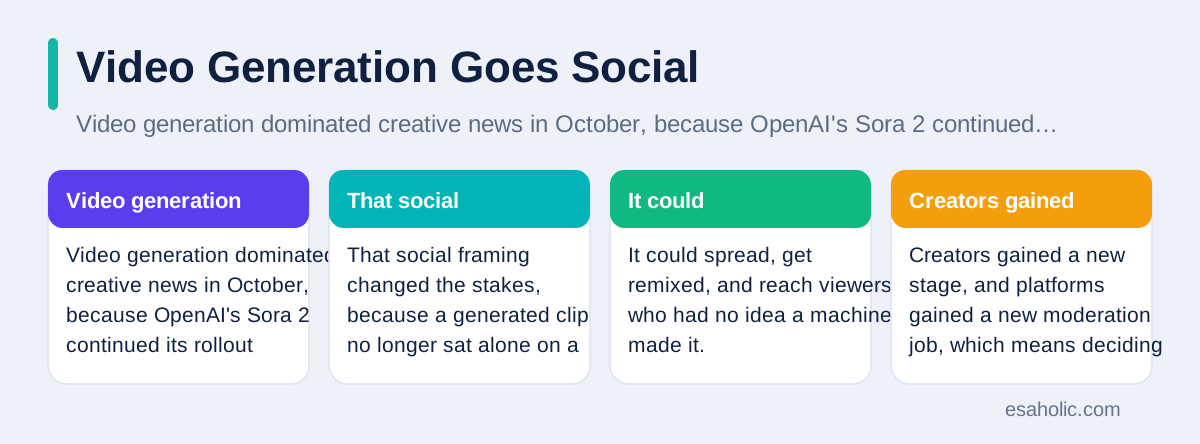
Video generation dominated creative news in October, because OpenAI's Sora 2 continued its rollout after its late September launch and added a social layer around generated clips. Sora 2 creates short videos with synchronized sound from text prompts, and its app presented clips in a feed with profiles, likes, and follows, much like a short form social network. That social framing changed the stakes, because a generated clip no longer sat alone on a creator's hard drive. It could spread, get remixed, and reach viewers who had no idea a machine made it. Creators gained a new stage, and platforms gained a new moderation job, which means deciding what content stays up and what comes down.
The rollout itself deserves attention, because it reached users gradually rather than all at once. Invite systems, waitlists, and regional limits meant that many readers saw Sora 2 clips weeks before they could make their own, and that gap fueled both excitement and confusion. People shared impressive clips without noting that the creator had early access, special prompts, or many failed attempts behind one success. A fair reading of October video news therefore asks three questions about every viral clip: who made it, with what access, and after how many tries. Those questions do not spoil the fun, but they stop a curated highlight from posing as typical performance.
Consent and likeness issues followed the video wave closely. A video model can imitate a real person's face, voice, or style closely enough to mislead viewers, so platforms added controls for real people and for copyrighted characters, and creators debated where inspiration ends and copying begins. The practical rule for readers and small creators stayed simple: never generate a realistic clip of a real person without that person's clear permission, and never present generated media as a real recording. Disclosure, which means stating plainly that AI made a piece of media, costs nothing and protects trust, while hiding the source can destroy it in one post. Our guide on how text to image tools work covers the same consent questions for still images.
Smaller Coding Models Earn Their Place
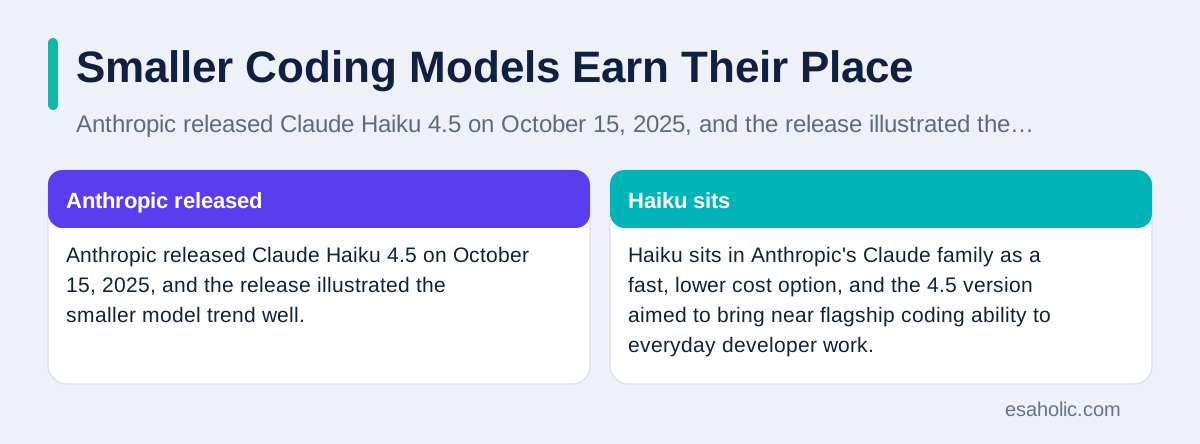
Anthropic released Claude Haiku 4.5 on October 15, 2025, and the release illustrated the smaller model trend well. Haiku sits in Anthropic's Claude family as a fast, lower cost option, and the 4.5 version aimed to bring near flagship coding ability to everyday developer work. Coding ability matters here because developers use AI models to write, explain, and fix code, and a model that handles routine coding quickly can save a team hours each week. Anthropic also described the model as its safest at the time under its internal safety levels, which are the company's own tiers for judging misuse risk, and it shipped the model through its own products and through major cloud platforms. The combination of speed, cost, and wide availability made Haiku 4.5 a practical choice rather than a headline choice.
Anthropic also introduced Agent Skills in mid October, which are reusable folders of instructions, scripts, and resources that a Claude agent loads when a task matches. Skills matter because they turn a good prompt, which is the instruction a user gives a model, from a one-off trick into a shared and repeatable asset. A team can write a skill for code review once, share it across projects, and update it in one place when standards change. That repeatability helps with audits too, because a reviewer can read the skill and see exactly what the agent was told to do. Teams that adopted skills in late 2025 often started with one skill for one repeated job, measured its effect, and only then expanded to a library.
The coding story also carried a warning about benchmarks, which are standardized tests that compare models on fixed tasks. Vendors quote the benchmarks where their model shines, and a high score on one coding test does not guarantee good results on a team's own codebase, which is its real collection of code, libraries, and conventions. A team should therefore run a small trial on its own tickets, which are its real work items, and judge the model by merged code, review comments, and bugs found later, not by a launch chart. That discipline sounds slow, but it prevents an expensive switch to a model that excels at tests and stumbles at real work. Anthropic's Haiku 4.5 announcement gives the company's own framing, and IBM's guide to agentic AI explains the agent patterns behind these coding tools.
Regulation Signals Stayed Loud but Unsettled
Regulation news in October stayed noisy without settling into one clear rulebook. In the United States, federal and state approaches pulled in different directions, with states debating transparency, which means requiring companies to disclose how AI systems work and what data they use, while federal voices pushed for a lighter and more unified national approach. In Europe, the AI Act timeline continued to shape company planning, because its phased duties for high risk systems and for general purpose models gave compliance teams concrete dates to work toward. Companies that sold across regions therefore faced overlapping duties, and they spent October building the same basic controls, such as documentation, testing, and incident response, that satisfy several rulebooks at once.
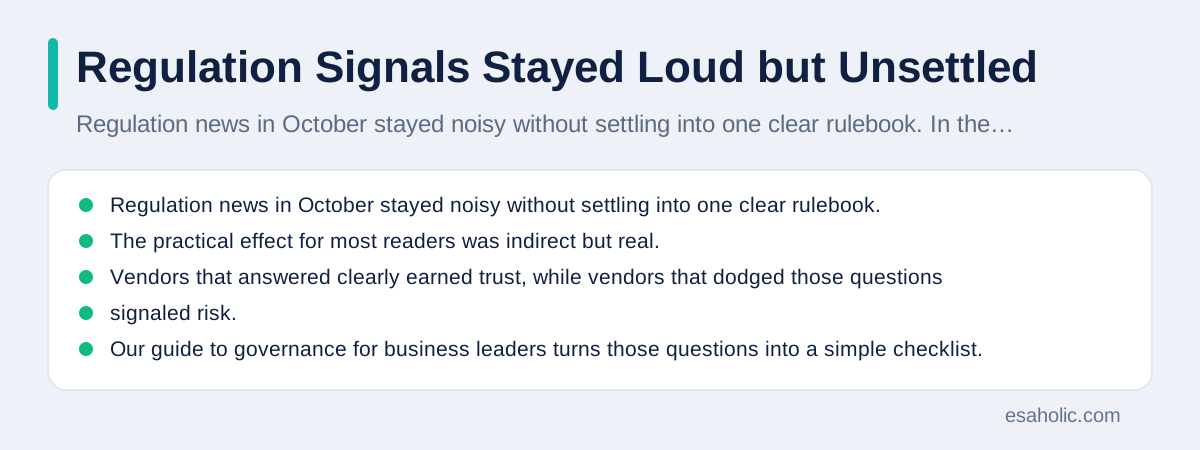
The practical effect for most readers was indirect but real. Transparency debates influenced what labels and disclosures platforms added to AI media, safety debates influenced which features shipped to which users, and procurement teams, which are the teams that buy software for a company, started asking vendors harder questions about data use, model updates, and audit trails, which are records that show who did what and when. A small business did not need to track every bill or proposal, but it did need to ask its vendors three questions: what data trains your model, what data leaves our account, and how do you tell us when your model changes. Vendors that answered clearly earned trust, while vendors that dodged those questions signaled risk. Our guide to governance for business leaders turns those questions into a simple checklist.
What October Meant for Businesses
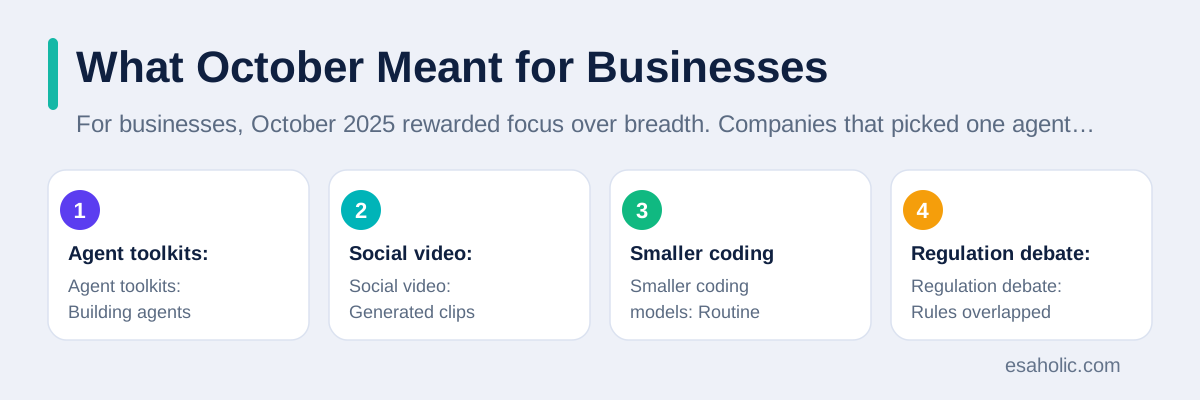
For businesses, October 2025 rewarded focus over breadth. Companies that picked one agent workflow, such as triaging support tickets or drafting internal reports, and measured it carefully learned faster than companies that bought many tools and used none deeply. The agent toolkit race made starting easier, but it did not remove the hard work of cleaning data, writing clear instructions, and reviewing early output. A support agent fed messy help articles will give messy answers no matter how good its kit looks, and an agent connected to live systems without approval steps will eventually take an action someone regrets. The winning pattern in October looked boring from the outside: one workflow, one owner, one scoreboard, and one human approval step for anything costly or irreversible.
Costs also shaped business decisions more openly in October. Smaller models, cheaper voice, and packaged kits all pushed the price of routine AI work down, which helped teams move pilots into daily use. At the same time, agent loops, which repeat search, reasoning, and tool calls until a job finishes, can multiply cost quickly when a job runs long or retries often. Finance teams therefore started asking for cost per completed job, not just cost per model call, and engineering teams added caps on steps and time per job. That accounting habit separates a pilot that looks cheap from a system that stays cheap at real volume, and it belongs in every agent business case.
| October 2025 thread | What changed | What to test first |
|---|---|---|
| Agent toolkits | Building agents became modular and faster | One workflow with a human approval step |
| Social video | Generated clips gained feeds and sharing | Consent rules and clear AI disclosure |
| Smaller coding models | Routine coding got faster and cheaper | A trial on your own tickets, not benchmarks |
| Regulation debate | Rules overlapped across regions | Vendor answers on data, updates, and audits |
How to Read a Busy AI Month
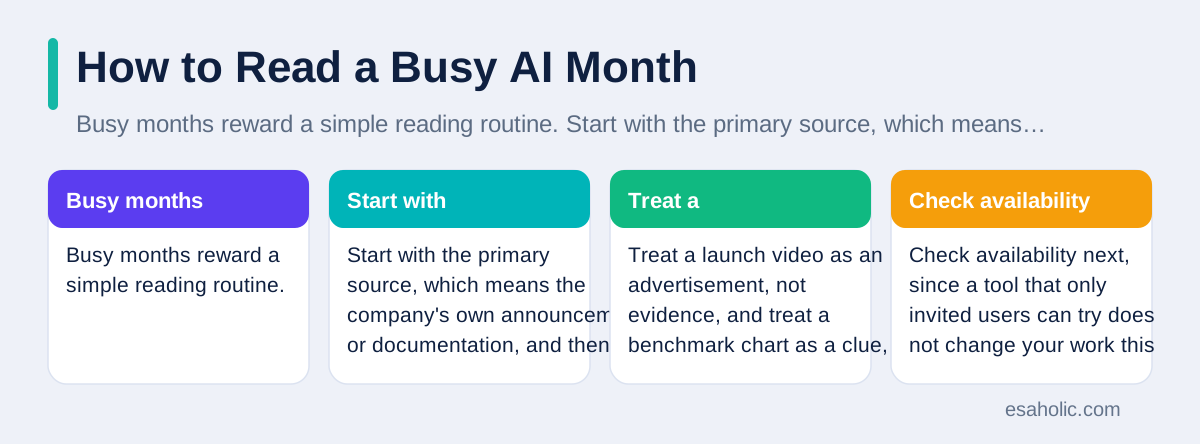
Busy months reward a simple reading routine. Start with the primary source, which means the company's own announcement or documentation, and then look for independent coverage that tests the claim on real tasks. Treat a launch video as an advertisement, not evidence, and treat a benchmark chart as a clue, not a verdict. Check availability next, since a tool that only invited users can try does not change your work this week. Then check limits, because every model page lists what the tool cannot do well, and those limits predict most real world failures better than the feature list does.
Separate three kinds of news that often blend together in feeds. Model news covers new or updated models and their abilities. Product news covers apps, kits, and features that package models for users. Policy news covers laws, rules, and company policies that shape what products may do. A month can look revolutionary on model news alone while product and policy news tell a slower story, or the reverse can happen when a policy change forces products to change overnight. Readers who sort stories into those three buckets will spot the real pattern faster, and they will waste less time on announcements that change nothing they can use.
What to Watch After October
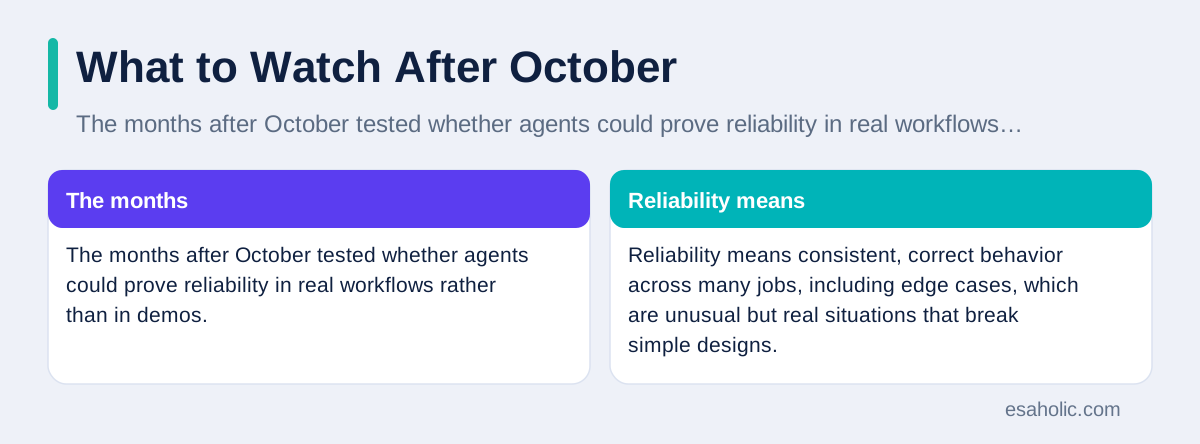
The months after October tested whether agents could prove reliability in real workflows rather than in demos. Reliability means consistent, correct behavior across many jobs, including edge cases, which are unusual but real situations that break simple designs. Watch for evidence from independent testers, customer case studies with numbers, and vendors that publish failure rates alongside success stories. A vendor that only shows wins has not yet earned enterprise trust, while a vendor that explains failures and fixes shows the maturity that long deployments need.
Video and creative rights also stayed on the watch list, because October's social video wave raised questions that no single launch could settle. Licensed deals, consent tools, and provenance labels, which are markers that record where media came from and how it changed, all moved from nice extras toward expected features. Creators and platforms that adopted clear labels early gained an advantage, because audiences and advertisers prefer media they can trust. Small creators can adopt the same habit today by labeling AI assisted work plainly and keeping original files that prove authorship.
Conclusion
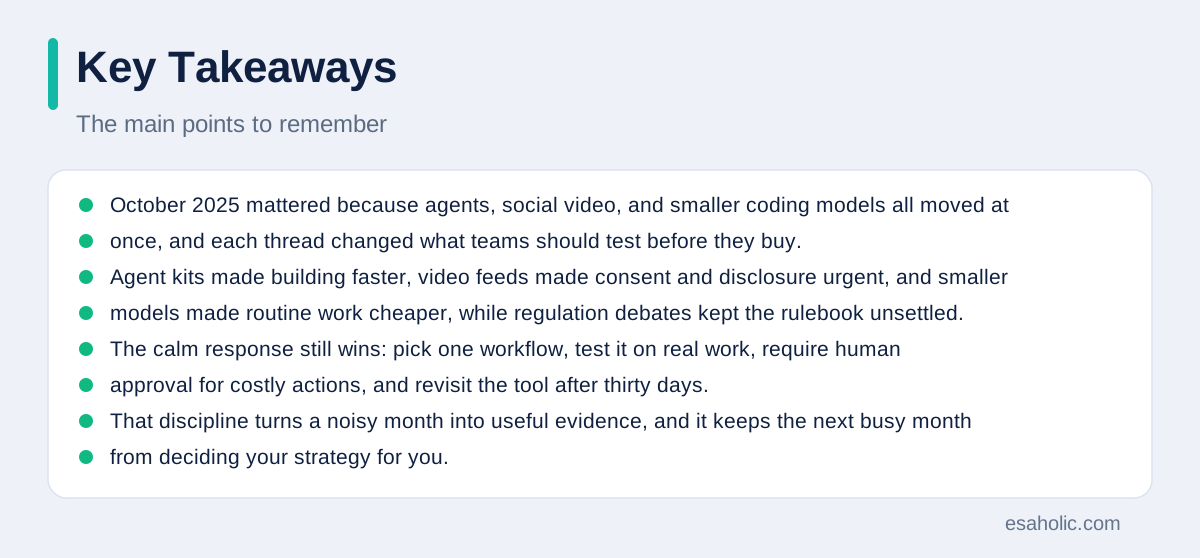
October 2025 mattered because agents, social video, and smaller coding models all moved at once, and each thread changed what teams should test before they buy. Agent kits made building faster, video feeds made consent and disclosure urgent, and smaller models made routine work cheaper, while regulation debates kept the rulebook unsettled. The calm response still wins: pick one workflow, test it on real work, require human approval for costly actions, and revisit the tool after thirty days. That discipline turns a noisy month into useful evidence, and it keeps the next busy month from deciding your strategy for you.
Frequently Asked Questions
What defined the AI industry in October 2025?
October 2025 was defined by agents moving from demos to developer tools, video generation going social, and smaller coding models doing more work for less cost. The month mattered less for any single launch and more for the shift toward systems that plan, use tools, and complete multi-step work with checks.
How is a product launch different from a rollout?
A launch announces a product, while a rollout decides who can actually use it, in which countries, and under what limits. A launch can look universal on announcement day while the rollout reaches only invited users or one region at first, so always check availability before you plan around a new tool.
How should a small team respond to a busy AI news month?
A small team should pick one workflow, test one tool on real work, and measure time saved and errors caught before it buys anything. Chasing every announcement spreads effort thin, while one careful pilot gives the team evidence it can use for the next decision.
Written by Danish Mustafa
Senior Agentic AI Engineer and Systems Architect
Danish Mustafa is a senior agentic AI engineer at Esaholic who designs multi-step AI systems with clear steps, safe limits, and human approval for high stakes actions.
Reviewed by Umar Abbas
Founder, Principal AI Architect and Operator
Umar Abbas is the founder of Esaholic and a principal AI architect who designs reliable large scale AI systems for regulated industries.
Relevant blogs
Multi-Agent AI News: Teams Of AI Agents Explained
What teams of AI agents are, where they are used, and what to watch, in plain language.
Ai News Today October 12 2025: A Retrospective Guide
What was reported around October 12, 2025, what it meant, and how to read AI news carefully.
On-Device AI News: Phones, Privacy, And Local AI
How phones run AI locally, why privacy and speed improve, and what limits remain.
Agentic RAG Explained: Architecture, Agents, and Uses
How retrieval agents plan, search, check sources, and answer from your own documents.
Back to all blog guides · Back to AI News and Regulation guides · Explore AI Agent Development Services