
Ai News Today October 12 2025: A Retrospective Guide
This is not live news. This is a retrospective, which means a careful look back, at ai news today october 12 2025 and the days immediately around it. If you searched for that date, you probably want to know what actually happened then, not what is happening now, and not a list of rumors dressed up as facts. This guide therefore covers only items that can be checked against an official announcement or reputable reporting from that period, and it says clearly when an item was announced on October 13 rather than October 12 itself. News rarely respects a single calendar day, and a retrospective that pretends otherwise would mislead you.
The honest way to read a dated news topic is to ask three questions. What was announced, in the words of the source itself? What was a plan for the future, rather than a product already in users' hands? And what did the story mean for ordinary readers, workers, and builders, beyond the headline? Those questions shape this guide. We anchor the story in three verified items from the week around October 12, 2025, explain each one in plain language, and then show what the three together reveal about where AI was heading at that moment. We do not fill gaps with invented events, because a retrospective built on invented events is worse than a short retrospective built on verified ones.
A note on scope will help you judge this article fairly. The phrase ai news october 2025 covers hundreds of stories, from research papers to product updates to policy debates in many countries. No single guide can cover them all, and this guide does not try. It focuses on three stories that were widely reported, that came from identifiable sources, and that still help readers understand later debates about AI chips, AI at work, and AI agents. If a story you remember from that week is not here, that does not mean it did not happen. It means we could not verify it to the standard this guide sets for itself, so we left it out rather than risk misleading you.
How to Read This Retrospective
Dates in this guide refer to announcement dates, not to the date this retrospective was published on this site. The article date shown above is the publish date on Esaholic, which is later than October 2025, and it should not be confused with the events it describes. When we say an announcement happened on October 13, 2025, we mean the source itself dated it that day. When we say a developer event happened on October 6, 2025, we mean the event took place a week before the search date, but its announcements were still shaping discussion in the week of October 12. That distinction matters, because search phrases often group a whole week of news under one day.
We also separate three kinds of claim that AI news often mixes together. A fact is something the source stated, such as a partnership or a veto. A plan is something the source said it would do, such as deploy hardware over several years. An interpretation is what the plan might mean, such as lower costs or stronger competition, and interpretations always carry uncertainty. This guide labels plans as plans and keeps interpretations modest. If you remember a headline that sounded certain about a future outcome in October 2025, check whether it was reporting a plan or predicting a result. Most AI hype comes from treating a plan as a result.
Story One: OpenAI and Broadcom Plan Custom AI Chips
On October 13, 2025, OpenAI and Broadcom announced a strategic collaboration to deploy 10 gigawatts of OpenAI designed AI accelerators, which are specialized chips built to run AI workloads faster and more efficiently than general purpose chips. According to the official announcement, OpenAI would design the accelerators and systems, while Broadcom would develop and deploy them, with racks targeted to start deployment in the second half of 2026 and to complete by the end of 2029. The announcement also noted that the two companies had long standing agreements on co development and supply, and had signed a term sheet, which is a non binding outline of a deal, for the deployment.
Why did that matter to readers who never buy a chip? Because AI services depend on computing capacity, which means the data centers, chips, and power needed to train models and answer user questions. When a company that runs a popular chatbot designs its own chips, it gains more control over cost, performance, and supply, instead of depending entirely on outside chip suppliers. That control can, in theory, lower the cost of each answer and allow more features, but it also requires huge investment, manufacturing, power, and time. A gigawatt, for scale, is a very large unit of power, roughly comparable to the output of a large power station, so 10 gigawatts describes an enormous infrastructure program, not a single product launch.
The careful reading of this story is therefore about scale and timing. The announcement described a multi year deployment plan, not chips already in users' phones or laptops in October 2025. Readers who treated it as an immediate product would have been misled, while readers who treated it as a signal about where AI investment was heading would have learned something useful. The signal was that leading AI companies were moving deeper into hardware, not only into models and apps, and that the cost and supply of computing had become a strategic question, not only a technical one. OpenAI's official Broadcom announcement remains the best source for the exact scope and dates, and it is worth reading directly rather than trusting a summary alone.
Story Two: California Vetoes the No Robo Bosses Act
Also on October 13, 2025, California Governor Gavin Newsom vetoed Senate Bill 7, known as the No Robo Bosses Act, which would have regulated employer use of automated decision making systems, meaning AI and other automated tools, in employment decisions. The bill would have required employers to notify workers before using such systems in ways that could affect employment, and would have prohibited employers from relying solely on those systems for disciplinary actions, terminations, or deactivations. It would also have given employees a right to request information about the data those systems used. A veto, in plain terms, means the governor refused to sign the bill into law, so it did not take effect in that form.
The governor's stated reasons matter, because they explain the debate better than the bill's nickname does. According to reporting on the veto message, Newsom argued that the bill's restrictions were overly broad and its notification requirements unfocused, because they would have applied to businesses using even relatively innocuous technologies, and would have overlapped with other rules. He also argued that the bill did not directly address specific incidents of misuse or discrimination, and could hinder businesses from using technology to recognize and reward high performing employees, for example through customer ratings. Supporters of the bill, by contrast, had argued that workers deserve human review and transparency when automated systems affect their jobs. Both sides agreed on one thing: automated workplace decisions need some form of human judgment. They disagreed on how broad the rule should be, and how much notice employers should owe.
For ordinary workers, the lesson of the veto was not that AI at work was unregulated, but that regulation in this area was contested and unfinished. A veto does not end a debate. It sends a bill back for revision, narrower scope, or a different approach, and it signals to other states and to employers that the exact design of workplace AI rules was still being worked out in late 2025. If your employer used automated tools for scheduling, performance, or hiring at that time, the practical advice remained the same after the veto as before it: ask what system is used, what data it uses, whether a human reviews its output, and how you can challenge a decision. Those questions protect workers whether or not a specific bill becomes law. Reporting on the veto from Kilpatrick Townsend on the California veto gives the date and the governor's reasons in detail.
Story Three: Developer Tools for AI Agents Take Center Stage
A week earlier, on October 6, 2025, OpenAI held its annual developer event, DevDay, in San Francisco, and its announcements centered on tools for building AI agents. An AI agent, in plain terms, is a program that carries out multi step work on its own, using tools and checking its progress, rather than answering a single question and stopping. The headline tool was AgentKit, a toolkit for designing, shipping, and monitoring agents, including a visual builder for agent workflows, a way to embed chat interfaces, a registry for connecting data sources, and upgraded evaluation tools for testing agents. The event also introduced apps inside ChatGPT through a new Apps SDK, which is a set of tools that lets developers build experiences that live inside the chat app, plus updates to coding tools and models in the API, which is the interface developers use to connect their own software to OpenAI systems.
That story belongs in a retrospective on October 12 because developer tools shape what users see months later, not on the day they are announced. When a major platform makes agent building easier, more developers can experiment with agents for support, research, scheduling, and operations, and users then meet those agents in products, websites, and apps. At the same time, easier building does not mean safer building. Agents that can use tools, send messages, or change records need checks, limits, and human approval for important actions, or they can repeat mistakes at speed. The DevDay story therefore pairs naturally with the governance story in this guide: tools were getting more powerful, and the rules for using them at work were still being debated.
Readers should also note what DevDay did not prove. An announcement of a toolkit does not prove that agents built with it will be reliable, affordable, or widely adopted. It proves that a major vendor was investing in that direction and inviting developers to follow. The honest takeaway for October 2025 is therefore a direction, not a verdict: agent development moved from a research topic to a platform priority, and the hard work of testing, checking, and governing agents remained ahead. Our guide on teams of AI agents and how they are checked explains that testing and checking work in plain language, and our guide on how retrieval grounded agents work shows one agent design where checking sources is built in. For the building side, see our AI agent development services.
What These Three Stories Show Together
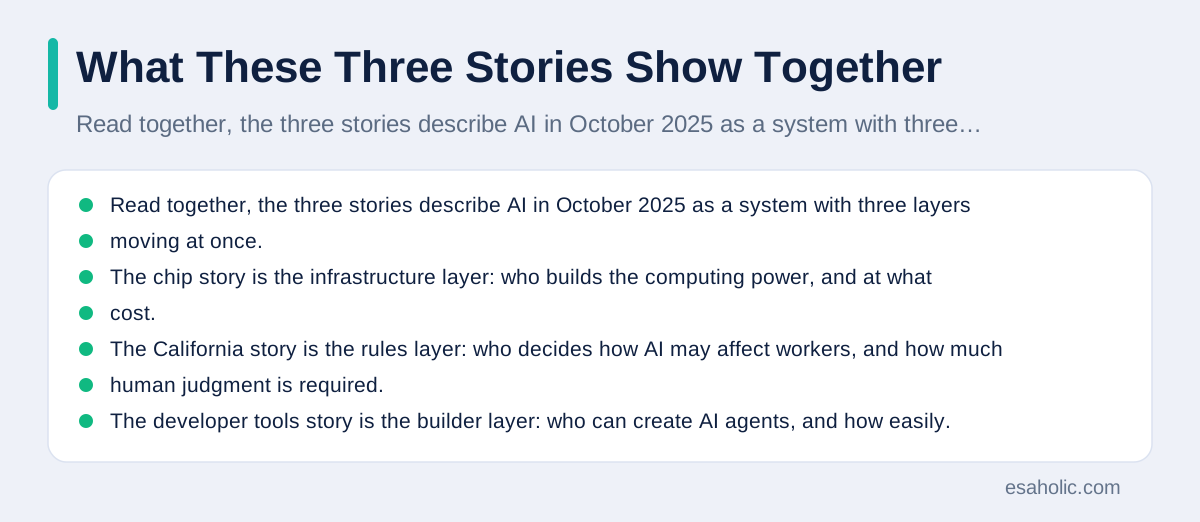
Read together, the three stories describe AI in October 2025 as a system with three layers moving at once. The chip story is the infrastructure layer: who builds the computing power, and at what cost. The California story is the rules layer: who decides how AI may affect workers, and how much human judgment is required. The developer tools story is the builder layer: who can create AI agents, and how easily. A reader who followed only one layer would have missed the picture. Infrastructure without rules can scale harm. Rules without infrastructure ignore cost and feasibility. Tools without either can produce agents nobody can check. The week around October 12, 2025 is useful precisely because all three layers were visible at once.
That three layer view also explains why AI news felt both exciting and unsettling at the time. Large investments suggested confidence in AI growth, while a high profile veto suggested caution about AI power over workers. New agent tools suggested that more tasks could be automated, while the same tools raised questions about who is responsible when an agent acts wrongly. Neither excitement nor fear alone captured the week. The accurate mood was a mix: builders were moving fast, regulators and governors were pushing back in places, and the public was learning to ask harder questions about both. A retrospective that captures only the excitement, or only the fear, would distort the record.
For businesses, the practical lesson from that week was to plan in all three layers at once. Check computing costs and vendor dependence before committing to a large AI project. Check workplace and customer rules before using AI for consequential decisions. And check agent testing and human approval before letting an agent act on your behalf. Companies that planned in only one layer, for example by buying a tool without checking its rules or its checks, were the companies most likely to face a surprise later. That lesson still applies, and it is the reason this retrospective spends as much time on method as on events.
What Was Not Clear in October 2025
Several important questions were unanswered in October 2025, and a good retrospective should name them rather than answer them with hindsight. First, the chip plan's cost, financing, and final delivery were not settled by the announcement, which described a term sheet and a multi year target, not a completed build. Second, the future shape of workplace AI rules in California was not settled by the veto, which rejected one bill design without settling what design would pass. Third, the reliability of agent tools at scale was not settled by a developer event, which showed what developers could build, not how well those agents would perform for real users over time. Naming those gaps is not pessimism. It is accuracy.
Uncertainty also surrounded prices, user numbers, and market effects that headlines often stated with false confidence. This guide deliberately avoids repeating market figures from that week unless they come from the announcement itself, because market figures in AI news often mix reported deals, rumored deals, and analyst estimates without labeling them. If you find an old headline claiming an exact market impact from the week of October 12, 2025, ask whether the number came from the company, from a filing, or from an estimate. That single question filters out a large share of AI news hype, in October 2025 and today.
The same caution applies to product claims. A demo at a developer event, a partnership announcement, and a product available to all users are three different stages, and news coverage sometimes blurs them into one exciting story. When you read old AI news, look for stage words: announced, previewed, in beta, generally available, and deployed. Those words tell you how close a technology was to everyday use. In October 2025, the chip story was at the announced and planned stage, the agent tools were at the developer availability stage, and the workplace rules story was at the vetoed bill stage. Keeping those stages straight is the simplest way to read AI news honestly.
How to Read the Next Wave of AI News
Use the method from this retrospective on the next big AI week. First, find the original source. For a company announcement, that means the company's newsroom or official blog. For a law, that means the bill text or the governor's message. For a research claim, that means the paper or the institution, not only a social post about it. Second, check a second trusted source that reports independently, not a copy of the first source. Third, separate the fact, the plan, and the interpretation, as described earlier. Fourth, ask who benefits if you believe the headline, because vendors, investors, and advocacy groups all frame news in their favor, often without lying outright.
Also watch for language tricks that inflate AI news. Words such as revolutionary, breakthrough, and replaces often hide a narrow test, a limited rollout, or a plan. Words such as all, every, and never often hide exceptions. Numbers without a source, a date, or a definition often hide an estimate. And a story that quotes only the company announcing a product, without an independent expert or a user, is a press release with a headline, not a verified report. None of those tricks proves a story false, but each one is a reason to pause and check before you share it or act on it.
Finally, keep a simple habit that costs little and saves much: when AI news affects a decision you must make, such as buying a tool, changing a workplace policy, or investing time in a new skill, wait for the second day of coverage. The first day often repeats the announcement. The second day often adds expert reaction, missing context, and corrections. That habit would have served readers well in October 2025, when the chip and veto stories both gained important context in the days after they broke, and it will serve readers well in the next wave too. For the wider picture of how AI rules fit business strategy, read our guide on governance, business context, and strategic visibility, and for how AI is moving onto devices themselves, read our guide on phones, privacy, and local AI.
| Date in October 2025 | Verified item | Stage at the time |
|---|---|---|
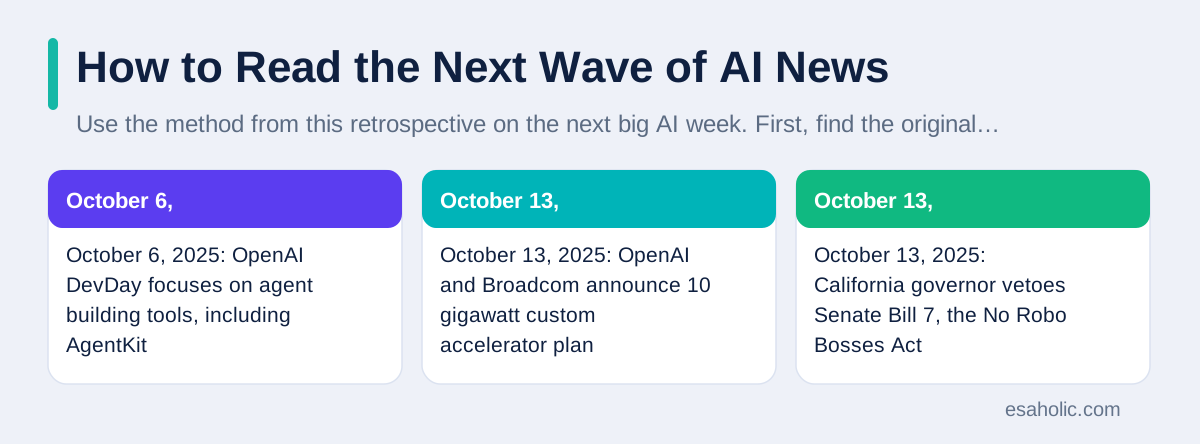
| October 6, 2025 | OpenAI DevDay focuses on agent building tools, including AgentKit | Developer tools announced |
| October 13, 2025 | OpenAI and Broadcom announce 10 gigawatt custom accelerator plan | Plan announced, deployment targeted from late 2026 |
| October 13, 2025 | California governor vetoes Senate Bill 7, the No Robo Bosses Act | Bill vetoed, did not become law in that form |
Conclusion
Around October 12, 2025, AI news was not one story but three linked ones: a large chip infrastructure plan, a contested workplace AI rule, and new tools for building agents. Each story was verified from its own source, each was at a different stage, and each left important questions open. Read that week as a retrospective, with original sources and stage labels in hand, and you will understand both what happened then and how to read the next wave of AI news more carefully.
Frequently Asked Questions
Is this article live news from October 12, 2025?
No. This article is a retrospective look back at what was reported around October 12, 2025. It was published later, and it covers only items that can be checked against official announcements or reputable reporting from that period.
What were the main AI stories around October 12, 2025?
Three verified stories anchor this retrospective: OpenAI and Broadcom announced a large custom chip collaboration on October 13, 2025, California's governor vetoed the No Robo Bosses Act on October 13, 2025, and OpenAI's developer event on October 6, 2025 focused on tools for building AI agents.
How should I read AI news without being misled by hype?
Check the original announcement first, separate a plan from a shipped product, look for a second trusted source, and ask what is still unproven. A partnership announcement, for example, is not the same as a finished product in users' hands.
Written by Ahmad Jajja
Senior AI Research Engineer and Generative AI Specialist
Ahmad Jajja is a senior AI research engineer who specializes in generative AI and data systems. He writes Esaholic guides that explain AI news and research in plain language, with a focus on accuracy and real examples.
Reviewed by Danish Mustafa
Senior Agentic AI Engineer and Systems Architect
Danish Mustafa is a senior agentic AI engineer at Esaholic who builds AI agents and software systems for real customers. He reviews Esaholic guides for technical accuracy and clarity before publication.
Relevant blogs
Ai Governance Business Context Strategic Visibility Guide
How leaders set rules, see risk clearly, and keep AI work honest in plain language.
Multi-Agent AI News: Teams Of AI Agents Explained
What teams of AI agents are, where they are used, and what to watch, in plain language.
On-Device AI News: Phones, Privacy, And Local AI
How phones run AI locally, why privacy and speed improve, and what limits remain.
What Is Agentic AI? A Simple Explanation
AI systems that set goals, plan steps, use tools, and check their own work.
Back to all blog guides · Back to AI News and Regulation guides · Explore AI and ML Development Services