
GenAI News: How To Follow Generative AI Clearly
Generative AI news arrives faster than most readers can use it. A model launch on Monday becomes a workplace policy debate on Tuesday and a vendor sales pitch on Wednesday, and each retelling adds confidence that the original story never earned. Readers feel pressure to react, yet reacting to every story wastes time and money. This guide slows the process down. It explains what generative AI does, how enterprise and policy stories differ, and how you can tell a real advance from marketing hype in a few careful minutes.
Start with the basic idea. Generative AI creates new content, such as text, images, code, music, or summaries, by learning patterns from large amounts of training data. A language model predicts likely next words, an image model predicts likely pixels, and both can produce fluent output that still contains errors. That mix of fluency and fallibility shapes every story in this field. A demo can look perfect while it hides mistakes, and a benchmark score can look decisive while it tests a narrow skill. Good readers look past fluency and ask for tasks, tests, and limits.
This guide covers four reading skills. You will learn how to sort stories into product news, enterprise news, and policy news, because each type needs a different check. You will learn how to spot hype language and hidden help in demos. You will learn how enterprise teams actually adopt these tools, with pilots, costs, and rules. And you will learn a weekly routine that keeps you current without drowning you. No section invents a launch, a price, or a statistic. The goal is a durable filter you can reuse on any future story.
What Generative AI Does, and What It Does Not Do
A generative model works by pattern prediction, not by understanding in the human sense. It learned which words, pixels, or notes often follow others in its training data, and it uses those patterns to build new output that resembles the data. That skill produces strong drafts, summaries, translations, and code suggestions. It also produces confident errors, because the model has no built in fact checker and no memory of your specific business unless you connect it to your own documents and checks. Teams that connect models to trusted sources and human review get far better results than teams that accept raw output.
Three limits follow from that design. First, models invent details when their training data runs thin, a behavior often called hallucination, which means a fluent but false statement presented as fact. Second, models repeat biases in their training data, so their output can favor some groups, topics, or phrasings unfairly. Third, models lack a sense of current events unless builders connect them to fresh sources, so a model can answer confidently about a topic it last saw months ago. Every news story that ignores these limits describes only half the technology.
IBM's guide to generative AI explains these patterns with clear examples, and our guide on how generative and predictive AI differ helps you place each story in the right family. Predictive AI forecasts or classifies, such as estimating demand or flagging fraud, while generative AI creates new content. A story that praises a generative tool for a prediction task, or vice versa, usually confuses the two, and that confusion is your first warning sign.
Sorting the Stories: Product, Enterprise, and Policy
Product stories announce a new model, feature, or tool. Check them with access questions: who can use it today, in which regions, at what cost, and with what limits? An announcement describes intent. Availability describes reality. Many stories blur the two, because a waitlist announcement sounds like a launch when you read only the headline. Open the product page, check the access terms, and try the tool yourself when you can. A product you cannot try remains a claim, not a fact you should plan around.
Enterprise stories describe how companies adopt these tools at work. Check them with outcome questions: which task changed, which measure moved, and what did the team stop doing? A credible enterprise story names a task, such as drafting support replies or summarizing meetings, and it reports a starting point and a result. A weak enterprise story quotes an executive praising the future with no task, no measure, and no failure. Remember that vendors often fund or shape these stories, so independent customer evidence deserves more weight than a vendor case study alone.
Policy stories describe rules, proposals, court cases, or standards that govern AI use. Check them with scope questions: which places, sectors, and uses does the rule cover, and when does it take effect? A proposal differs from a law, a draft standard differs from a final one, and a rule in one region may not apply in yours. Policy headlines often exaggerate scope to gain clicks, so read the primary document or a careful summary from a trusted legal source before you change a business process. Our guide on how leaders set AI rules with clear visibility shows how companies turn policy news into practical internal rules.
Enterprise News: Pilots, Costs, and Workplace Rules
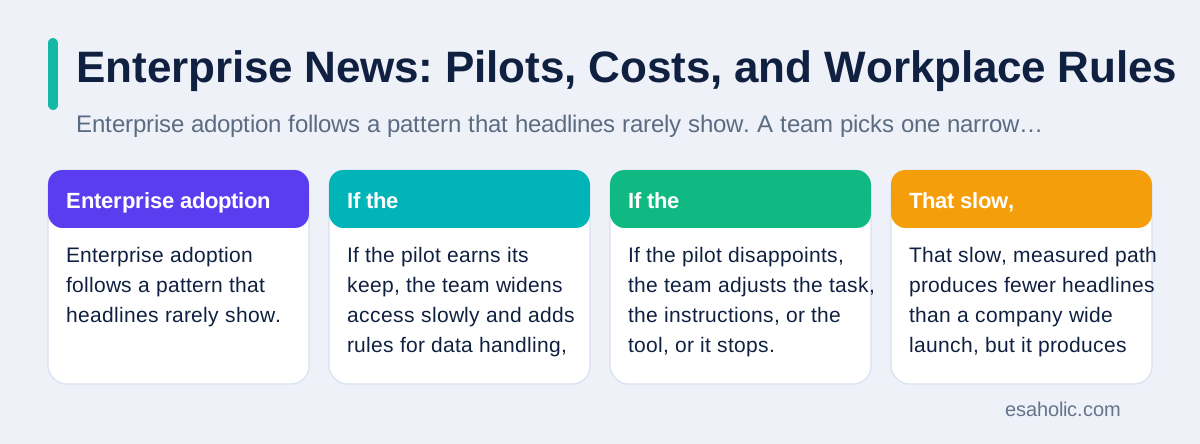
Enterprise adoption follows a pattern that headlines rarely show. A team picks one narrow task, runs a small pilot with real inputs, reviews a sample of outputs every week, and measures a clear outcome, such as time saved, errors caught, or tickets closed. If the pilot earns its keep, the team widens access slowly and adds rules for data handling, approval, and review. If the pilot disappoints, the team adjusts the task, the instructions, or the tool, or it stops. That slow, measured path produces fewer headlines than a company wide launch, but it produces far more real value.
Costs shape enterprise stories more than vendors admit. Model calls, storage, review time, and integration work all add up, and a tool that looks cheap in a demo can cost far more at scale. Smart teams track cost per task, not only cost per month, and they route simple tasks to simple tools. They also track review time, because a tool that saves drafting time but doubles checking time may save nothing at all. When an enterprise story quotes savings, ask whether it counts review time, tool costs, and the staff time spent fixing errors.
Workplace rules form the third part of enterprise news. Companies write rules on which data staff may paste into public tools, which outputs need human approval, and how customer facing content gets checked. Those rules protect privacy, quality, and legal standing, and they change as tools change. A story about a company banning a tool often reflects a missing rule, not a verdict on the technology itself. A story about a company scaling a tool usually reflects rules that finally caught up with enthusiasm. Our generative AI development services build those rules into projects from the start, and our guide on how to read agent headlines calmly covers the related agent side of enterprise adoption.
Policy News: Labels, Rights, and Disclosure
Policy news clusters around a few recurring themes. Labels ask whether AI generated content should carry a mark that identifies it as machine made. Rights questions ask who owns AI output, which training data uses need permission, and how creators get paid when their work shapes a model. Disclosure rules ask companies to state when AI helped produce content, made a decision, or handled personal data. Safety rules ask builders to test high risk uses, report serious failures, and keep human oversight for decisions that affect jobs, credit, housing, or health.
These themes matter for ordinary teams, not only for lawyers. A marketing team that publishes AI images needs to know the label rules for its channels. A publisher that uses AI drafts needs to know the disclosure expectations of its audience and its platforms. A hiring team that uses AI screening needs to know the fairness and record keeping rules for its region. You do not need to master every proposal, but you do need a short list of rules that touch your work, a named owner for that list, and a review date. Without an owner, policy news stays interesting and useless.
Read policy stories with a calendar mindset. Note whether the item is a proposal, a passed law, a court ruling, or a voluntary standard, and note its effective date. A proposal may change or die. A passed law may phase in over years. A court ruling may apply narrowly to one dispute. Headlines collapse these stages into one urgent verb, such as "bans" or "requires," so the primary document or a careful legal summary earns your trust more than a social post. The NIST AI Risk Management Framework gives teams a practical structure for turning policy themes into internal checks, without waiting for every rule to settle.
Spotting Hype: Benchmarks, Demos, and Superlatives
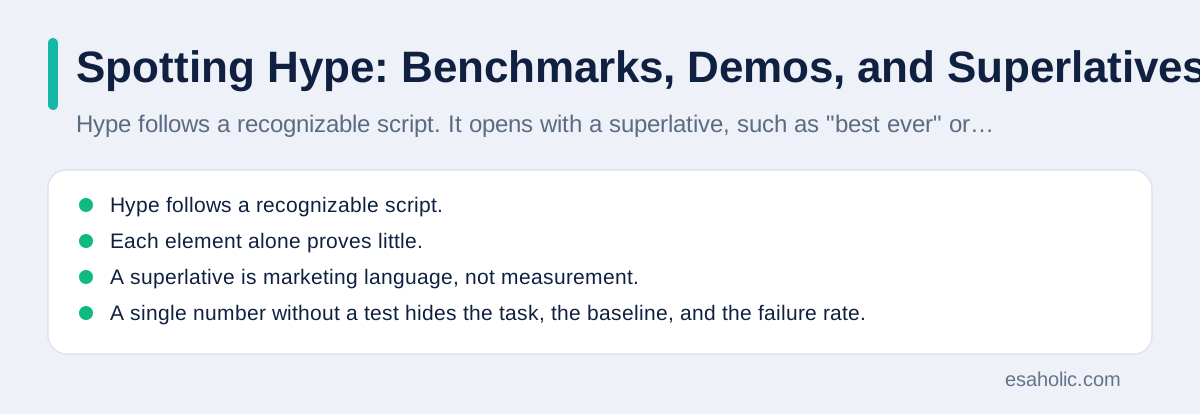
Hype follows a recognizable script. It opens with a superlative, such as "best ever" or "revolutionary," it quotes one big number with no test description, it shows a polished demo, and it closes with a prediction about jobs, industries, or the future. Each element alone proves little. A superlative is marketing language, not measurement. A single number without a test hides the task, the baseline, and the failure rate. A polished demo hides retries, edits, and human help. A prediction about the future is a guess, not evidence, no matter who states it.
Benchmarks deserve special care. A benchmark is a standardized test that scores a model on set tasks, and good benchmarks help compare models. But benchmarks can mislead when they test narrow skills, when builders train on test-like data, or when reporters quote the best score across many tests and hide the rest. A credible story names the benchmark, explains what it covers, and admits what it leaves out. A hyped story quotes a percentage and moves on. When a story leads with a score, search for the benchmark description before you trust the claim.
Demos hide help in several ways. A presenter may retry a prompt until it works, edit the output before showing it, add hidden instructions that guide the model, or run the demo on hardware far stronger than yours. None of this makes demos worthless, but it does mean a demo proves possibility, not reliability. Reliability needs repeated trials on messy inputs, with failures counted honestly. Ask for that evidence whenever a demo drives a purchase or a project decision, and treat a vendor who cannot provide it as a vendor who has not finished testing.
Reading Older Stories in Context
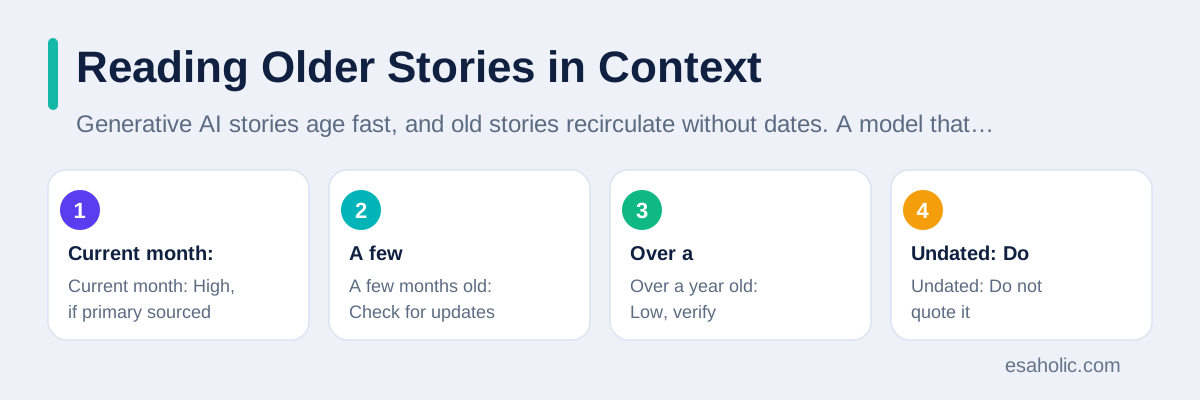
Generative AI stories age fast, and old stories recirculate without dates. A model that led the field in October 2025 may rank far lower months later, a price quoted in an old story may no longer hold, and a policy proposal from last year may have changed shape or died. Before you quote an old story, check for a newer update on the same topic. Search the product page, the changelog, or a trusted news archive, and note what changed since the original date. That one check prevents many embarrassing meeting moments.
Old stories still teach durable lessons. A story about a failed pilot teaches you which tasks resist automation, even after the tool improves. A story about a policy debate teaches you which values societies weigh against each other, even after the specific proposal changes. A story about a benchmark dispute teaches you how to read scores skeptically, a skill that never expires. Read old stories for patterns and methods, not for product facts, and you will extract lasting value from news that otherwise misleads.
| Story age | Trust for product facts | Trust for patterns |
|---|---|---|
| Current month | High, if primary sourced | High |
| A few months old | Check for updates first | High |
| Over a year old | Low, verify everything | Moderate, for methods |
| Undated | Do not quote it | Low, find the original |
Our guide on how to read model update stories models this dated approach, and our guide on how to follow hub updates safely shows the same habit applied to shared models. Both guides agree on one rule: keep the date beside every claim you save, because in generative AI, a claim without a date is a claim without context.
A Weekly Routine for Small Teams
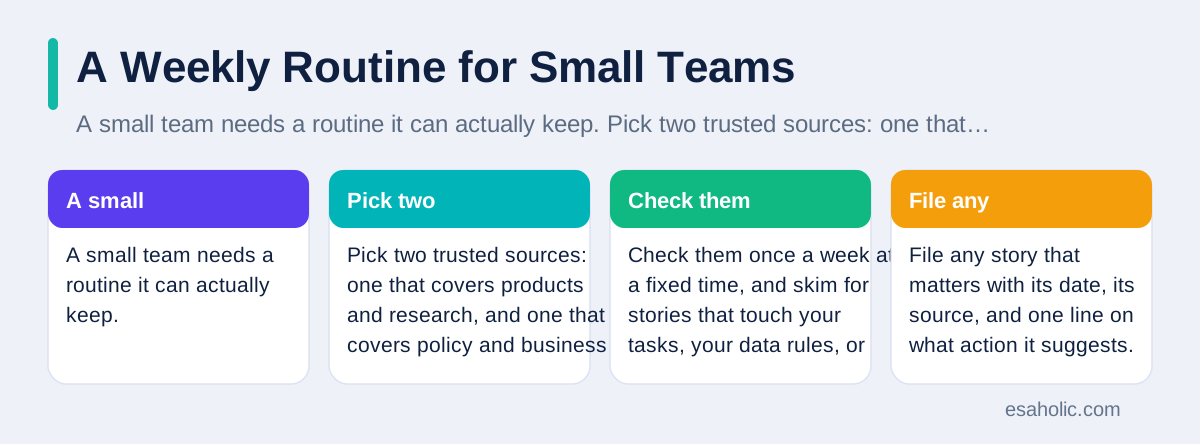
A small team needs a routine it can actually keep. Pick two trusted sources: one that covers products and research, and one that covers policy and business use. Check them once a week at a fixed time, and skim for stories that touch your tasks, your data rules, or your customer promises. Ignore the rest. File any story that matters with its date, its source, and one line on what action it suggests. Review the file once a month with your team, and mark which claims shipped, which slipped, and which vanished. That file becomes your team's memory, and it stops hype from re-entering through a new headline each week.
Assign one owner to the routine, even on a tiny team. The owner need not read everything. The owner only needs to run the weekly check, file the relevant stories, and flag any policy change that touches your work. Rotate the role every few months so no single person becomes the bottleneck, and keep the file where everyone can read it. A routine with no owner dies within weeks, while a routine with a named owner and a fixed time survives busy periods, which is exactly when hype does its worst damage.
Finally, protect your attention. Turn off breaking news alerts for AI stories, because almost no generative AI story requires an instant response. A launch, a policy proposal, or a benchmark result will still matter next week, and it will matter more once independent tests and careful summaries appear. Speed rewards the loudest voice. Patience rewards the most accurate one. Choose patience, and your team will make fewer rushed purchases, fewer panicked policy changes, and fewer decisions based on demos that never survived contact with real work.
What Actually Changes Your Work
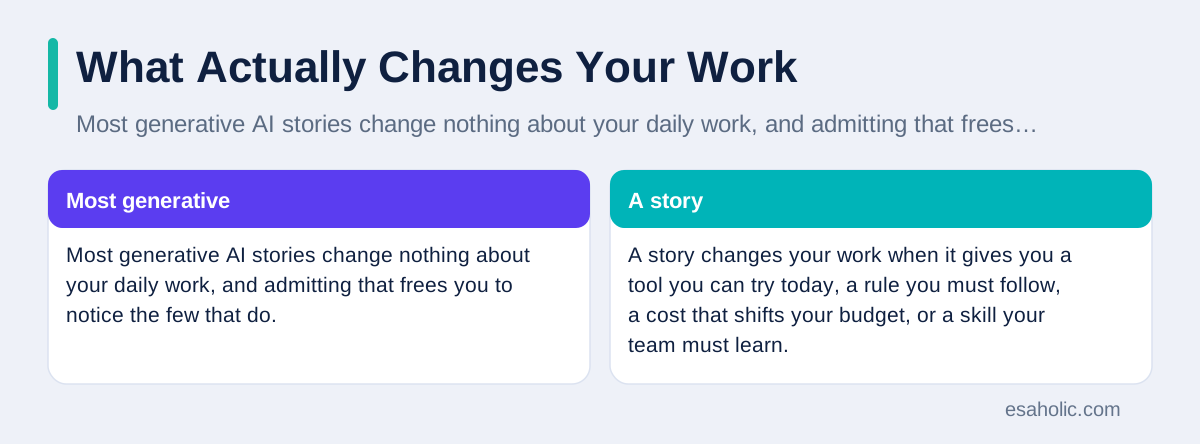
Most generative AI stories change nothing about your daily work, and admitting that frees you to notice the few that do. A story changes your work when it gives you a tool you can try today, a rule you must follow, a cost that shifts your budget, or a skill your team must learn. Test each story against that list. If it offers none of the four, file it as background and move on. If it offers one, act on that one item, not on the excitement around it.
Start with one task, not with a platform. Pick a repeated job that eats time, such as drafting first versions, summarizing long documents, or sorting support messages. Test one tool on that task with real inputs, measure the time and the error rate with human review included, and compare the result with your current method. A tool that passes that test earns a wider trial. A tool that fails it goes back to the file, no matter how exciting its launch story sounded. Our AI chatbot development services follow that task first pattern, and our guide on creative tool developments shows the same test applied to image, video, and music tools.
Keep a human in the final check for anything customers see, anything that affects money or safety, and anything that carries your name. That rule sounds simple, and it prevents most generative AI embarrassments. Models draft well and verify poorly, so let them draft, and let people decide. Teams that keep that division of labor gain speed without losing trust, and they can adopt new tools calmly, because their review step catches the errors that every new model still makes.
Conclusion
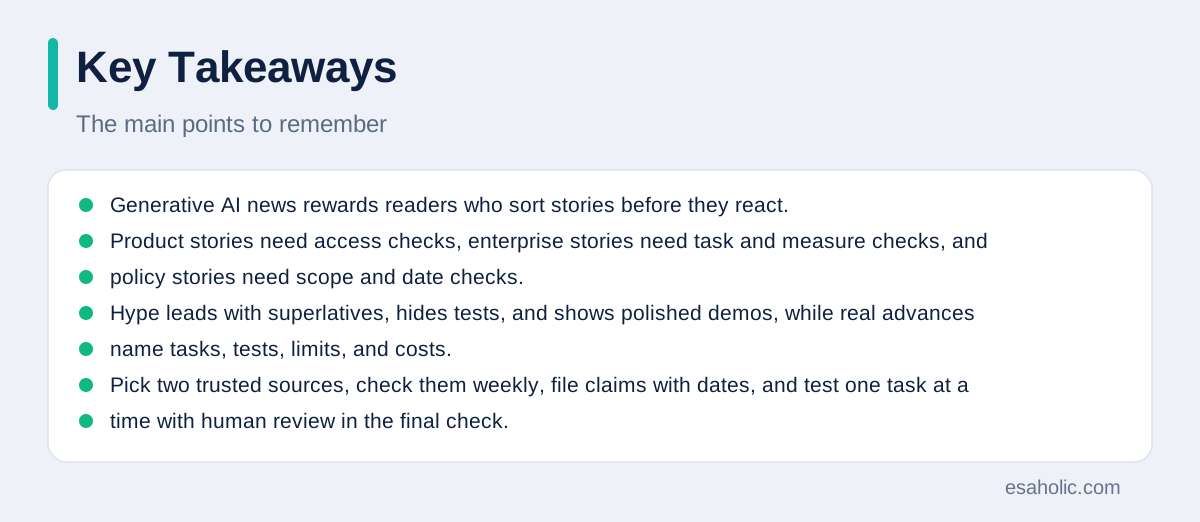
Generative AI news rewards readers who sort stories before they react. Product stories need access checks, enterprise stories need task and measure checks, and policy stories need scope and date checks. Hype leads with superlatives, hides tests, and shows polished demos, while real advances name tasks, tests, limits, and costs. Pick two trusted sources, check them weekly, file claims with dates, and test one task at a time with human review in the final check. That routine turns a noisy feed into a steady signal, and it keeps your team focused on tools and rules that actually change its work.
Frequently Asked Questions
What is generative AI in simple terms?
Generative AI is software that creates new content, such as text, images, code, or summaries, by learning patterns from large amounts of training data. It predicts likely next words, pixels, or notes, so its output can sound fluent while still containing errors, which is why human review matters.
How do I tell a real GenAI advance from hype?
A real advance names the task, the test, and the limits, and ordinary users can try it or see independent results. Hype leads with a superlative, hides the test, and skips costs, failures, and access limits. Ask who can use it today, what changed for real work, and what still fails.
Why does GenAI policy news matter for small teams?
Policy news matters because rules on labels, copyright, data use, and automated decisions can change what a small team may publish, sell, or automate. You do not need to read every proposal, but you do need a short list of rules that touch your work, reviewed on a regular schedule.
Written by Danish Mustafa
Senior Agentic AI Engineer and Systems Architect
Danish Mustafa is a senior agentic AI engineer who designs multi-step AI systems with clear steps, safe limits, and human approval for high stakes actions.
Reviewed by Amir Iqbal
Senior AI Systems Architect and Lead Technical Reviewer
Amir Iqbal is a senior AI systems architect at Esaholic who leads production readiness checks for agents, model serving, and data systems before they reach real users.
Relevant blogs
Llm News Today: A Guide To Model Updates
A calm guide to large language model news, open versus closed models, and how to read updates without hype.
Generative AI for Marketing
How generative AI helps marketing teams draft, personalize, and test content, with human review in the final check.
Agentic AI News: A Plain Guide To What Matters
How to follow agent developments, spot real progress, and ignore hype without missing what matters for your work.
Hugging Face News: A Simple Guide To The Hub
What the hub is, how models and datasets work, and how to follow updates safely without chasing rumors.
Back to all blog guides · Back to AI News & Regulation guides · Explore Generative AI Development Services