
Value Proposition: How to Write One Customers Trust
A value proposition is the clear reason a customer should choose you instead of someone else. It is not a slogan, a mission statement, or a list of features. It is a short statement that names the customer, the problem they face, the outcome your product delivers, and why your way is different. When a visitor lands on your page, they ask a silent question: why should I choose this one? Your value proposition is the answer, in words they can understand in seconds.
Most value statements fail because they try to say everything at once. They promise quality, innovation, excellence, and customer focus in one breath, and they end up saying nothing a competitor could not also claim. A strong statement does the opposite. It picks one main benefit, names one main customer, and offers one proof point the customer can check. That focus feels risky, because it leaves some buyers out, but it is exactly what makes the right buyers trust you. A statement for everyone convinces no one.
This guide shows how to write a value proposition from scratch, with a simple formula, a customer map, examples across business types, and tests that prove whether the words work. It also shows the common mistakes that make statements vague, and where the statement belongs on a page. If you run campaigns, read our guide on campaign ideas from 2025 that earned attention after this one, because a campaign can only amplify a value statement that is already clear. If you measure results, our guide on measures that help teams improve helps you track whether the new wording changes real behaviour.
What a Value Proposition Is, and What It Is Not
A value proposition answers three questions in order: who is this for, what problem does it solve, and what outcome does the customer get? The outcome matters most, because customers buy results, not features. A feature, which is a fact about what a product does, such as "cloud storage with 2 terabytes," only matters when the customer sees the benefit, which is what that feature does for them, such as "never lose a family photo again." Write the outcome first, then support it with the feature that delivers it, not the other way around.
A slogan is different. A slogan is a short memorable phrase, such as a tagline, that supports a brand over years. A value proposition is a working statement that helps a visitor decide in the moment. A mission statement is also different: it explains why a company exists, often for staff and investors, not for a buyer choosing between two options. A value proposition can sit beside both, but it must do its own job, which is to help a stranger choose you, fast, with confidence.
Differentiation, which means the real difference between you and the alternative, is the hardest part to write honestly. A difference must matter to the customer, not just to you. Faster delivery matters if the customer waits. Lower cost matters if the customer pays. Expert support matters if the customer fears getting stuck. A difference nobody cares about, such as an internal award or a rare technology name, will not move a buyer. Ask customers which difference made them choose you, and use their words, because customers describe value in plain language the team often forgets.
Map the Customer Before You Write a Word
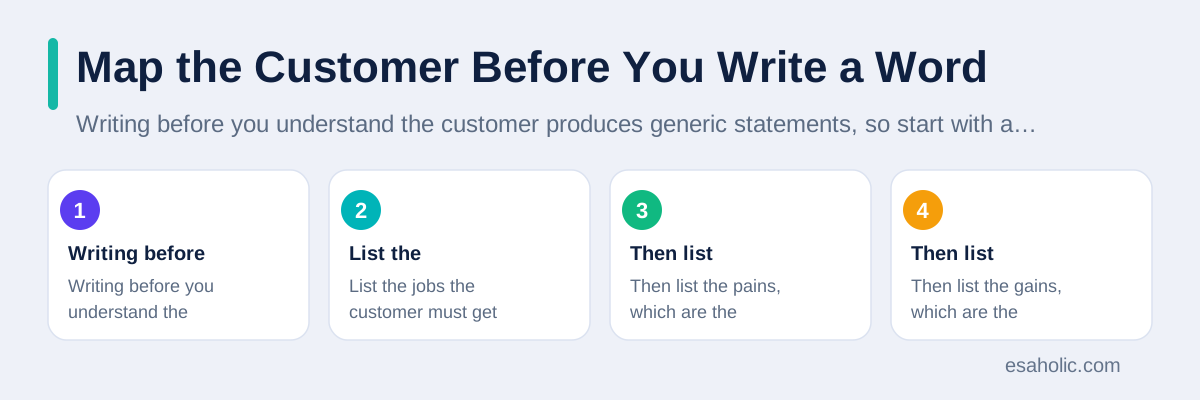
Writing before you understand the customer produces generic statements, so start with a simple customer map. List the jobs the customer must get done, which are the tasks they hire your product to handle, such as booking appointments, filing invoices, or learning a skill. Then list the pains, which are the frustrations, costs, and risks that slow those jobs down, such as double bookings, late payments, or confusing setup. Then list the gains, which are the results the customer hopes for, such as saved time, fewer errors, or peace of mind.
Next, match each pain and gain to something your product actually does. This matching step is often called a value proposition canvas, which is a one page tool that places customer jobs, pains, and gains on one side and your products, pain relievers, and gain creators on the other. The Strategyzer value proposition canvas guide explains the tool in full. You do not need the formal canvas to benefit from it. A simple two column list, customer pains on the left and your real answers on the right, reveals gaps fast. A pain with no answer is a promise you cannot make yet.
Talk to real customers during this step, even briefly. Ask five customers what problem they had before they found you, what they tried first, and what made them stay. Their answers will contain phrases you should steal, with permission, because they describe value the way buyers think about it. A team that writes only from internal meetings will produce words the team loves and customers ignore. A team that writes from customer interviews will produce words customers recognise as their own problem, which is the first step toward trust.
A Simple Formula You Can Use Today
Use this formula for a first draft: "For [customer] who [problem], [product] delivers [outcome] by [how it works], unlike [alternative], because [proof]." Fill each blank in plain words, then cut the draft to one headline and one subline. The headline states the outcome. The subline names the customer, the problem, and the proof. For example, a bookkeeping service might draft: "For busy shop owners who dread month end paperwork, Ledgerly delivers clean books in three days by matching bank feeds daily, unlike generic software, because a human reviewer checks every month." That draft is long, but it contains every part, and cutting it becomes easy.
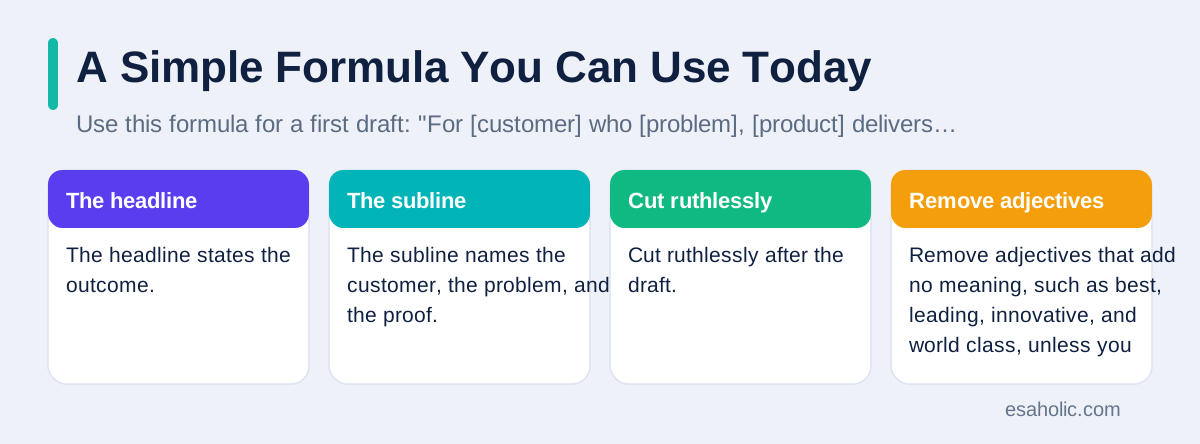
Cut ruthlessly after the draft. Remove adjectives that add no meaning, such as best, leading, innovative, and world class, unless you can prove them with a fact. Replace vague verbs, such as empower, leverage, and streamline, with concrete verbs, such as save, cut, book, or deliver. Read the draft aloud to a stranger and ask them to explain it back. If they cannot, the draft is still too clever. Plain words are not dull words. They are the words that survive a five second scan, which is all most visitors give a new page.
Keep one value proposition per page, not one per product line. A page that serves everyone with five benefits will confuse everyone. If you serve two very different customers, build two pages, each with its own statement. A landing page, which is a single page built for one offer and one action, works best when its headline, its images, and its button all support the same statement. When every element repeats the same promise, the visitor feels certainty instead of doubt, and certainty is what turns a visit into an enquiry.
Examples Across Business Types
Consider a cleaning service for busy families. A weak statement says, "Quality cleaning services you can trust." That could describe any cleaner. A strong statement says, "For busy families, Spotless Home delivers a clean home in two hours, booked in one minute, with the same trusted cleaner each visit." The strong version names the customer, the time outcome, the booking ease, and the trust proof, which is the same cleaner. A family reading it can picture the result and the experience, not just the service category.
Consider a software tool for small shops. A weak statement says, "All in one business software for growth." A strong statement says, "For shop owners who lose sales to stockouts, Stockwise warns you before stock runs out, so you reorder in time and never miss a sale." The strong version names a painful, specific problem, stockouts, and a clear outcome, never miss a sale. It also states who it is not for, by implication: large chains with their own systems will not need it, and that is fine. A statement that excludes the wrong buyers attracts the right ones.
Consider a consulting service for clinics. A weak statement says, "Expert healthcare consulting for better outcomes." A strong statement says, "For clinic managers drowning in appointment no shows, ClinicFlow cuts no shows with same day reminders and easy rescheduling, so chairs stay full." Each example follows the same pattern: customer, problem, outcome, proof. The Shopify guide to value propositions offers more business examples in the same pattern, and it is worth reading if you want to compare statements across industries before you write your own.
Mistakes That Make Value Statements Vague
The first mistake is claiming everything. A statement that promises speed, quality, low cost, and personal service at once asks the reader to believe four things, and most readers will believe none of them. Pick the one benefit that matters most to your main customer, and let the rest of the page support it with features and proof. A page can mention other benefits below the headline, but the headline itself must make one promise, clearly, so the visitor knows what to remember.
The second mistake is writing features instead of outcomes. "AI powered analytics dashboard" is a feature. "Know which product sells best before you reorder" is an outcome. Features belong in a features section, where interested buyers can compare details. Outcomes belong in the value proposition, where new visitors decide whether to keep reading. If your headline contains a technology name but no customer result, rewrite it from the customer's point of view, and ask what the customer can do after buying that they could not do before.
The third mistake is promising what delivery cannot do. A statement that promises same day delivery when the team delivers in three days will create refunds, complaints, and bad reviews, even if the product is good. Value must match operations, which means the real way a business delivers its work day to day. Check every promise in the statement with the team that delivers it, and change the statement if delivery cannot keep up. A modest promise kept beats a bold promise broken, because trust, once lost to a broken promise, costs far more to rebuild than a sale is worth.
Test Your Statement Before You Publish It Widely
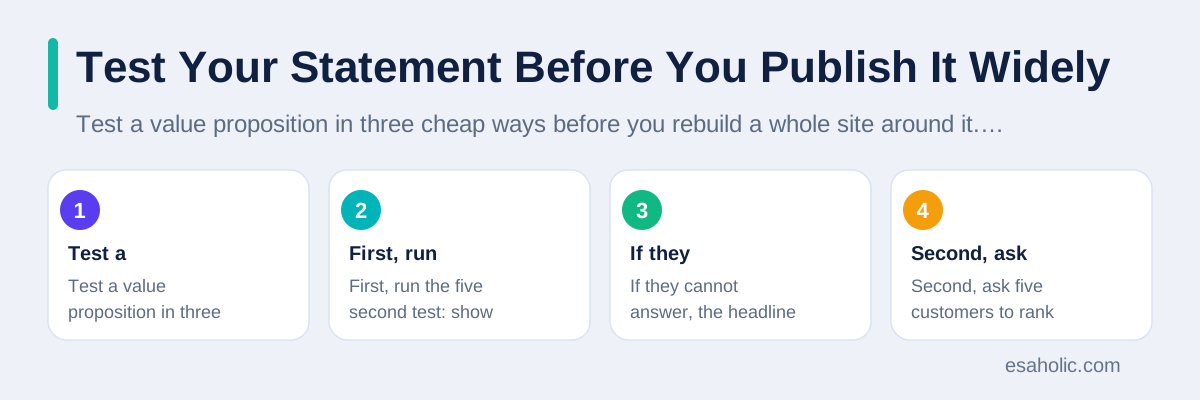
Test a value proposition in three cheap ways before you rebuild a whole site around it. First, run the five second test: show the headline to a stranger for five seconds, hide it, and ask what the product does and who it is for. If they cannot answer, the headline needs simpler words. Second, ask five customers to rank two versions and explain their choice in one sentence. Their reasons will reveal which benefit matters, not just which wording sounds nicer. Third, test one version on a landing page for a few weeks and compare enquiries or sales with the old wording, keeping everything else the same.
Measure the test with a small set of honest numbers, not with opinions in a meeting. Track visits, enquiries, and sales for each version, and note the time period, so a holiday or a price change does not mislead you. Our guide on measures that help teams improve explains how to pick measures that lead to decisions, and the WordStream value proposition examples show how different industries test and refine their statements. A test that changes one thing at a time gives a clear answer. A test that changes headline, images, and price at once gives only confusion. Choose the test measures from KPI examples that match the outcome in the statement, so a win in clicks is not mistaken for a win in sales.
Update the statement when the business changes, not on a fixed schedule. A new customer group, a new main benefit, or a new proof point, such as a guarantee or a result customers report, all justify a revision. A statement that stays the same while the business moves on will slowly drift from the truth, and customers will notice the gap in reviews and support chats before the team does. Review the statement once a quarter, compare it with recent customer words, and revise it in small steps rather than waiting for a full rebrand.
Where the Statement Belongs on a Page
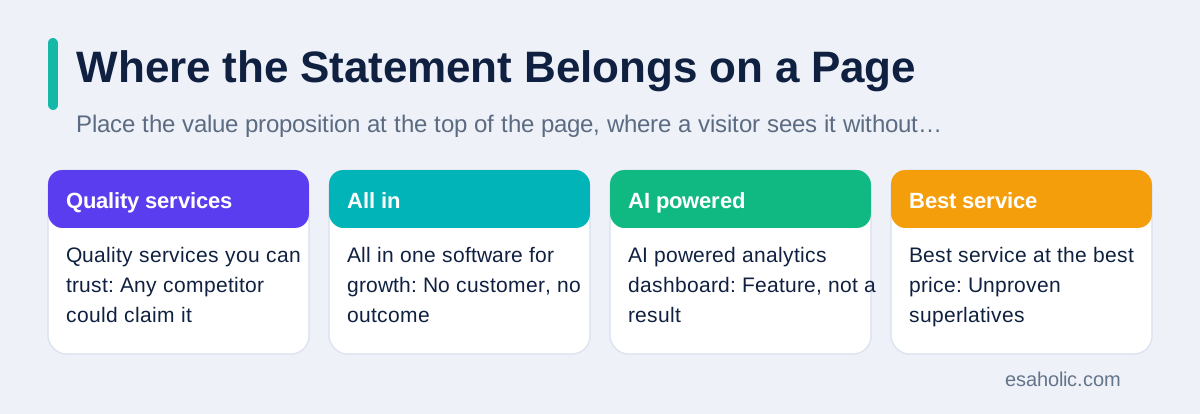
Place the value proposition at the top of the page, where a visitor sees it without scrolling. The headline states the outcome, the subline names the customer and the proof, and a button invites the next step, such as booking a call or starting a trial. Below that, add proof in order of strength: a short customer quote, a result with a clear source, a guarantee, or a demo the visitor can try. Proof near the button matters, because doubt peaks at the moment of action, and a proof point at that moment can turn hesitation into a click.
Repeat the statement, in shorter form, in other places a visitor may land, such as ads, emails, and social profiles, so the promise stays consistent. A visitor who sees one promise in an ad and a different promise on the page will feel tricked, even if both promises are true. Consistency also helps search and sharing, because people repeat a simple promise in their own words when they recommend you. If your team cannot repeat the statement from memory, it is too long or too complex, and it needs cutting before it reaches customers.
For service businesses, the value proposition also belongs in sales conversations and proposals, not only on the website. A proposal that opens with the customer's problem and the promised outcome, in the customer's words, will read as helpful, while a proposal that opens with company history will read as self focused. Esaholic shapes service pages this way in its custom software development work, where each service states the outcome for the client first and the method second. Use the same order everywhere, outcome first, method second, and the statement will do its job in every channel.
| Weak statement | Problem | Stronger version |
|---|---|---|
| Quality services you can trust | Any competitor could claim it | Clean home in two hours, same trusted cleaner |
| All in one software for growth | No customer, no outcome | Warns you before stock runs out, so you never miss a sale |
| AI powered analytics dashboard | Feature, not a result | Know which product sells best before you reorder |
| Best service at the best price | Unproven superlatives | Booked in one minute, confirmed by text, no hidden fees |
Adapt the Statement for Ads, Email, and Sales Calls
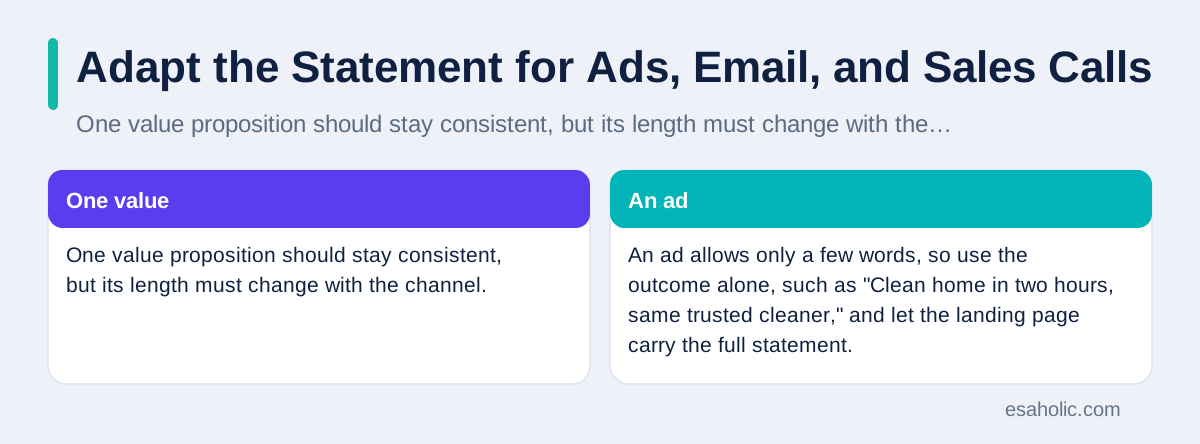
One value proposition should stay consistent, but its length must change with the channel. An ad allows only a few words, so use the outcome alone, such as "Clean home in two hours, same trusted cleaner," and let the landing page carry the full statement. An email subject line can carry a little more, such as the customer and the outcome together, because the reader already knows your name. A sales call allows the full version, because the seller can explain the proof and answer doubts in real time. The promise never changes across channels. Only the amount of detail changes, and that discipline keeps the message recognisable wherever a customer meets it.
For paid ads, test the outcome first and the proof second. An ad that states a clear outcome will attract the right clicks, while an ad that lists features will attract curious clicks that never buy. Watch cost per enquiry, not clicks alone, because cheap clicks from the wrong audience waste budget and sales time. If an ad version drives many clicks but few enquiries, the outcome may appeal to the wrong customer, or the landing page may break the promise the ad made. Fix the match between ad and page before you increase spend, because more spend on a mismatched message only buys more disappointment faster.
For email, open with the customer's problem in their own words, then state the outcome in the first two lines. Readers decide in seconds whether an email deserves more time, and a long introduction about the company will lose them. A short customer quote can carry the proof better than a paragraph of claims, because a quote sounds like a person, while a claim sounds like marketing. End every email with one action that matches the value proposition, such as booking a call or starting a trial, rather than offering five links that split attention. One promise, one action, and one proof point make an email easy to act on.
For sales calls and proposals, use the value proposition as the opening, not as a closing line. A seller who opens with the customer's problem and the promised outcome shows they listened, while a seller who opens with company history shows they only want to talk about themselves. Prepare two proof points for the call: one result a similar customer achieved, and one detail about how delivery works, such as a timeline or a named contact. If the buyer doubts the promise, the proof points answer without argument. If the buyer accepts it, the conversation can move to price, timing, and next steps, which is where deals actually close.
Conclusion
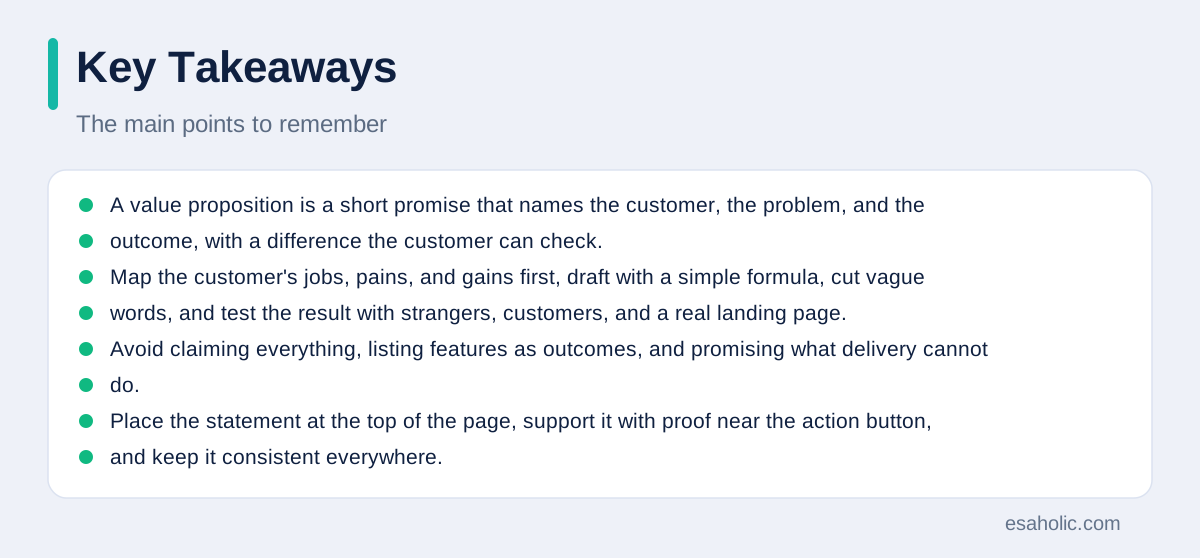
A value proposition is a short promise that names the customer, the problem, and the outcome, with a difference the customer can check. Map the customer's jobs, pains, and gains first, draft with a simple formula, cut vague words, and test the result with strangers, customers, and a real landing page. Avoid claiming everything, listing features as outcomes, and promising what delivery cannot do. Place the statement at the top of the page, support it with proof near the action button, and keep it consistent everywhere. A clear value proposition does not just improve a page. It helps the right customers choose you with confidence, and it helps the wrong customers leave early, which saves everyone time.
Frequently Asked Questions
What is a value proposition in simple terms?
A value proposition is a short, clear statement of the benefit a customer gets from your product or service, who it is for, and why it is better than the alternative. It answers the customer's silent question, which is why should I choose this one, in plain words a stranger can understand in seconds.
How long should a value proposition be?
A value proposition should fit in one or two short lines on a page, with a headline that states the outcome and a subline that names the customer and the proof. Longer explanations belong below it, in features, examples, and testimonials, not inside the statement itself.
How do you know if a value proposition works?
You know a value proposition works when strangers can explain it back to you in their own words, and when a page using it converts visitors into enquiries or sales better than a page using the old wording. Test one version at a time, with real visitors, and keep the version with the better result.
Written by Amir Iqbal
Senior AI Systems Architect and Lead Technical Reviewer
Amir Iqbal is a senior AI systems architect at Esaholic who designs resilient systems and reviews guides for practical, testable detail.
Reviewed by Danish Mustafa
Senior Agentic AI Engineer and Systems Architect
Danish Mustafa is a senior agentic AI engineer at Esaholic who builds systems that find trusted answers in real documents and keep them easy to use.
Relevant blogs
Innovative Marketing Campaigns 2025 Examples
Duolingo, Spotify, Gap, Coca-Cola, and Canva ideas from 2025, explained without invented results.
KPI Examples: Measures That Help Teams Improve
Practical measures for sales, marketing, support, and operations, with targets and traps to avoid.
Project Planning Templates: A Simple Guide for Teams
How to pick a template, fill it honestly, and keep a plan useful from start to finish.
Knowledge Base Software: A Simple Guide for Teams
How to plan, write, and keep clear guides that help readers finish a task without guessing.
Back to all blog guides · Back to Business and Productivity guides · Explore Custom Software Development Services