
ARK Augmented Reality: What the Phrase Really Means

Search for ark augmented reality and you will find confident articles describing a platform, an ecosystem, and a revolution, often in the same paragraph, and almost never with an official product site, a price, a download link, or a named company behind it. That absence is the most important fact about this phrase, and this guide starts with it rather than hiding it. As far as public, verifiable sources show, there is no single product called ARK augmented reality that you can buy, download, or compare feature by feature with other AR platforms. The phrase points to several different things, and treating them as one product would mislead every reader who acts on it.
That does not mean the search term is meaningless. People who type it usually want one of three things: to understand a research project that used the letters ARK, to understand an archaeology tool that combined a database called ARK with an AR view, or to understand AR in general after meeting the phrase in a vague article. This guide separates those three meanings, explains augmented reality itself in plain language, names the documented AR platforms that actually exist, and gives you a checklist for judging any vendor who uses the ARK name. If you came here looking for a product review, the honest answer is that no review is possible until a specific, verifiable product is named, and this guide explains how to demand exactly that.
A note on method matters here, because it is how this guide stays honest. Where a claim rests on a research description or a documented platform, this guide says so and links to the platform's own documentation. Where a claim comes only from low quality marketing style articles that copy each other without sources, this guide labels it as unverified and does not repeat its features as facts. Readers deserve that distinction, especially in emerging technology, where a confident tone is cheap and a checkable source is not. If a future, verifiable ARK product appears with official documentation, this guide should be updated to describe that product specifically, and until then, ambiguity itself is the finding.
Augmented Reality First: What AR Actually Does
Augmented reality, usually shortened to AR, adds digital information to a live view of the real world. You look through a phone, a tablet, or glasses, and the device shows labels, models, directions, or instructions aligned with real objects. A furniture app can show a sofa in your living room at real size, a repair app can draw an arrow on the exact bolt to turn, and a museum app can label a painting with its story as you stand before it. The device achieves this with a camera that sees the scene, sensors that track how the device moves, and software that anchors digital content, which means it fixes that content to a real place so it stays put as you move.
AR differs from virtual reality, which replaces the world with a fully digital scene, and from mixed reality, which is often used for AR systems where digital objects react more deeply to the real world, such as hiding behind a real table. Those labels overlap in marketing, but the practical question is simpler: does the user still see the real world, and does the digital content stay correctly placed in it? Good AR answers yes to both, in ordinary light, with ordinary movement, and without making the user ill or exhausted. Bad AR drifts, meaning its labels slide away from the objects they describe, flickers, or demands a headset and a powerful computer for a task a phone could do.
Most people meet AR on a phone, and that is where honest AR work still starts. Phones already carry cameras, motion sensors, and screens, and the two documented platforms for phone AR are Apple's ARKit and Google's ARCore. Apple documents ARKit for iPhone and iPad apps, and Google documents ARCore for Android apps. Both let developers detect surfaces, track motion, estimate light, and place 3D models, and both are free to learn with published documentation. Any article that describes an AR system without naming a platform, a device, or a developer tool should be read with suspicion, because real AR work always runs on something specific.
Meaning One: The ARK Kiosk, a Research Prototype
One documented use of the letters ARK in augmented reality is the Augmented Reality Kiosk, a research system described as coming from researchers at a computer graphics centre in Portugal. The idea behind a kiosk approach was to deliver an AR experience without an expensive headset: a visitor would stand before an ordinary screen, in descriptions a standard monitor, and see themselves and virtual objects combined on that screen, with the system designed so that real objects could correctly hide, or occlude, parts of virtual ones. Occlusion, which is the effect where a nearer object blocks a farther one, is one of the hardest problems in AR, because without it virtual objects look pasted on top of reality rather than part of it.
The kiosk idea matters because it attacked cost, which is the main barrier to AR in museums, schools, and public places. Headsets are expensive, fragile, shared headsets raise hygiene questions, and many visitors will not wear one at all. A screen based kiosk avoids those problems, at the cost of a smaller, less immersive view and a fixed location. As a research prototype, its value lay in showing what could be done cheaply and where the limits sat, not in launching a product. Readers should therefore treat the ARK kiosk as an interesting proof of concept from research, not as a platform to build a business on, unless a current, maintained version with documentation can be produced.
The kiosk story also carries a warning about how research descriptions travel online. A prototype described once in a research context can be retold by marketing style articles as a current product, with features added at each retelling and sources dropped along the way. By the time the story reaches a reader, a lab experiment can sound like a shipping platform. The defense is to ask for the primary source: a paper, a university page, or a project site with names, dates, and contact details. If an article about ARK cannot point to such a source, its details should be treated as retelling, not as evidence, however polished the article looks.
Meaning Two: ARK the Archaeology Database, With an AR View
A second, completely different ARK appears in archaeology. The Archaeological Recording Kit, also shortened to ARK, is an open source database system for recording archaeological data, such as finds, contexts, and site records, built for researchers who need a shared, structured record of a dig. Separately, a researcher working with that database also experimented with an AR interface for phones and tablets, using game engine tools to overlay 3D content from the database onto a live camera view. In that experiment, the AR view was a way to look at archaeological data in place, such as seeing a recorded object where it was found, rather than a product in its own right.
This meaning shows how easily names collide. The ARK database existed for archaeology before anyone added an AR view to it, and the AR view was an experiment built on top of it, not a rebranding of the database as an AR company. A reader who finds the archaeology ARK and assumes it is the same ARK as a kiosk or an ecosystem will draw false conclusions about features, ownership, and support. The two projects share letters and a broad interest in placing digital information in real places, and they share little else: different teams, different purposes, different users, and different stages of development.
For teams in heritage, museums, or field research, the archaeology example still holds a useful lesson. AR is often most valuable as a view onto data a team already owns, rather than as a standalone world. A museum that already records its collection, a field team that already maps its site, or a maintenance team that already documents its machines can add an AR view to that data with modest effort on a documented platform. Our guide to how machines see and act in shops, hospitals, and factories explains the vision technology behind such views in plain terms, and it is a better starting point for a heritage or field project than any article promising an all purpose ARK platform.
Meaning Three: ARK as a Generic Label in Low Quality Articles
The third meaning is the least satisfying and the most common online: ARK used as a generic, impressive sounding label for AI driven AR ideas, in articles that describe features such as knowledge inference, cross modality reasoning, and spatial computing without naming a product, a company, a release date, or a source. Knowledge inference, in plain terms, means drawing conclusions from data, cross modality means combining inputs such as voice, gesture, and vision, and spatial computing means software that understands three dimensional space. All three are real research directions, and all three appear in genuine AR and AI work, but bundling them under the name ARK, without a product behind the bundle, creates the illusion of a single system that does all of them.
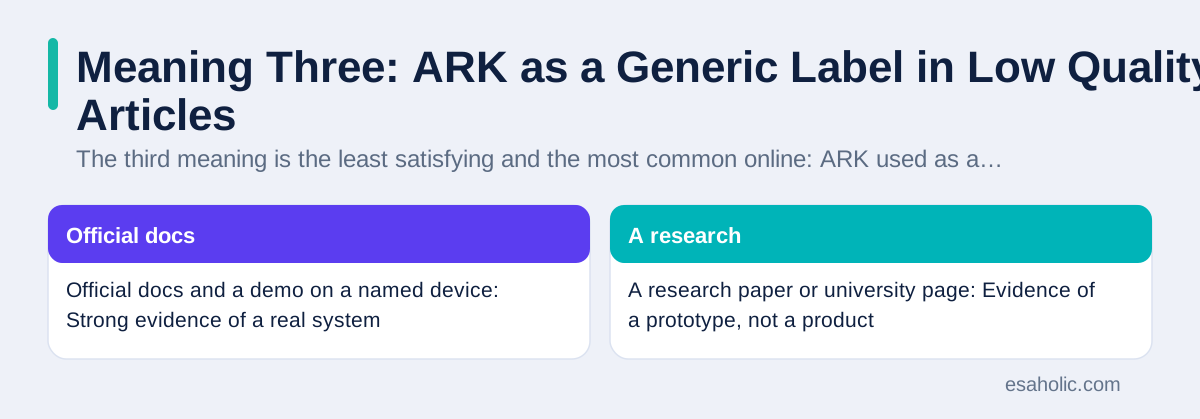
Readers can spot this pattern with a few checks. First, look for an official site: a real platform has documentation, a developer guide, a changelog, and a way to contact its makers. Second, look for independent coverage: a real launch is reported by more than one outlet that does not copy the same text. Third, look for specifics that can be checked, such as supported devices, a price or a licence, and a demo video that shows the system running on a named device rather than a rendered animation. Articles that fail all three checks are not evidence of a product, even if they use confident language, and their feature lists should not be quoted as facts in business plans or purchase decisions.
This pattern is not unique to ARK. Emerging technology attracts content that ranks for a search term by restating the term with grand claims, and readers who need a real decision can waste weeks chasing such articles. The practical response is to invert the search: instead of searching for the impressive name, search for the task, such as placing a 3D model in a room on an iPhone, and judge the documented tools that answer that task. Esaholic's computer vision development work follows that approach with clients, starting from the task and the data rather than from a brand name, because a task can be tested and a brand name cannot.
| What you find | How to judge it | What to do next |
|---|---|---|
| Official docs and a demo on a named device | Strong evidence of a real system | Test the demo on your own device |
| A research paper or university page | Evidence of a prototype, not a product | Ask whether a maintained version exists |
| Many articles with the same text, no source | Weak evidence, likely copied marketing | Do not budget or plan around it |
| A sales page with no price, docs, or company | A warning sign, not a product page | Ask for docs before any payment |
Real AR Tools and Use Cases Worth Your Time
Once the ARK fog clears, the real AR landscape is easier to judge, because its tools are documented and its use cases are testable. ARKit and ARCore remain the starting points for phone AR, and game engines such as Unity provide AR building blocks on top of them for teams that need one project to run on both iPhone and Android. IBM's overview of augmented reality uses and limits gives a vendor neutral summary of where AR helps, and it is a useful second opinion before any purchase. None of these tools is called ARK, and none of them needs the ARK label to be useful.
Use cases that consistently repay investment share one trait: the AR view answers a question at the exact place where the question arises. A technician repairing a machine sees the next step drawn on the machine itself, rather than flipping through a manual. A shopper sees a product at real size in their own room, rather than guessing from a photo. A trainee practises a procedure with guided overlays on real equipment, with mistakes that cost nothing. A museum visitor sees a ruined building restored in place, with labels that explain what is reconstruction and what is original. Each case can be measured: fewer errors, fewer returns, faster training, or longer visits, and each case fails honestly when the measurement does not improve.
Our guide to fast product tests that learn quickly applies directly to AR projects, because AR is easy to demo and hard to deploy. Build the smallest test that answers a real question, such as whether technicians finish a repair faster with an overlay, run it with real users in real light and noise, and keep the plain manual beside it as the control. Teams that prototype this way learn in weeks what a year of vendor meetings cannot teach, and they learn it before committing to devices, licences, or a platform that may not fit their task.
Costs, Privacy, and the Buyer Checklist
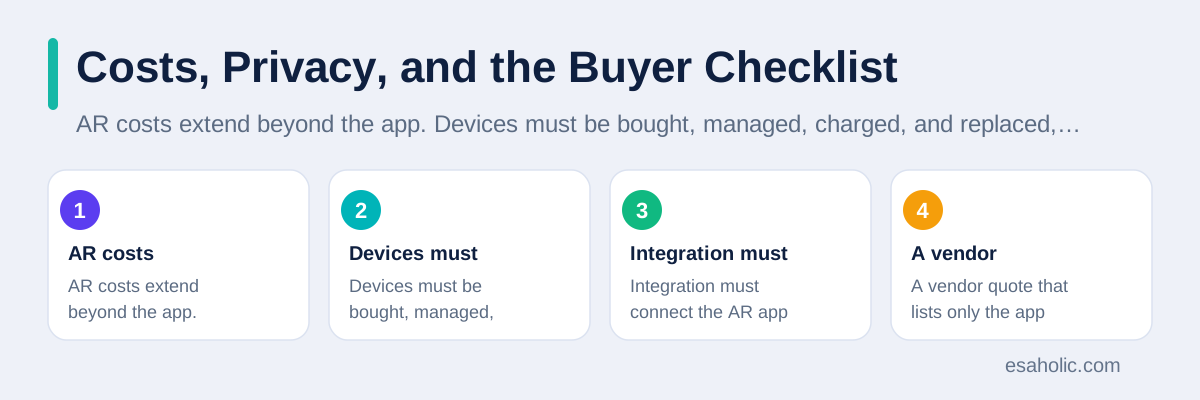
AR costs extend beyond the app. Devices must be bought, managed, charged, and replaced, and a fleet of headsets costs far more than a fleet of phones that staff already own. Content must be created: 3D models, labels, and instructions take skilled time, and they must be updated whenever the real product or procedure changes, or the overlay will teach the wrong step with great confidence. Integration must connect the AR app to the systems that hold the real data, such as stock, manuals, or customer records, or the overlay will show stale information. A vendor quote that lists only the app licence, without devices, content, integration, and support, understates the true cost by a wide margin.
Privacy deserves equal weight, because AR cameras see far more than the task requires. A repair app pointed at a machine may also capture a whiteboard, a colleague, or a customer's home, and a retail app may capture a shopper's face and surroundings. Good AR systems process as much as possible on the device, store as little video as possible, blur bystanders by default where the platform allows it, and explain in plain language what is recorded and for how long. Teams should demand those answers in writing, test them with their own data, and keep a non camera alternative for every task, so no customer or worker is forced to be recorded to receive service.
Use this checklist before paying anyone who uses the ARK name, or any AR vendor at all. Ask for the official site and documentation. Ask for a live demo on your own device, in your own light, with your own data. Ask for the price, including devices, content, and support, and for the contract terms if the vendor closes. Ask who owns the data the app collects, and how a user deletes it. Ask for two reference customers you can call, not just logos on a slide. A genuine vendor answers these questions gladly, because they have real answers. A vendor who answers with grand claims about an ecosystem, without a single checkable detail, has told you everything you need to know, and the right response is to walk away and build on a documented platform instead.
Augmented Reality Use Cases That Work Without the ARK Name
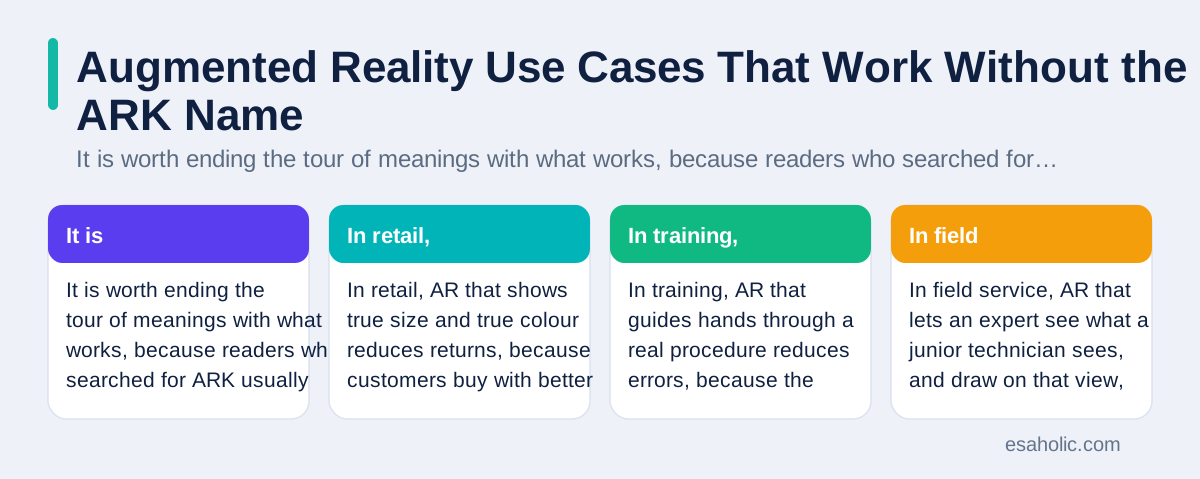
It is worth ending the tour of meanings with what works, because readers who searched for ARK usually wanted AR, and AR itself is worth their time. In retail, AR that shows true size and true colour reduces returns, because customers buy with better information. In training, AR that guides hands through a real procedure reduces errors, because the instruction sits where the hands work. In field service, AR that lets an expert see what a junior technician sees, and draw on that view, resolves jobs that once needed a site visit. In education, AR that places a model, such as a heart, a building, or a planet, where a class can walk around it, makes abstract ideas concrete in a way a flat picture cannot.
Each of these cases works on documented platforms today, with no need for an ARK product. A small team can start with a phone, a documented AR kit, and one task, and can measure the result in weeks. A larger team can add 3D content, integration, and device management as the pilot proves itself. The common thread is modesty: one task, one measurement, one platform with documentation, and a plain alternative that keeps working when the camera fails. That modesty is not a lack of ambition. It is how AR projects survive contact with real users, real light, and real budgets, while grand platform claims collapse at the first demo that cannot run on a real device.
For businesses that want help, Esaholic's custom software built around real constraints starts from the same place: the task, the data, and the measurement, before any platform choice. Bring a task, a rough idea of who will use the AR view, and a willingness to test with real users, and a team can tell you quickly whether AR helps that task and which documented platform fits it. Bring only a brand name from a vague article, and the honest answer will be a request for specifics, because without them, no responsible team can promise a result.
Conclusion
ARK augmented reality, as a search phrase, does not name one verifiable product. It names a research kiosk prototype that tackled occlusion without a headset, an archaeology database that gained an experimental AR view, and a generic label used by low quality articles to bundle real AI and AR research directions into an imaginary platform. None of those meanings, on its own, gives a reader a product to buy, a price to compare, or a feature list to trust, and treating them as one system would mislead any decision based on them. The useful path forward runs through documented platforms such as ARKit and ARCore, through one task tested with real users, and through a buyer checklist that demands demos, prices, data ownership, and references before payment. Readers who follow that path will get real AR value, whether or not anyone ever ships a product called ARK, and readers who chase the name alone will keep finding confident articles and no product behind them. Honesty about that gap is not a failure of this guide. It is the guide's main finding, and it is the finding that saves readers time, money, and misplaced trust. For a build that relies on seeing and interpreting the real world, computer vision development is the relevant service.
Frequently Asked Questions
Is ARK augmented reality a product I can buy?
No single verified product matches this phrase. The name ARK has been used for a research kiosk prototype, for an archaeology database with an AR view, and as a generic label in low quality articles. Anyone selling an ARK product should be asked for an official site, a demo, and documentation before payment.
How is ARK different from ARKit or ARCore?
ARKit and ARCore are documented platforms from Apple and Google that developers use to build AR apps on phones. ARK, as a phrase, has no comparable official platform documentation, so it cannot be compared feature by feature with them, and claims that it outperforms them have no verifiable basis.
What should I do if I need AR for my business?
Start from one task, such as guiding a repair or showing a product in a room, and build or buy a solution on a documented platform such as ARKit or ARCore. Judge vendors by a live demo on your own device, a clear price, and a written statement of what data the app collects.
Written by Amir Iqbal
Senior AI Systems Architect and Lead Technical Reviewer
Amir Iqbal is a senior AI systems architect and lead technical reviewer at Esaholic who keeps live AI systems fast and reliable.
Reviewed by Umar Abbas
Founder, Principal AI Architect and Operator
Umar Abbas is the founder of Esaholic and a principal AI architect who designs reliable large scale AI systems for regulated industries.
Relevant blogs
Blockchain in Intellectual Property: A Plain Guide
What a shared record proves about creative work, and where lawyers and registries still decide.
Augmented Reality in Accounting: A Simple Guide
How AR overlays help accountants, auditors, and bank customers see numbers clearly and safely.
Computer Vision Applications Explained Simply
How machines see and act in shops, hospitals, factories, and cars, plus limits and privacy checks.
Rapid Prototyping: A Simple Guide to Fast Product Tests
How teams turn an idea into a testable model in days and learn fast without wasting budget.