
Best Coding Interview Books Explained
Search for interview preparation advice and you will find the same short list of books everywhere, usually with no explanation of who each book actually helps. That is a problem, because the books on that list are not interchangeable. One teaches the interview process itself, another teaches problem patterns through many worked examples, a third focuses on the reasoning behind data structures, and a fourth targets the design discussions that senior roles face. Buying the most famous book is not a plan. Matching a book to your level, your target role, and the time you have is a plan, and this guide helps you make that match.
A coding interview, for readers new to the term, is a hiring test where a candidate solves programming problems live, explains the reasoning aloud, and discusses tradeoffs, which means the costs and benefits of each approach. Interviewers score clarity and method as much as a final answer, because they want to see how a candidate thinks under a time limit. A good book therefore does more than list problems. It teaches how to clarify a vague question, choose a data structure, which is a way of organizing data so a program can use it efficiently, test an idea on small examples, and improve a slow solution step by step. A book that only gives answers teaches recall. A book that teaches method teaches transfer, which is the ability to handle a problem you have never seen before.
This guide covers the well-known titles by what they cover, who they suit, and how to use them, without quoting their content and without guessing at prices or editions. Prices and editions change, so check the publisher page before you buy any title, and treat any article that states a fixed price with suspicion. You will also find a study plan that works with any of these books, a comparison table, and the mistakes that waste the most preparation time. If you are preparing for a first developer job, a mid-level move, or a senior design-heavy role, start with the section that matches your level, then use the plan at the end. For an honest view of how coding help fits into real work, see our guide on coding assistants for developers, which explains where tools help and where human practice still matters.
What Interview Books Actually Teach
Most interview books share a core curriculum, even when their styles differ. They cover arrays, which are ordered lists of items, strings, linked lists, stacks, queues, trees, graphs, hash tables, sorting, and searching. They add techniques such as two pointers, sliding windows, recursion, which means a function that calls itself to solve smaller versions of a problem, and dynamic programming, which means solving a large problem by reusing answers to smaller overlapping problems. A book earns its place when it connects each technique to the kind of problem where it helps, and when it shows the wrong turns a solver might take, not only the clean final path. That connection is what lets a reader recognize a new problem as a member of a known family.
Beyond problems, good books teach interview behavior. They show how to ask clarifying questions before coding, such as what the input size is, whether the data is sorted, and what should happen for empty input. They show how to talk while coding, so the interviewer follows the plan instead of watching silent typing. They show how to test a solution with examples, find edge cases, which are unusual inputs at the limits of a problem, and estimate time and space complexity, which means how running time and memory grow as input grows. Readers who skip these chapters often solve problems alone but struggle live, because an interview scores the conversation, not only the code. Treat behavior chapters as required reading, not as filler before the problems.
Cracking the Coding Interview: The Famous All-Rounder
Cracking the Coding Interview, by Gayle Laakmann McDowell, is the best known book in this space, and its fame is earned for a specific reader: a candidate who already knows basic data structures and wants a full tour of the interview process plus a large bank of practice problems. The book explains how interviews work at large technology companies, how to prepare a study schedule, and how to approach each problem type, from arrays and strings to system design sketches. Its strength is breadth and process: it tells you what interviewers look for, which mistakes candidates repeat, and how to structure an answer before you start coding. Readers who follow its method chapters tend to sound more organized in live interviews, even before their problem speed improves.
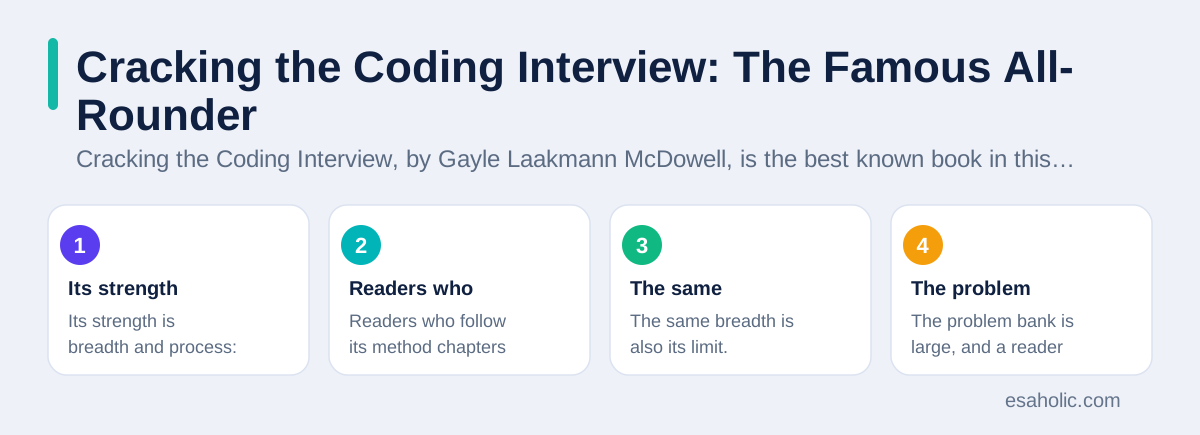
The same breadth is also its limit. The problem bank is large, and a reader who tries to finish every problem will run out of time and energy before the interview. The book works best as a reference and a method guide, not as a checklist to complete. A practical way to use it is to read the process chapters fully, work through the chapters for your weakest topics, and use the remaining problems as timed practice rather than as homework to finish. The official site for the book lists current editions and companion material, so check there rather than trusting a reseller page that may describe an older edition. If you are new to data structures, pair this book with a gentler algorithms guide first, or its problem chapters will feel like a wall rather than a ladder.
Programming Interviews Exposed: The Conversational Guide
Programming Interviews Exposed, by John Mongan, Noah Suojanen Kindler, and Eric Giguere, suits readers who want to understand what an interview feels like, especially in a traditional software engineering interview. Its tone is conversational, and its examples walk through the reasoning a candidate might voice, including false starts and corrections. That style helps readers who freeze when a problem looks unfamiliar, because it normalizes the messy middle of problem solving. The book also covers topics beyond code, such as how to discuss a resume, how to handle behavioral questions, and how to think about a job offer, which makes it useful for candidates preparing for their first full hiring process rather than only a coding round.
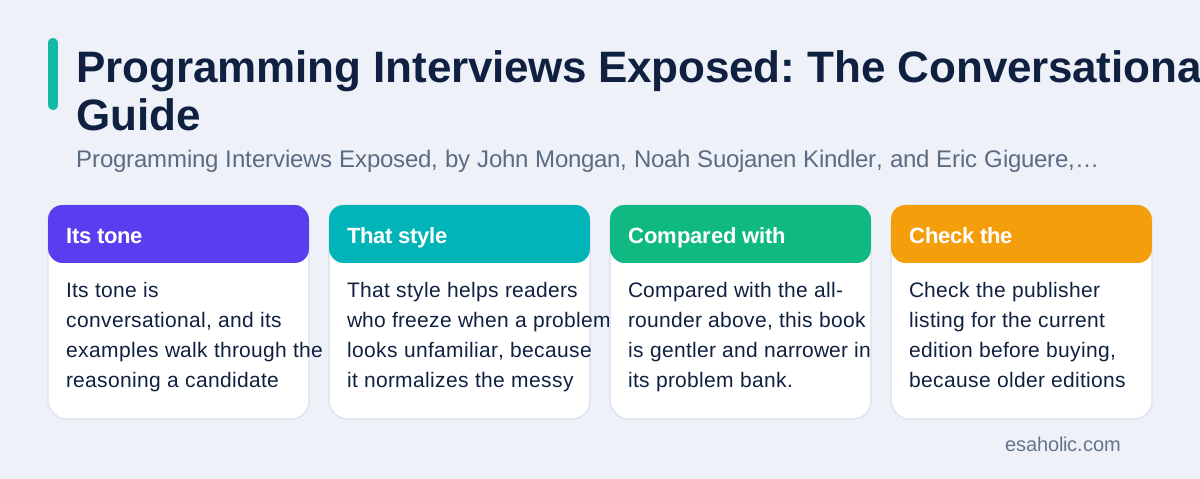
Compared with the all-rounder above, this book is gentler and narrower in its problem bank. Readers who already solve medium problems comfortably may find its coding chapters too easy, and readers targeting the hardest large-company rounds will need harder practice elsewhere. Its best role is as a first book for a candidate who needs confidence and interview fluency, or as a companion to a harder problem book for a candidate who needs to improve communication. Check the publisher listing for the current edition before buying, because older editions circulate widely and their problem sets differ. Used that way, it teaches the human side of interviewing that problem banks alone cannot teach.
Elements of Programming Interviews: Depth for Strong Candidates
Elements of Programming Interviews, by Adnan Aziz, Tsung-Hsien Lee, and Amit Prakash, suits candidates who already code confidently and want deep, demanding practice. Its problems are organized by topic and by difficulty, and its solutions emphasize reasoning, variants, and follow-up twists that an interviewer might add after a first solution. That structure rewards a reader who studies actively: attempt a problem, compare your approach with the solution's reasoning, and then try the variant that changes one constraint. Readers who do that work build a flexible toolkit, because they learn why a technique works, not only which technique to apply. The book also exists in language-specific variants, so choose the variant that matches the language you will actually use in interviews.
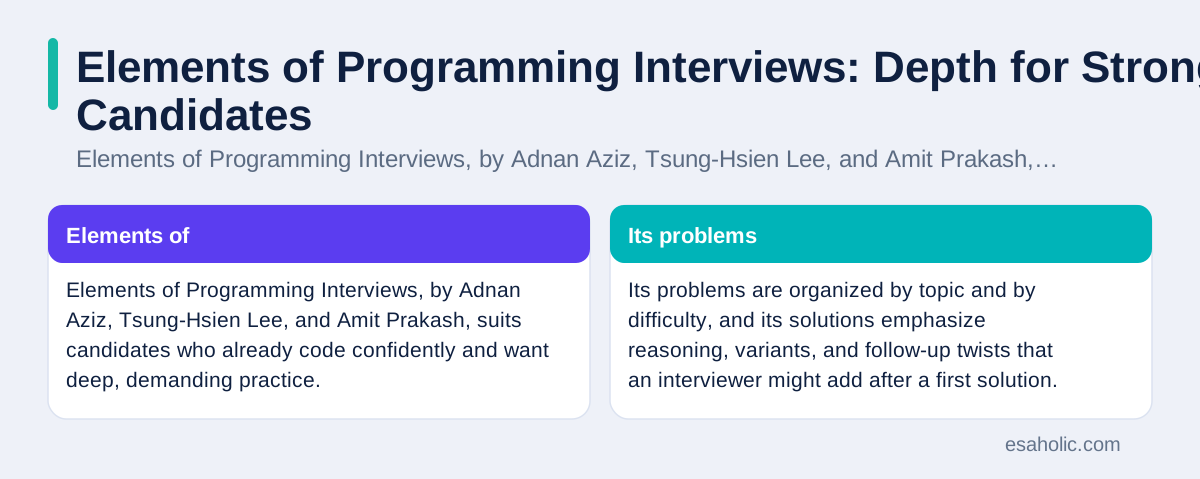
The cost of that depth is difficulty. Beginners who start here often feel lost, because the book assumes comfort with data structures and with reading dense technical explanations. It is also a poor book to read passively: skimming solutions without attempting problems creates a false sense of understanding that collapses under live pressure. A sensible path is to use it after a gentler book, focus on the topics your target companies emphasize, and keep a notebook of patterns you missed, with one fresh example for each. The official site for Elements of Programming Interviews describes the book's structure and variants, which helps you pick the right version. For most candidates, this is a second book, not a first one, and buying it first is a common and avoidable mistake.
Books for Algorithms Intuition and Senior Design
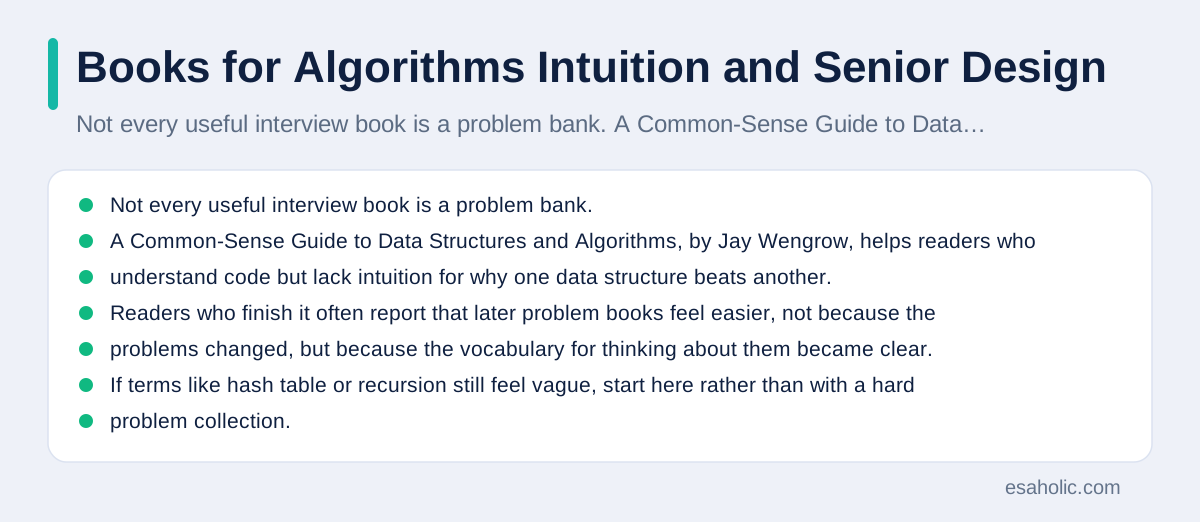
Not every useful interview book is a problem bank. A Common-Sense Guide to Data Structures and Algorithms, by Jay Wengrow, helps readers who understand code but lack intuition for why one data structure beats another. It explains ideas such as Big O notation, which is a shorthand for how an algorithm's cost grows, in plain language with small examples, and it suits self-taught developers and career changers who need foundations before they face timed problems. Readers who finish it often report that later problem books feel easier, not because the problems changed, but because the vocabulary for thinking about them became clear. If terms like hash table or recursion still feel vague, start here rather than with a hard problem collection.
Senior candidates face a different test: system design, which means designing a large system, such as a feed, a chat service, or a video platform, and defending choices about scale, storage, and failure. System Design Interview, by Alex Xu, walks through common design problems with a repeatable framework: clarify requirements, estimate scale, sketch the high-level design, then dig into data storage, caching, and bottlenecks. Its value is the framework and the discussion habits, not a set of answers to memorize, because real design interviews reward tradeoff reasoning, which means explaining what you gain and what you give up with each choice. Pair a design book with real architecture reading, such as our guide on connecting business systems cleanly, so your design answers reflect real constraints rather than textbook diagrams. Once you can discuss tradeoffs clearly, that skill carries directly into custom software development work, where the same choices about scale and storage shape real products.
Choosing by Level and Role
Choice becomes easier when you name your situation honestly. A beginner who can write basic programs but has not studied data structures should start with an intuition book, then move to a general interview guide. A mid-level developer who knows the basics but lacks speed should use a general guide for method plus a problem bank for timed practice, focusing on weak topics rather than finishing every chapter. A senior candidate should spend most preparation time on system design and behavioral stories, with coding practice kept sharp on medium problems rather than chasing the hardest puzzles. A candidate changing careers should add extra time for foundations, because interviewers test the same topics regardless of how recently you learned them.
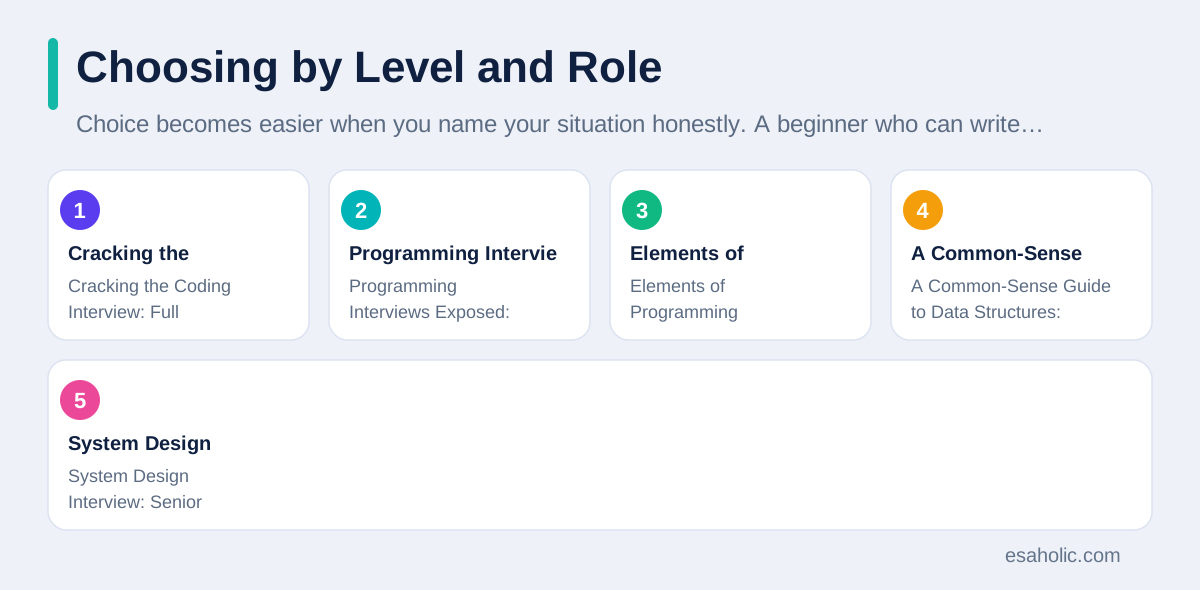
Role matters too. A frontend role still tests core data structures, but it may add practical topics such as interface behavior and performance, so a general book plus role-specific practice beats a design-heavy book. A backend role rewards system design and data modeling, so a design book earns more of your time. A data-focused role rewards statistics and data handling alongside coding, so a pure coding book leaves gaps. In every case, ask what the actual interview loop for your target companies includes, because preparing for a test you will not face wastes the scarcest resource in preparation, which is focused practice time. One well-chosen book plus consistent practice beats three books read halfway.
| Book | Best for | Watch out for |
|---|---|---|
| Cracking the Coding Interview | Full process plus broad practice | Too large to finish cover to cover |
| Programming Interviews Exposed | First interviews and communication | Problem bank is gentler than hard rounds |
| Elements of Programming Interviews | Strong candidates wanting depth | Too hard as a first book |
| A Common-Sense Guide to Data Structures | Foundations and intuition | Not enough hard practice alone |
| System Design Interview | Senior and backend design rounds | Memorizing designs does not transfer |
A Study Plan That Works With Any Book
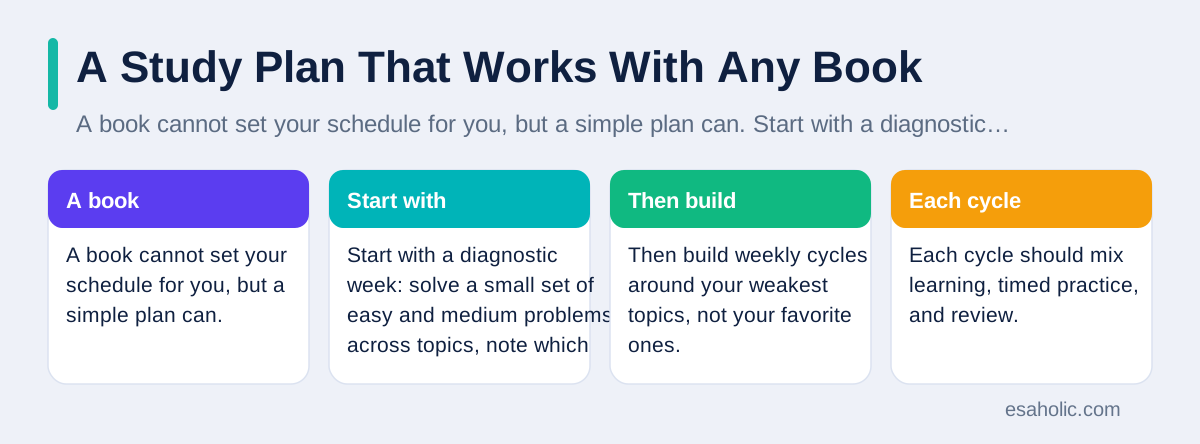
A book cannot set your schedule for you, but a simple plan can. Start with a diagnostic week: solve a small set of easy and medium problems across topics, note which topics feel slow, and read the method chapters of your chosen book. Then build weekly cycles around your weakest topics, not your favorite ones. Each cycle should mix learning, timed practice, and review. Learning means reading one chapter and working its examples by hand. Timed practice means solving new problems under a clock, talking aloud as you go. Review means revisiting problems you missed after two or three days and solving them again without looking at the solution. That spaced return, which means revisiting material after a gap so memory must work to retrieve it, is what turns a solved problem into a learned pattern.
Mock interviews deserve a fixed slot in the plan, because they test skills that solo practice cannot. Ask a friend or a peer to play interviewer, give you an unseen problem, and score your clarifying questions, your communication, and your testing, not only whether the code ran. Record what felt hard: Was it choosing a data structure, handling edge cases, or explaining while coding? Then target that skill in the next cycle. Two mocks per week in the final month beat ten mocks in the final week, because feedback needs time to change habits. Also protect rest: a tired brain memorizes answers and forgets reasoning, while a rested brain retrieves patterns. Candidates who study every waking hour usually peak before the interview, not during it. Practising clear explanations also helps with software testing basics, since explaining how you would check a solution is part of showing that it works.
Mistakes That Waste Preparation Time
The most common mistake is reading solutions too early. A candidate reads a problem, feels stuck after two minutes, reads the solution, nods, and moves on, believing the idea is learned. It is not. The test of learning is whether you can solve a fresh problem of the same type tomorrow, without the solution in front of you. A better rule is to struggle for a set time, such as twenty minutes, write down what you tried, and only then read the solution. Write the key idea in your own words, and schedule a retry. If the retry still fails, the idea needs a smaller example or a foundations chapter, not another skim of the same solution.
Other mistakes are quieter but just as costly. Some candidates collect books and courses without finishing any, which feels like progress but builds no skill. Some practice only easy problems, which protects confidence but never builds speed on medium problems, where most interviews live. Some ignore communication, then discover live that they can solve problems silently but cannot explain them. Some memorize specific problems from a book, then fail when the interviewer changes one constraint. The fix for all of these is the same: practice under interview conditions, review mistakes by pattern rather than by problem, and keep a short list of patterns you truly own. A list of twenty owned patterns beats a shelf of books you once skimmed.
Tracking progress also prevents wasted effort. Keep a simple log with three columns: the pattern, whether you solved a fresh problem of that type without help, and the date you last retried it. When a pattern stays marked as solved across two retries spaced days apart, you own it, and you can move practice time to weaker patterns. When a pattern keeps failing on retry, it signals a gap in foundations rather than a lack of effort, and the fix is to return to the chapter that explains that idea with smaller examples. This log also builds honest confidence: on interview day, you will know which patterns you own, instead of hoping that a stack of finished chapters means readiness.
Conclusion
The best coding interview book is the one that matches your level and your role, and that you actually use with timed practice and review. Beginners should build intuition first, mid-level candidates should combine a general guide with focused practice, and senior candidates should add system design. Read the method chapters, attempt problems before reading solutions, retry missed problems after a gap, and practise explaining aloud. Do that consistently, and any of the books in this guide can carry you much further than a shelf full of books you never finished.
Frequently Asked Questions
Which coding interview book should a beginner start with?
A beginner should start with a book that teaches data structures and basic problem patterns in plain language before moving to hard practice problems. A friendly algorithms guide plus one general interview book usually beats a hard problem collection, because early confidence and clear fundamentals matter more than problem count.
Is one interview book enough to pass a coding interview?
One book can teach the patterns and the interview process, but passing still requires timed practice, mock interviews, and review of your own mistakes. Books supply the map, while practice builds the speed, communication, and calm under pressure that interviewers actually score.
How should I use an interview book without just memorizing answers?
Attempt each problem yourself for a set time before reading the solution, then explain the solution in your own words, hide it, and solve the problem again from memory a few days later. If you can re-derive the idea on a fresh problem of the same type, you learned the pattern rather than memorizing one answer.
Written by Ahmad Jajja
Senior AI Research Engineer and Generative AI Specialist
Ahmad Jajja is a senior AI research engineer at Esaholic who builds generative AI systems grounded in real documents for accurate answers.
Reviewed by Danish Mustafa
Senior Agentic AI Engineer and Systems Architect
Danish Mustafa is a senior agentic AI engineer at Esaholic who builds AI agents, voice systems, and messaging systems for real customers.
Relevant blogs
Best AI Coding Assistants
How coding assistants help developers write, review, and fix code faster, and where human review stays essential.
Rapid Prototyping: A Simple Guide to Fast Product Tests
How teams turn an idea into a testable model in days and learn fast without wasting budget.
Cross Platform Mobile Programming Explained Simply
How one code base can serve Android and iPhone apps, where shared code helps, and where native code still wins.
React vs React Native: Which One Should You Pick
How React for the web differs from React Native for phones, and how to choose between them.
Back to all blog guides · Back to Software Development guides · Explore Custom Software Development Services